Wainwright Shipyard


By Dr. Glenda Walters, Photography By Rick Cooper
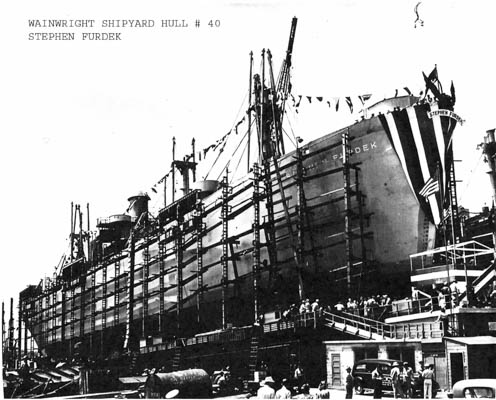
– – On April 7, 1942, the J. A. Jones Company of Charlotte, North Carolina signed a contract to build a shipyard at Panama City, Florida to produce Liberty Ships for the military. These slow but sturdy cargo ships, dubbed the ‘ugly ducklings’ by President Franklin Roosevelt, were built for durability not beauty. In my opinion, the ships, ready to launch with flags flying and names proudly printed on the hull, looked quite majestic.
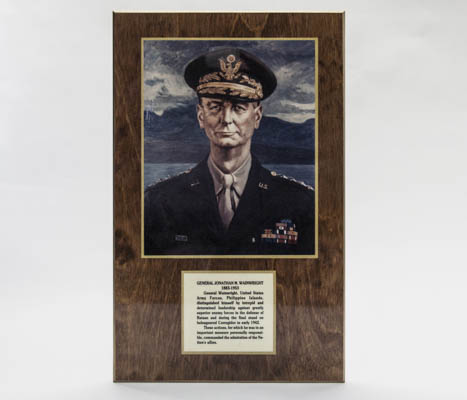
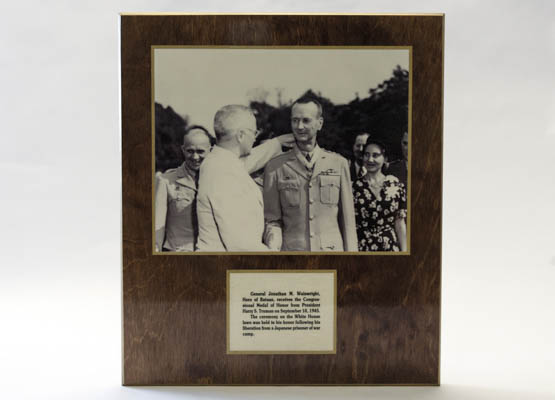
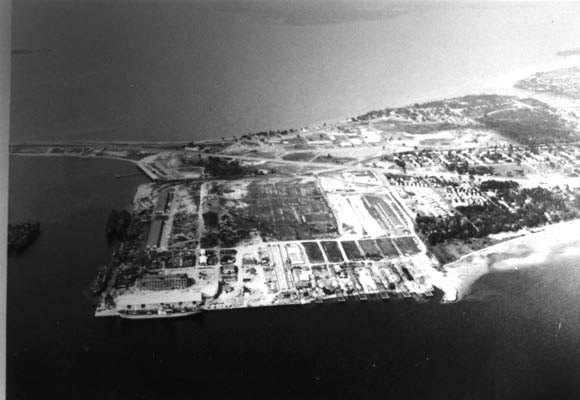
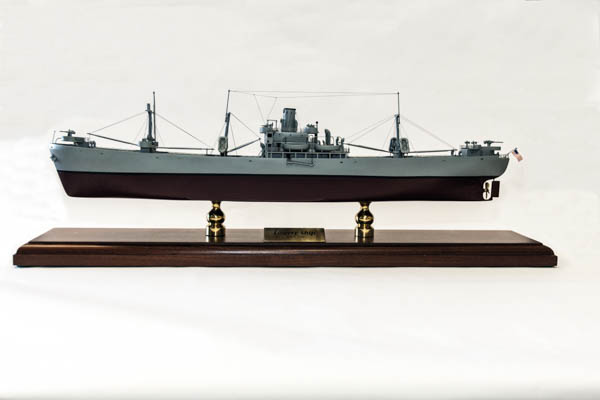
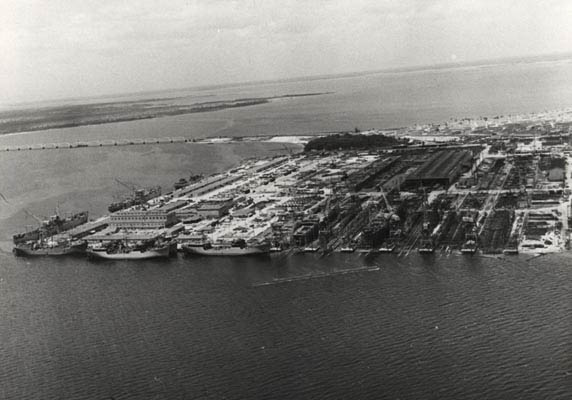
A site at Dyers Point just off U.S. 98 at the southwest boundary of the City of Panama City with almost 5,000 feet on St. Andrew Bay was selected and construction began immediately. Seven miles of railroad track were laid to transport raw materials from the business district to the shipyard. Once site preparation was finished, the shipyard was completed in a record 79 days. Raymond A. Jones, company vice president and son of the owner, arrived with his family to supervise construction of the shipyard and the beginning of production. The facility included shipways, job shops, warehouses, administrative offices, café, a welding school, and pipe, structural, and machine shops. Dedication ceremonies were held on May 22, 1942. The yard was named in honor of General Jonathan Wainwright who was captured on Corregidor (The Philippines) by the Japanese and held prisoner of war. Photographs of General Wainwright, as well as a model of a Liberty Ship and photographs of ship construction, were loaned to the recent exhibit, Women of Wainwright, at the Historical Society of Bay County Museum by the Panama City Port Authority. The items are a part of the Port Authority’s permanent tribute to the Wainwright Shipyard.
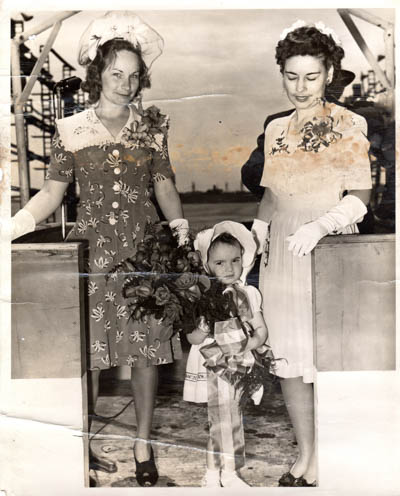
Taking a second look or a look back almost always reveals something new or initially overlooked. And so it was at the recent exhibit. A resurgence of memories and new insights into the role played by Bay County in World War II occurred. It all began with a small collection of photographs found online and perused by society member, Robert Moore. Shown in the photographs were the members of the launching party who actually launched the ship and her flower girl and attendees from the public or offices of the shipyard or workers who came to watch. City officials and special guests were often invited to attend the launching or christening of the ships built at Wainwright Shipyard down the waterway and into St. Andrews Bay. Moore first purchased a pair of the photographs to satisfy his curiosity. But that only brought another question, who were these women and girls?
An additional purchase brought to our area a collection of 24 photographs. Identifying those pictured became a mission. Using local newspapers and issues of The Wainwright Liberator, the shipyard’s weekly newspaper, the identities came to light. Then locals began to share their stories and memorabilia.
The launching party of the ship the Stephen Furdek, June 1944, identified Virginia Dickerson, first female employee of the shipyard and secretary of the welding shop and Ruth Kleiber of the personnel coordinator’s office. The flower girl was Mary Gay McKenzie, daughter of the shipyard photographer Andrew McKenzie. Still a resident of the area, she loaned the exhibit her framed copy of The Wainwright Liberator describing the event.
A remarkable feature of the shipbuilding industry during the war was that most all of its workers were inexperienced. Young men had gone to war so those left behind, women and older men, moved into the industry. On the Bay County scene, people crowded into the area to take advantage of the good-paying jobs available and to do their part for the war effort. The local population soared. Workers came from surrounding towns and neighboring states. Four hundred were on the job at Wainwright by July 1942 and, by June 1943, employment numbers peaked somewhere between 15,000 and 18,000. Many of these new workers were the wives, sisters, mothers, or fathers of the soldiers overseas. They also came to be the parents and grandparents of many of Bay County’s citizens of today.
It was customary during the war that when a town or organization raised enough money through the sale of war bonds to build a ship or airplane, the town or organization was permitted to select its name. The Nick Stoner, launched on June 17, 1943, was paid for with funds raised by a small community in New York located on the shores of Lake Nick Stoner. According to the Liberator, Stoner was a pioneer in that part of the country who fought Indians, trapped, and did much to establish the area.
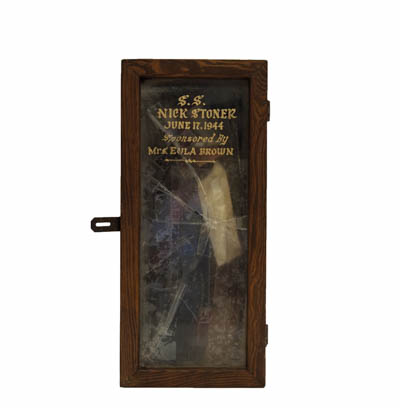
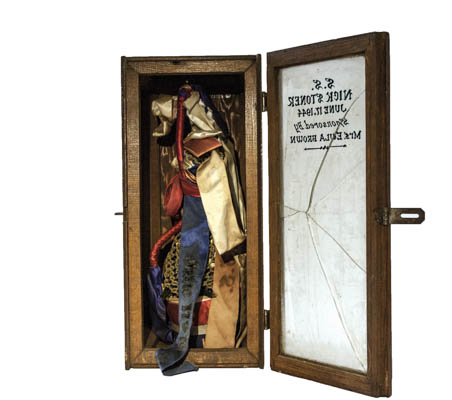
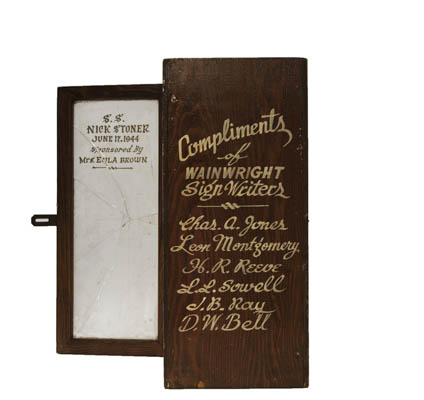
Sondra Richardson of Pensacola learned of the Wainwright exhibit through social media. She knew from family history that her grandmother, Eula Brown, had christened the Nick Stoner and her mother had been the flower girl. The wooden box built by shipyard carpenters to preserve the remains of the champagne bottle (called the dead soldier) used in the christening had been handed down to Mrs. Richardson. She visited the exhibit and brought the bottle, with her mother’s permission, to loan it to the exhibit. She expressed her impression of the exhibit “History is such a wonderful thing. I can’t express what a fine job you all did with the exhibit, bringing the past to the present.”
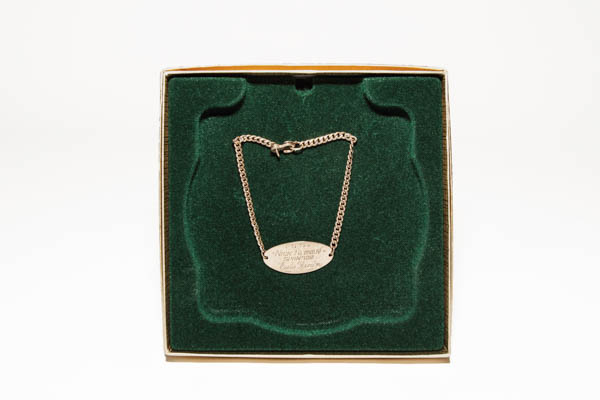
After the visit to Panama City, she told her mother, Carol Jeanette Brown Godfrey who lives in Mississippi, how exciting it had been. As they talked they remembered the tradition that each sponsor of a ship was given a gold bracelet to commemorate the occasion. Mrs. Godfrey still had the bracelet that had been given to her mother. In February, Eula Brown’s daughter, granddaughter, and great-granddaughter traveled to Panama City to place the gold bracelet on display. Mrs. Godfrey shared her thoughts on the occasion, saying, “Wainwright was an important part of Panama City and it was a war effort, Panama City was very patriotic.” So it was that three generations stood looking at memorabilia from the past and laughing and talking as if that fourth generation were with them.
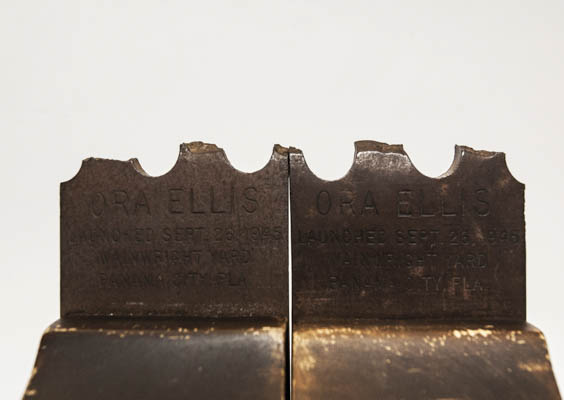
Local resident Gary Smith came forward ready to share his bookends made from wood and steel from the Ora Ellis, Wainwright’s last ship, launched on September 26, 1945. He explained, “While the Liberty Ships were under construction on the ways, these steel stays were attached to the ships’ hull to retain position of the ship while it was under construction. When the ship was launched, these stays would shear off or break at predrilled holes and the ship would launch. Bookends were made from these stays and this pair was given to my grandfather, A. N. Smith, at the Van Kleeck Company …”
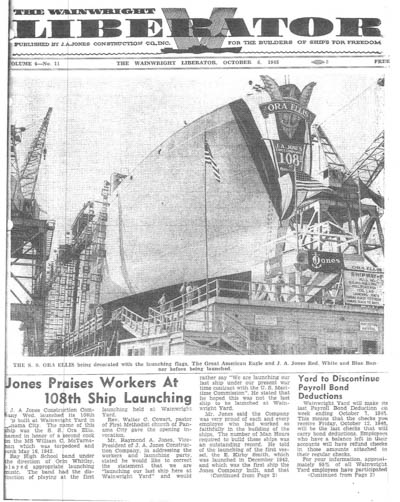
The October 6, 1945 issue of the Liberator describing the launch of the Ora Ellis was loaned to the exhibit by Martha Powell Greerson. Her sister, Charla Beth Powell was the flower girl in that christening.
Several large binders loaned by the Bay County Library were also displayed. These binders contain documentation on each ship built at the Wainwright Shipyard. They are the product of years of research done by Lynn Haven resident, Roger Schad. He has traced the story of these ships from their launch, through their military service, post war use, and final resolution.
Wainwright Shipyard closed in 1945, but its impact on the community has continued. The property was purchased from the federal government by the city and, during the 60s and 70s, Cove Contractors operated a ‘ship breaking’ and salvage yard on the site, employing nearly 200 workers. Several of the Liberty Ships built in the yard came back for scrapping. Now that tract of land along Dyers Point is home to Port Panama City. Wainwright Shipyard linked the dream of city founders who envisioned a port to the Panama Canal and the world to the reality of today’s international Port Panama City.