

TYNDALL AIR FORCE BASE – One Year After Hurricane Michael


By Col. Brian Laidlaw, 325th Fighter Wing commander, Tyndall Air Force Base
ONE YEAR AFTER HURRICANE MICHEAL – Q&A WITH COL. BRIAN LAIDLAW, 325TH FIGHTER WING COMMANDER
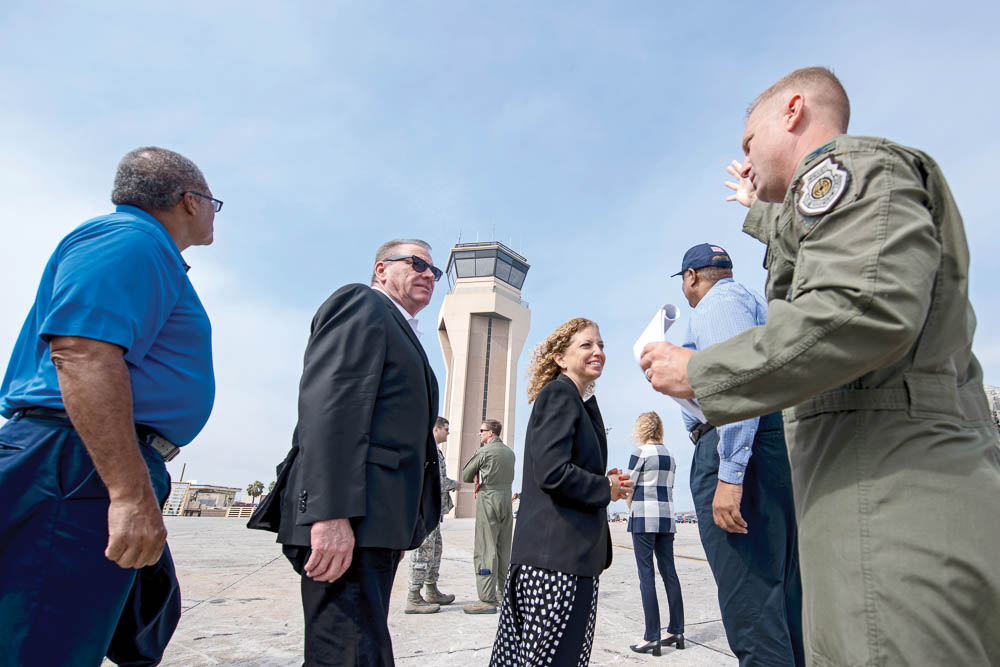
Debbie Wasserman-Schultz (FL-23), Neal Dunn (FL-2), and Al Lawson Jr. (FL-5) at the flightline at
Tyndall Air Force Base, Fla., Feb. 20, 2019. (U.S. Air Force photo by Senior Airman Javier Alvarez)
Tyndall AFB plays a significant role in the economic success of Bay County. 11,000 people were evacuated from Tyndall before Hurricane Michael.
How many are back and what will it take to see just as many (or more) people stationed or working at Tyndall?
About 80 percent of our pre-storm personnel are back at our base. Most have their families with them. The total number of Airmen and families at Tyndall will fluctuate as we rebuild and prepare for different missions in the future. In the end, we do expect to have more people assigned to the base. You mentioned in another interview that lessons learned from recent hurricanes were implemented in the projects list for Tyndall’s reconstruction.
What are those lessons and solutions?
We have done our homework. We’ve been to bases and airports in other hurricane-prone areas, including south Florida, and compared notes with their engineers. We combined these lessons with what we learned from the facilities on Tyndall that weathered the storm very well. Right now we are in the programming and design phase of the rebuild, and our Program Management Office is incorporating all that we’ve learned into the rapidly evolving designs.
What is the current status of the plans to bring three squadrons of F-35A stealth fighter jets and an MQ-9 wing to the base by 2023?
The previous Secretary of the Air Force directed us to prepare for up to three squadrons of F-35As at Tyndall with the first aircraft arrival in late 2023. Additionally, Tyndall AFB remains the preferred alternative to be the new home for a wing of 24 MQ-9 aircraft.
The Air Force steps through a thorough and deliberate strategic basing process for these types of actions. The current step in the process is a National Environment Policy Act directed Environmental Impact Study. We began this study over the summer, and we hope to finish this step in the process in about a year and a half. In sum, we are on schedule, albeit an aggressive schedule.
In an interview, you stated that the F-35 squadrons, along with efforts to land the MQ-9 Reaper Wing, would each add between 1,200 and 1,800 additional employees. Will this replace the number of employees that left with the move of the F-22s?
At this point it looks like Tyndall could end up with more people in the end. It’s too soon to tell exactly how many, though. The Air Force uses a Site Activation Task Force process to calculate, among other things, exactly how many personnel a base needs to conduct a new mission. This process is underway and steadily progressing, but it is years away Q&A from being complete. We will continue to refine our numbers through aircraft arrival.
What are the short-term and long-term plans for Tyndall AFB?
We will continue to repair the facilities that Michael did not completely destroy and simultaneously continue our aggressive schedule to design and rebuild the facilities we lost. Beyond the buildings, our enduring missions will continue. Our Airmen will gradually transition from their short term, interim, and work-around fixes to long-term, permanent solutions. In partnership with our local community, we will steadily improve quality of life for Airmen and their families.
As we have for the last year, we will do everything in our control to make each day just a little bit better than the day before.
You rode out Hurricane Michael with less than 100 other personnel at Tyndall and it is reported that your communication went out for a time. Can you share some of your personal impressions during or after landfall? What was your saddest moment? What was most encouraging? When were you and the others able to call your family to let them know you were okay?
We had 93 personnel in our ride-out element. Each one was there for a specific reason, as they brought to the team a unique skill, expertise, or capability. I couldn’t be more proud of every single one of them. They did exactly what we trained them to do in some pretty tough conditions. Within a couple days, everyone made contact with their families, but we had to use satellite phones to do it. Sure, riding out the storm on-base was a bad day for all of us. It was a bad day for our entire community. As bad as it was, though, I like to think that it brought out the best in all of us … and continues to do so today.
[author image=”[author image=”https://panamacityliving.com/media/2019/11/Panamacity-Living-December-2019-tyndall-air-force-base-2.jpg” ][/author]” ]Airmen on Tyndall Air Force Base stand arm in arm with our neighbors in Panama City and other surrounding communities as together we rebuild our infrastructure and reshape the future of Northwest Florida. Hurricane Michael left its mark on all of us, but we didn’t break.We absolutely would not be where we are today if not for the outpouring of support from the local community and from other bases across the U.S. Air Force. Anyone who has been in this area for any significant length of time knows that the communities in Northwest Florida are fiercely protective of our Airmen, their families, our civilians, and our critical missions.
Thank you for that enduring support. Each day Tyndall Air Force Base makes progress rebuilding damaged infrastructure in innovative ways incorporating the latest in construction expertise and designs. Our Airmen are doing 90 percent of the base’s pre-storm missions with 80 percent of the personnel, but in only 50 percent of the facilities.
That’s all the infrastructure that survived the hurricane. Ironically, one sign of progress around the base is the demolition and removal of our most heavily damaged and destroyed structures. This is necessary to remove storm debris and make room for the replacement facilities that should take five to seven years to rebuild. In the interim, our Airmen are performing their missions in a combination of temporary facilities and recently repaired permanent facilities. For example, after the storm many Airmen lived in tents for several months. Today, those Airmen no longer live in tents.
They live in recently repaired dormitories and modular living quarters. These will hold us over until we can rebuild the dormitories that the storm destroyed. Not only are our Airmen getting their missions done, they are taking care of our families as well. Our Airman and Family Readiness Center has a full staff and is ready to assist newcomers to Tyndall. Our Child Development Center is open in limited capacity today, but we will have enough seats for all of our children, including those on the waitlist, by the first of the year.
Our School Age Program is open for children ages 5–12. We currently have space available for qualified dependents in this program. The School Age Program provides supervised activities and help with homework for our children after school hours. Other agencies getting back to normal include outdoor recreation, our arts and crafts center, the base gym, the library, and both our employee and civilian personnel offices who can help family members with career opportunities.
We have accomplished more than we expected in the last 12 months. We have the right people in the right places with the right resources, and they have accomplished so much. There have been great Airmen, both military and civilian, here at Tyndall before, during, and after the storm. We owe a sincere thank-you to all of them and to their families who support them. We also sincerely appreciate the enduring support from this community that we are lucky enough to call home. Let’s commit to sustaining our momentum … together. Just think where we will be this time next year![/author]