THROUGH THE STORM: Lynn Haven’s Mayor Margo Anderson


BY BRITTANY HAWES
PHOTOS BY ALEIGHSA WRIGHT (HOPEPANHANDLE.ORG, WHITE HOUSE PRESS)
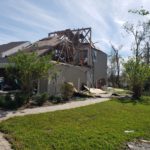
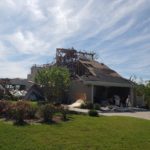
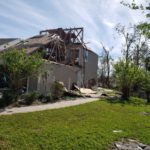
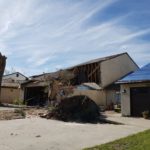
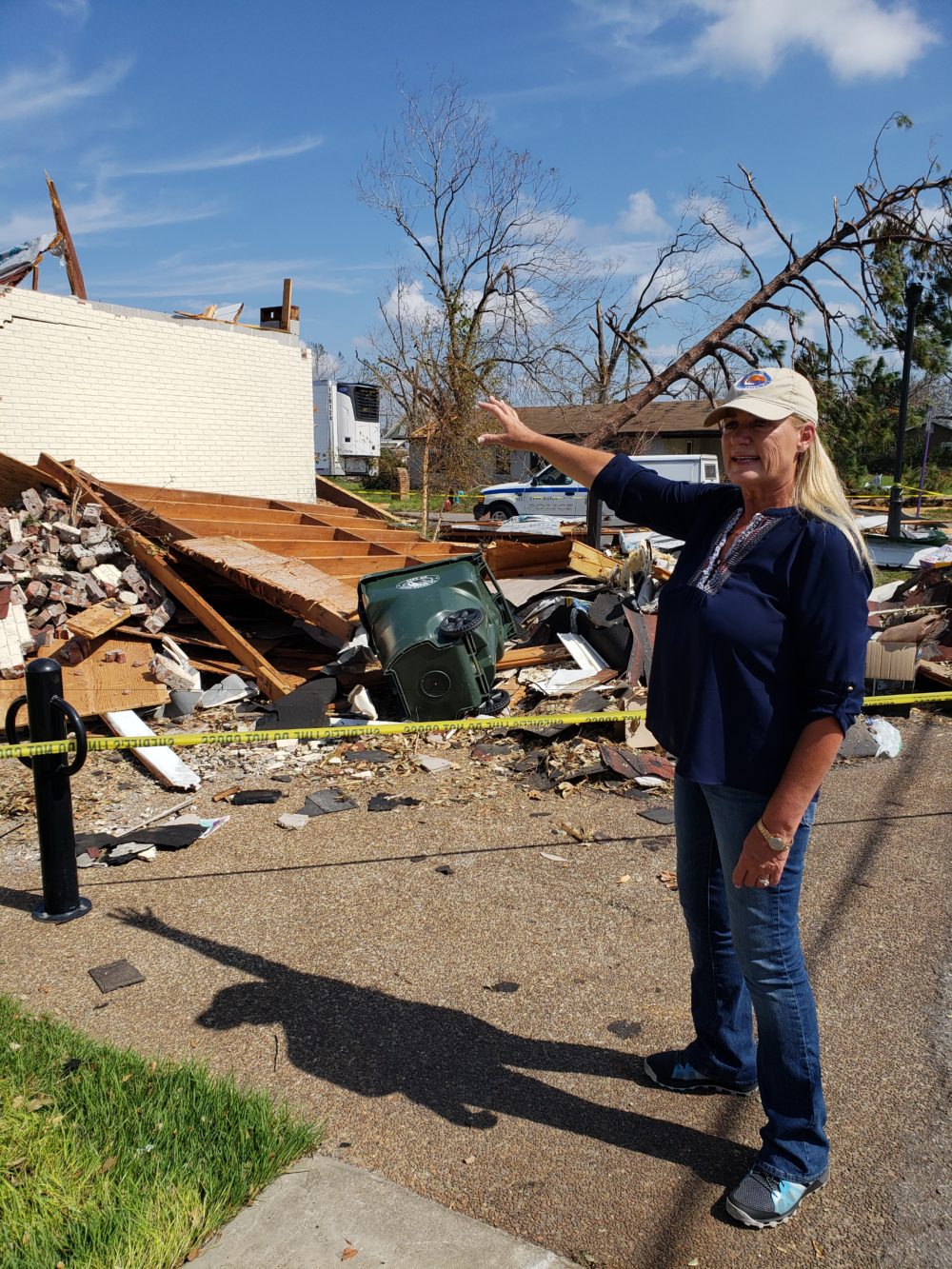
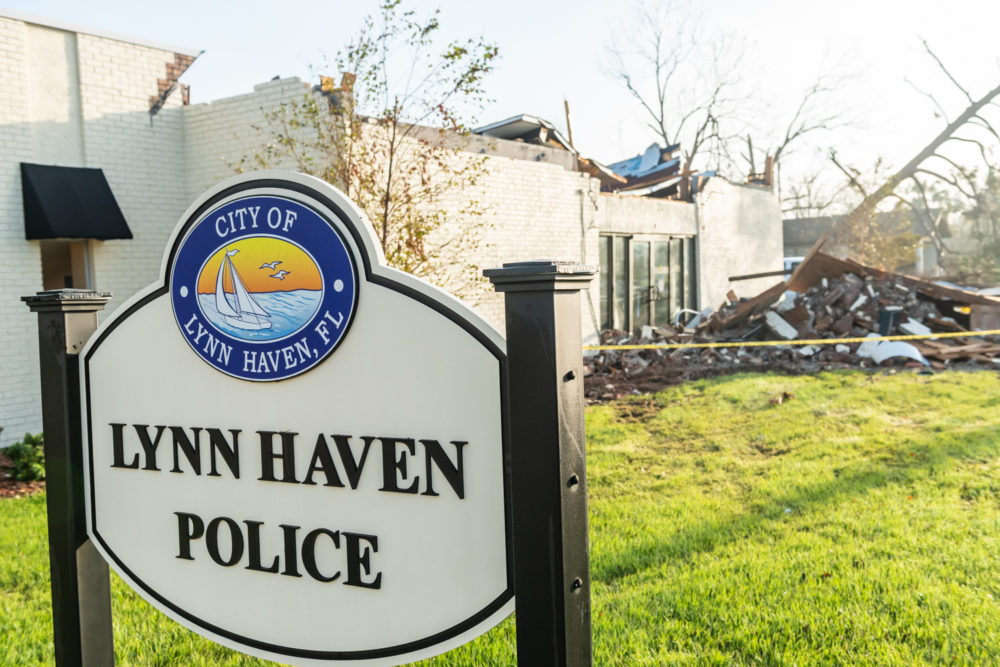
Dust and broken bricks spill around the crumbling building like forgotten Legos left scattered about by a child. Broken windows let the hot, humid air inside. The sun beats down through the leafless branches of tilting, windswept trees. A white structure in the heart of Lynn Haven that once stood for the protection and best interests of the people of Lynn Haven sits in ruins.
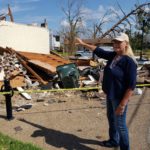
“The roof went first.” Mayor Margo Anderson points to the building that, just a week before, served as a meeting hall for Lynn Haven’s city commissioners.
The structure was built in 1928 and adjoins the Sheriff Annex Building next to Lynn Haven’s historic City Hall.
Around 40 people looked for refuge in the building when Hurricane Michael made its way to Northwest Florida. It started off as a tropical storm. Everyone thought it would dissipate. Hurricane Michael turned out to be one of the strongest storms to ever make landfall in the U.S. in documented history.
Margo Anderson, an entrepreneur, published author, and singer, has served as the City of Lynn Haven’s mayor for two years and has earned the love and trust of her citizens. Her family has lived in Lynn Haven since the 1940s. Her father worked in the Army Corps of Engineers and took his family with him around the globe. In the late 80s, she returned to Lynn Haven. Happily married, she and her husband of 17years live in the 1930 wooden home her parents had owned, and before them, her grandparents. “I’ve been in a lot of hurricanes, been here most of my life,” she says. Never would she have imagined that in her career as elected official she would emerge from a collapsed building and, days later, be shaking the hand of the president of the United States of America.
As she stares up at the ruins, the emotions are palpable. “Fifty-five minutes,” she recounts. “I timed it. It only took fifty-five minutes for it to be torn apart.”
When evacuation advisories were announced the day before, she decided she wanted to be there for her residents. She and her husband, joined other officials and law enforcement officers inside
the City Hall Annex building–part of which once was a church and seated up to 220 people. City Commissioner Dan Russell and his
family, the Lynn Haven police force with their significant others, and children, plus family pets were in the building.
 There were around 10 children, the youngest just three months old. As news stations warned that Michael would decidedly be making landfall with windspeeds of up to 155 mph (just a few miles shy of reaching a Category 5 classification), Mayor Anderson and the officers started a live feed on Facebook. “Get out. Get your family, get a few clothes, get out now. You’ve got six hours before it starts to hit the north,” she urged her Facebook followers the same day. Afterwards, she and the officers shed tears. They prayed together, thanking God for their protection from the oncoming storm.
As the storm drew nearer, the wind began to howl. Rain poured down in sheets. Trees were struggling to stand against the brutal gales. Emptied branches broke off. The group inside City Hall looked out the window and saw the roof of the Lynn Haven Public Library lift up into the air and drop back down again.
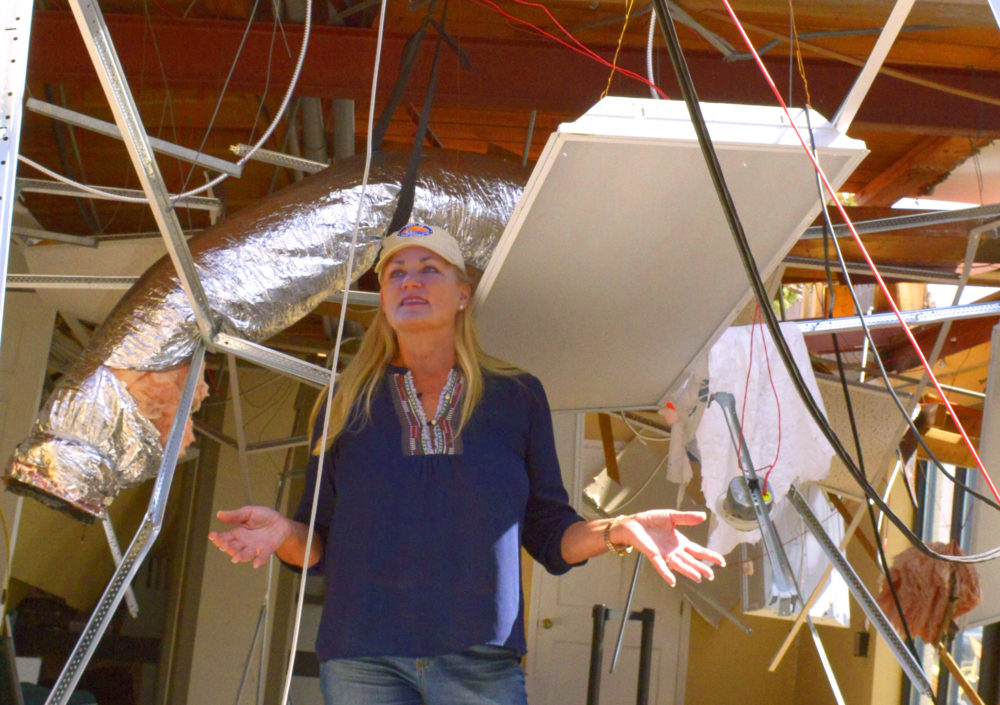
It wasn’t long before the storm began to tear at their own building. The building shook. The refugees buckled down in the old church building. At one point, they even had to place cases of water against the glass double door to keep it from blowing out. Then, the roof gave out. “You can see where one of the rafters, well, all the rafters, were coming at us. The walls buckled, one of the two A/C units was torn off the roof, and rain poured inside.”
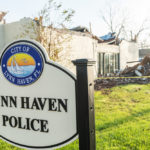
Her eyes have a stark expression. She and the other refugees escaped just seconds before the entire roof collapsed. They made their way into the police department through an adjoining hallway with the roof collapsing behind them.
The force of the hurricane ripped one of the two-ton air-conditioning units straight up into the air. Rafters from the church fell, crushing into one of the hallways and removing large chunks of its ceiling. The noise was deafening. Now, rain rushing like a river poured directly into the building.
With all walls shaking, the children, women, and pets gathered in a windowless room in the center of the police department. Others huddled together in a hallway.
The pressure and rising water caused the flooring to pull away. They could feel the floor rising beneath their feet. Electric shock was a concern until the power suddenly turned off. The group was thrust into a deep, black darkness.
During the turmoil, several news outlets sought updates on the storm. It was during a phone interview with the producer of the television show “The Five” that the cell phone signals were lost. She was preparing to go live when her signal cut out. “I said, ‘We’ve got to move kids. I know I’m going to lose power. I don’t know if we’re going to make it in this building. It’s falling apart.’ And then I lost service and I didn’t get it back.”
Some police officers physically held a nearby door closed to make sure the inside of their haven would not be battered by the rain and winds. The other police officers and a few officials sat in the hallway.
“The moms and the kids were very, very calm,” Mayor Anderson recalls. “The dogs were the weirdest thing to me. They were just like … ‘What’s going on? You need to take care of us!’ Commissioner Dan Russell, he was a calming element here. He stayed through the whole thing as well. My husband was calm … I mean, everybody here was stand-up. It was a great group of people.”
The wind quieted down. For a while, everything was peaceful. But everyone knew that the quiet didn’t necessarily mean the storm was over. Maybe they were now in the eye of the storm. Anxiety filled the black hallways. It was a defining moment of survivorship. “The dogs are calm,” Mayor Anderson told the kids. “They’re like ‘Everything’s cool, we’re going to make it!’”
She returned to her husband in the hallway and took hold of his hand. “I said … and it’s real hard for me to say again, but I said, ‘You know I love you more than anything in the whole world. I really, really believe that this building will not hold up if this is the eye.” Her husband argued that perhaps they were at the tail of the hurricane, and that the end was in sight. Everyone held on to this hope.
As the storm picked back up, Mayor Anderson began to pray. “Dear Lord God, do not let it be the eye. Let this be the end. Put Your hand of protection over us.”
After twenty more minutes of uncertainty, the winds subsided. Hurricane Michael moved north to wreak havoc in Washington and Jackson counties.
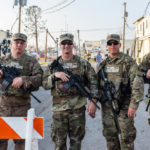
“As soon as we were sure that the worst had passed, the entire police force went out the door and mobilized. They were just heroes,” Mayor Anderson says.
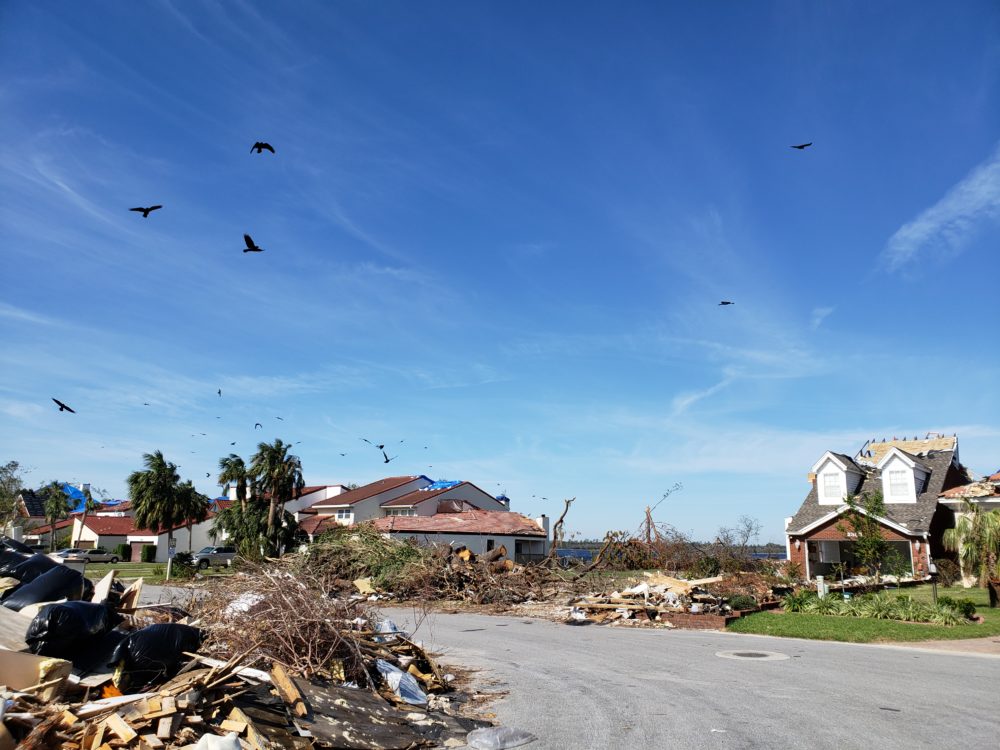
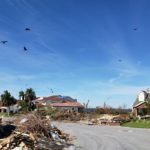
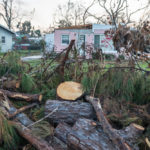
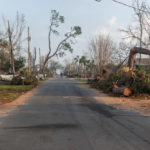
As they emerged from the decimated building, they found the city much changed. Pine needles covered the streets of Lynn Haven like brown carpet. Displaced squirrels looked frantic. Oak trees exposed roots to the late afternoon sky. Storefronts had been blown out and littered goods and large shards of glass on the roads. Light poles crushed residences and cars, dripping their thick power lines along sidewalks. Throughout the city, people had lost everything—electricity, their home, their sense of safety.
“A Category 5 hurricane is complete destruction,” Mayor Anderson says. Hurricane Michael stayed just below on the wind scale.
There was no time to lose. Residents started the cleanup effort. The police officers sought out the injured. The immediate thought was to clear the roadways for transportation.
“City Manager Michael White got in his four-wheeler and went into the city to get a bulldozer to clear roads of debris. People like the sanitation director got out and started to help with clearing. 19-year-old Wesley Stone jumped in his front loader and cleared the tree-filled Highway 77 by himself,” the mayor explains. By the next morning, Highway 77, 9th Street, and Highway 390 had been cleared enough so that people were able to get back to their homes.
Healthcare was another immediate concern. “Our fire department and EMTs were our first medical care,” says Mayor Anderson. “We were able to treat people who had minor injuries, and people who needed medicine, such as diabetics, started getting the things they needed transported to them.”
Mayor Anderson looks up, like a silent prayer. “We had no casualties in this town,” she says. Her voice reveals that she recognizes how bad it could have been. Hurricane Michael claimed lives in other cities in its path.
The next day, Mayor Anderson’s daughter, Hilary Frierson Keeley, arrived in town with her husband, their friends, and two semi-trucks filled to the brim with the supplies the city desperately needed, such as water and baby goods.
The night before Hurricane Michael’s landfall, Mayor Anderson declared a state of emergency for Lynn Haven. According to city charter, she was now the head of the fire and police departments and of all city operations until the end of the emergency. Local volunteers Mara and Reese Harrison had started cooking food and organized the distribution of water and necessities. The Federal Emergency Management Agency set up a claims center so that residents could sign up for assistance.
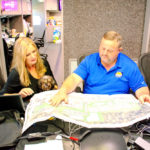
Getting in contact with government officials and government assistance programs, Mayor Anderson moved the battered city forward, helped coordinate the cleanup efforts, and started plans for restructuring. Dividing responsibilities, everyone worked like clockwork and with determination. “City management oversees the employees and operations. I am taking care of the government. I communicate with Governor Rick Scott, with Secretary Nielsen of Homeland Security, and even the President of the United States.”
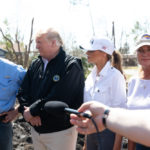
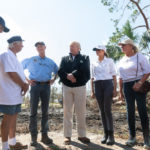
Her voice reached the White House. Even before government assistance arrived, President Donald Trump and First Lady Melania witnessed firsthand the aftermath of Hurricane Michael.
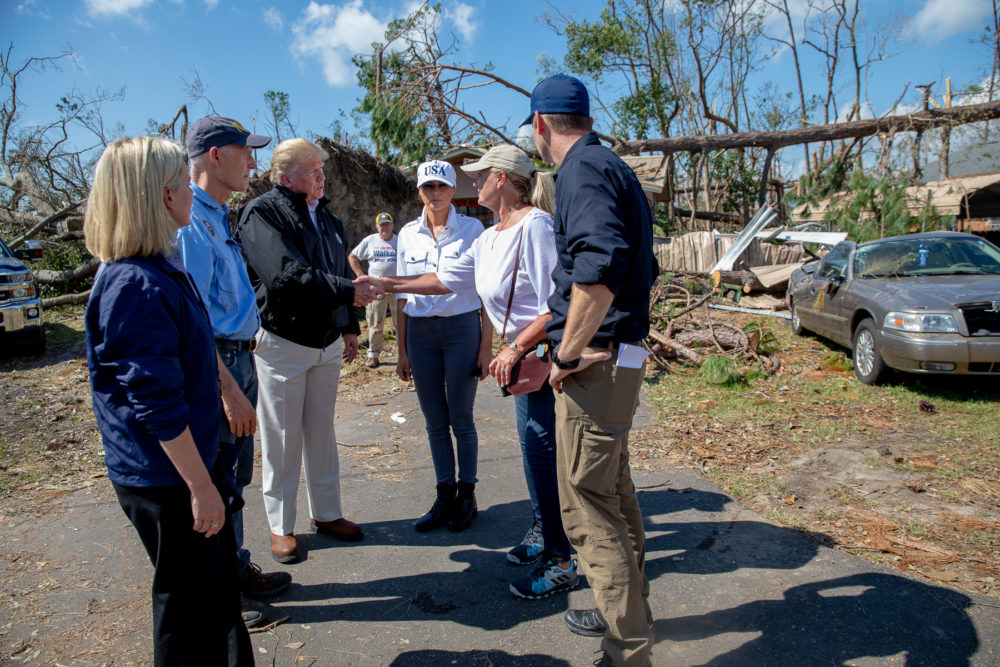
Escorted by Ospreys stationed at Eglin Air Force Base, the president arrived at Northwest Florida Beaches International Airport three days after Hurricane Michael’s landfall. Accompanied by Governor Rick Scott, Florida CFO Jimmy Patronis, Congressman Neal Dunn, Secretary of Homeland Security Kirstjen Nielsen, and FEMA Director William B.Long, Mayor Anderson says the meeting with President Trump was very personable. Other local elected officials to meet the president included County Commissioner Bill Dozier, Panama City Mayor Greg Brudnicki, and the Mayor of Mexico Beach, Al Cathey.
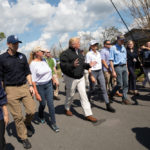
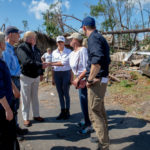
“I thought it was going to be a handshake when he got off Marine One, that we would ride in the motorcade through town and that would be it,” she remembers. But the president wanted to meet the residents of Lynn Haven. The Secret Service agents addressed her and other Bay County representatives before arriving in Lynn Haven: “I apologize, gentlemen. I hope your feelings won’t be hurt, but I have to ask you to remain on the bus. The president and the first lady have asked for the mayor to walk with them.”
“And so, I just went,” Anderson says. “We visited with several residents on the streets as we walked. He was warm, he was gentle, he
was kind. It was a big crowd. The overall feeling was, ‘The president is here to help us.’ It was wonderful.”

While posing for a photograph, Mayor Anderson remembers apologizing to Melania Trump for her dirty clothes. She’d spent all
day outside and was now standing next to the president and first lady for a press photo. “Melania reached over and took a hold of my hand. That meant a lot. In other words, she was saying, ‘It’s going to be okay.’”
Asked about the lessons learned after the storm, Mayor Anderson points at not-so-obvious key aspects. “Most people think water and food are the number one thing that we need. I think one of the lessons learned from this tragedy is that communication is key. You have to communicate to be able to recover. I was in a panic for 72 hours because I wanted to speak to my residents.”
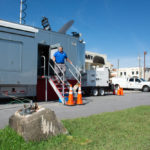
On the Verizon Wireless outage that affected a large number of customers, Mayor Anderson has been understanding. Their towers were decimated, just as her city was. Just a few steps away from City Hall sits a high-tech mobile command center donated to the City of Lynn Haven by Verizon until the city’s offices are restored. Inside, air conditioners are humming and residents are able to charge their devices. Above the metal trailer rise two powerful satellite towers that work to give the city of Lynn Haven what they need more now than ever—a way to communicate with the world. “Anything they can send into Lynn Haven right now, send it,” the mayor asks. This is a big area. I also told them Millville, Parker, Cedar Grove, Callaway, and Mexico Beach are in need.”
I think one of the lessons learned from this tragedy is that communication is key. You have to communicate to be able to recover.
With plans for the future already forming, right now, the mayor’s main concerns are the children and the elderly. At the time of the interview, she is focused on making Halloween happen as normal in Lynn Haven. Already, she is reaching out to Reverend Tom Daniels to set up in his church’s parking lot for Trunk-or-Treat. “They don’t need to know that Halloween was cancelled because of the storm,” she says. As schools are still used as shelters and many people do not have a home to go
back to, FEMA-supported temporary housing is requested so that classes can resume in the schools. She encourages those who can to share their homes to accelerate this transition. Her daughter has also begun raising money so that the children of Lynn Haven will be able to have a normal Christmas. Over the next few days that followed the hurricane, she and her group of friends brought in seven more semi-trucks filled with supplies.
With a diligent administrative team contacting local businesses to see what they need most and when they can expect to open again, she is hopeful that the city’s vital economy can be restored. Many are expecting to open in November, but nothing’s been set in stone yet.
Next door to the City Hall Annex building that saved their lives, splintered rafters dangle into the hallway, spilling light into the dark halls. Electricity had not been restored yet at the time of the interview.
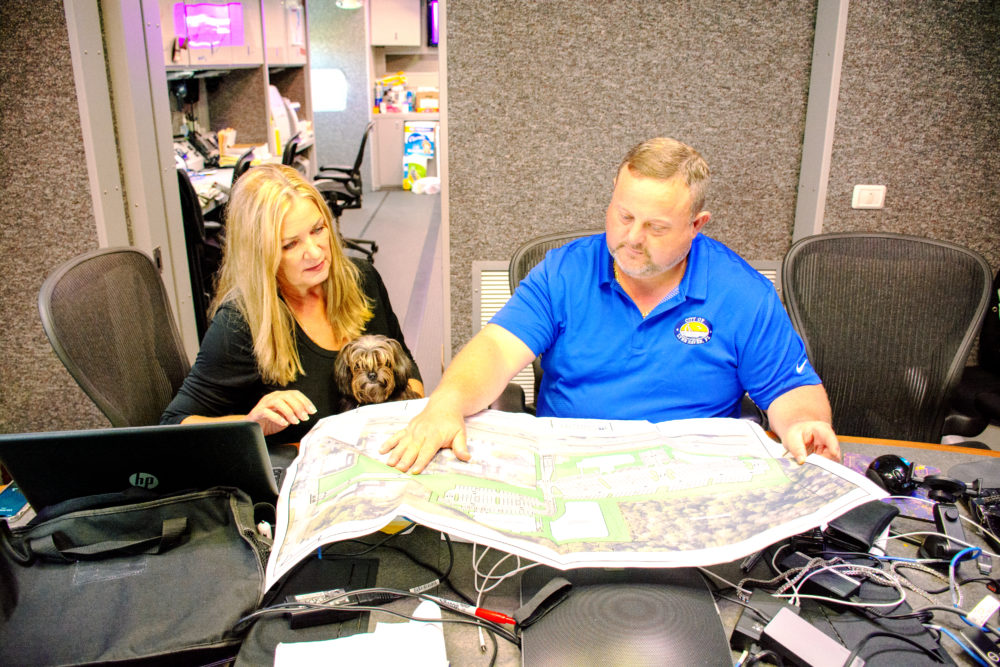
“We’re going to bulldoze this complete building.” Mayor Anderson admits that she still feels the anxiety of October 10th when in the building. “What I’ve asked to do is to demolish the backside of the old City Hall, the part that is not reparable. We’re going to keep the front. We’re probably going to make it into a museum.” She also says she will keep the old date palm that sits outside of City Hall. It’s been a long-standing favorite of the citizens. “It’s an icon,” she says. “I said we can’t destroy that. We’ve got to keep it.”
Plans are being made to build a new annex, perhaps with a rounded center, that will withstand windspeeds of up to 225 mph. Mayor Anderson asks all residents to come together and present their own ideas, wanting the city to move forward together. “Once all of the residents are back and we’re past this initial recovery phase, I want us to start designing right away so that people will have hope and will stay.”
Out of all the tragedy, there is a light, the hope and a vision for a better, stronger Lynn Haven. “A positive for me, as far as functioning as mayor, is that this has united my city employees, my police department, first responders, city managers—all of us. The commission as well. I think our commission is united. We all have a united mission right now and that is to take care of the residents of Lynn Haven and to rebuild the city. We are all committed to that.”
Those wishing to help in the city’s restoration process can donate to the
City of Lynn Haven’s Hurricane Relief Trust Fund.
For more information visit the City of Lynn Haven’s Facebook page
or the city’s website, www.cityoflynnhaven.com