
Reviewing 30 Years of Providing Support for the Navy’s LCAC


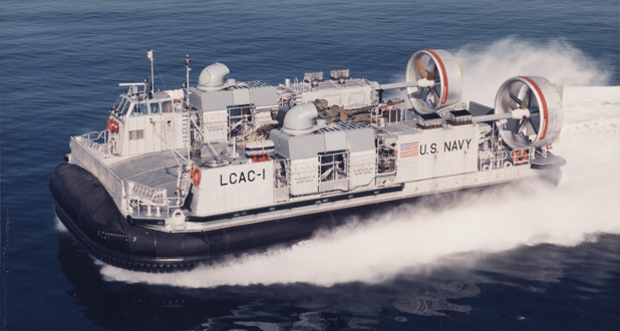
Arguably, the reason the United States Navy is the most powerful navy in the world is because of our ability to fulfill the core mission area of power projection, which at the Naval Surface Warfare Center Panama City Division (NSWC PCD) means landing Marines and their equipment ashore aboard Landing Craft Air Cushion (LCAC) vehicles. This month we celebrate the 30th anniversary of the arrival of LCAC 1 in Panama City!
On May 29th, 1984, as reported in the Naval Coastal Systems Center (formerly NSWC PCD) command newsletter The Underseer, “the first production unit of the Landing Craft Air Cushion vehicle was being offloaded at its berth in the high bay area of Building 319 after a journey by barge from Bell Aerospace Textron New Orleans where it was built under contract to the Naval Sea Command.”
When the LCAC was first introduced it was considered the first significant improvement in waterborne landing craft since World War II, able to transport troops, weapons and equipment at speeds in excess of 40 knots from support ships over the horizon to dry landing points beyond the beach. Because of its unique amphibious capabilities it can land on 70 percent of the world’s beaches, which is a four-to-one improvement over conventional craft of the day. According to Bruce Nolte, then Head of the Amphibious Warfare Branch (Code 2250), “the craft’s arrival marked a milestone in the program and represented several years of effort.”
The first LCAC detachment, consisting of three craft from Assault Craft Unit 5 (ACU 5), deployed to the Western Pacific in June 1987. ACU 4 conducted several highly successful operations providing further proof of the LCAC’s potential, including cold weather testing at the Air Force’s Climatic Control Hangar, Eglin Air Force Base, Florida, in the summer of 1987. These tests successfully demonstrated that the LCAC is able to operate in a temperature range of -30F to +160F (below deck). In early November 1987, ACU 4 changed homeports from Panama City, Florida to Naval Amphibious Base Little Creek, Norfolk Virginia, where they placed three LCAC in operation.

Over the course of the next 15 years 91 craft were delivered to the US Navy, of which 81 are still in operation today. The original craft were capable of carrying a 60 short ton payload, with an overload payload capacity of 75 short tons. More than 90 percent of the Marine Air-Ground Task Force equipment is too heavy for vertical lift, and LCAC are the only craft with the speed and range to deliver the surface component of a Marine Expeditionary Brigade (MEB) from over the horizon in one period of darkness.
They were designed for a service life of 20 years, however, with a Service Life Extension Program (SLEP) upgrade the LCAC lifecycle has been extended another 10 years. The SLEP refurbishes all rotating machinery, includes a complete command, control, communication, computers and navigation replacement, enhanced engines and a deep skirt system, which increased the cushion from 5 feet to 7 feet. LCAC SLEP has extended the expected service life of LCAC to approximately 2028.
Through the years, LCAC have been deployed throughout the world and taken part in a range of amphibious operations. In 1990-91, LCAC were deployed to the Arabian Gulf in support of Operation: DESERT SHIELD and Operation: DESERT STORM. In 1993 LCAC present in Somalia were used to bring Marines and equipment ashore in support of United Nations actions to restore order to the region. In 1994 LCAC took part in Operation PROVIDE COMFORT in Haiti. More recently LCAC have provided humanitarian assistance and disaster relief after the earthquakes in Haiti and Japan, after Superstorm Sandy and after Typhoon Haiyan in the Philippines. To date, LCAC have logged over 130,000 operational hours of service.
On the horizon is the next generation LCAC, the Ship-to-Shore Connector (SSC). The research and development for the SSC is complete and the new design is under contract. As the first LCAC retire the SSC will begin to enter the fleet with an initial operational capability projected in 2020. The SSC maintains a similar footprint as the LCAC and will operate from existing and planned amphibious well deck ships. The SSC increases the non-overload lift capability from 60 to 74 short tons, and it can carry this larger payload across a broader operational envelope. It is also expected to reduce fuel consumption and maintenance.
For 30 years LCAC have been supported by the engineers, logisticians and technicians at: NSWC PCD in their role as the craft platform In-service Engineering Agent (ISEA); NSWC CD Philadelphia in their role as the gas turbine engines and drive trains ISEA; and the Space and Naval Warfare Systems Command in their role as the ISEA for communications. This support team and the men and women in uniform serving at Assault Craft Units 4 and 5 and Naval Beach Unit 7 have enabled the Navy – Marine Corps team to successfully conduct operations in the littorals — that congested and diverse area where the sea and land merge. Whether those operations are conflict or humanitarian assistance or something in between, LCAC have set the US Navy apart from the rest with their ability to deploy, employ and sustain expeditionary forces ashore.