
Passion for Orchids


By Jody Wood-Putnam
Photography by Michael Booini
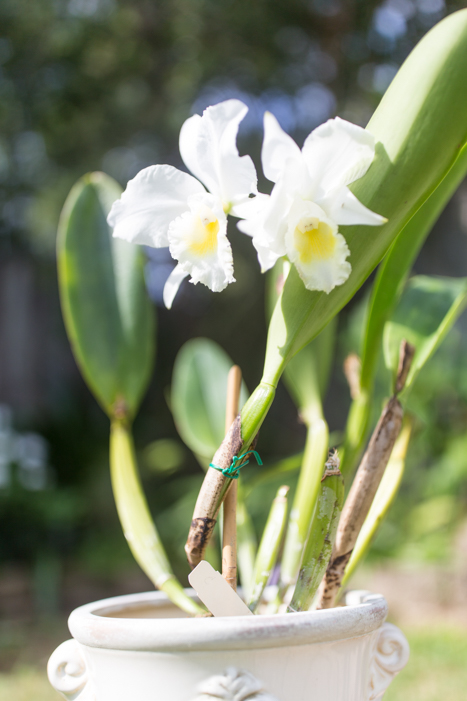 The orchid family, one of the largest families of plants, has approximately 28,000 diff ent species. Orchids are native on all continents except for Antarctica. They are exotic, they are elegant. Countries such as Costa Rica, Panama, Singapore, Belize, and Honduras have chosen orchids as their national flower.Tropical species with colorful, spectacular, and sometimes fragrant flowers are known by most of us. Orchids can be terrestrial, growing on the ground, or epiphytic, growing on supports such as trees, shrubs, and rocks. Orchid flowers have evolved into many diverse forms with some attracting very specific pollinators. They may have a single flower or may have long scapes with many flowers. A high demand and people’s passion for orchids have led to the development of more than 100,000 hybrids and named varieties.
A greenhouse behind Jonnie Smallman’s house is where she keeps many of her beloved orchids and protects them when the weather gets cold. Orchids can be found everywhere in the Smallman household – in various locations throughout her home and even hanging from small trees in the backyard. “You can bring the girl out of the tropics, but not the tropics out of her yard,” the South Florida native jokes.
Growing Tropical Orchids in Northwest Florida
Orchids are perennial. If treated properly, they can be enjoyed for many years. Most of the plants commonly for sale in stores are native to the tropics. In the wild, these orchids grow on structures such as trees or rocks instead of in the ground. Orchids have aerial roots that, in addition to absorbing water and nutrients, are adapted to hold them in place on these structures. In the wild, they get plenty of light and air circulation and never sit in standing water. These conditions should be mimicked as much as possible to successfully grow them in a home or Northwest Florida garden.
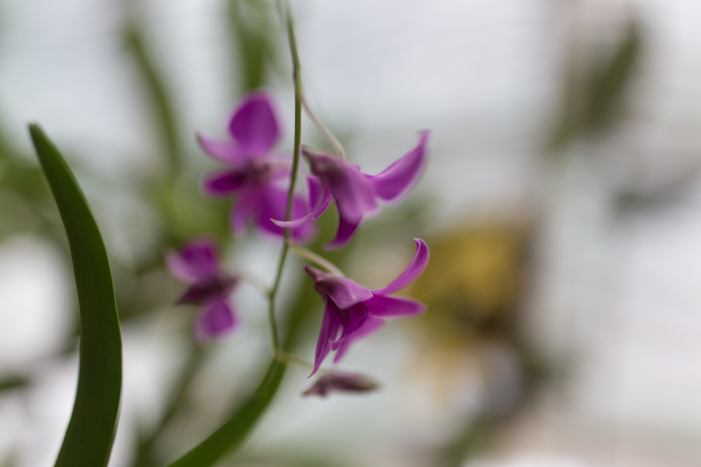 “Orchids are not hard to grow once you know how,” says Jonnie. She recommends orchids to be potted in a porous medium that allows some contact with air, drains quickly and decomposes slowly. Materials commonly used for growing orchids include dried plant fibers (for example dried coconut husks) rocks and bark. According to Jonnie, the most common mistake people make is overwatering which leads to rotting. “Wait to water until the growing media is almost dry. I generally water once or twice a week, letting the water drain from the pots. Indoor growers can take them to a sink to drain, or they can set the plants in a tray, emptying the tray after watering, so the plants do not sit in the water. Orchids prefer bright light in order to flower. Dark green leaves on an orchid may be an indication that it needs more light.” Orchids should also be repotted every few years as the decomposing medium material can cause the plant to decline.” When hanging orchids in pots or baskets on trees and other structures in a northwest Florida yard, direct sun should be avoided- ed. Particularly the afternoon sun can scorch their leaves, so a nice location with an eastern exposure and morning sun works well. Orchids need to be protected from temperatures below 50 degrees.
Which Orchids to Grow?
Jonnie’s favorite orchids are Cattleya orchids, and one particular orchid plant, a Blue Vanda, she has nurtured for 15 years. For a beginner, she suggests a Phalaenopsis orchid, commonly called a moth orchid. This variety is very popular as they come in a wide range of colors, are one of the easiest to grow inside, and can bloom more than once during the year with blooms lasting sometimes up to six months. When selecting an orchid, check that the roots are fi within the potting medium. It is a good sign if there is an actively growing leaf.
 More than just a Flower: The Vanilla Orchid
The Mayans and Aztecs used the seed pods of Vanilla Orchids to flavor beverages long before the Spanish arrived in Central America. Spanish explorers brought the seed pods back to Europe where vanilla gained popularity. Vanilla Orchids are generally hand pollinated. The seed pods are harvested by hand and undergo a lengthy curing and drying process before becoming the vanilla beans we buy in supermarkets. Because of labour intensity, it has become one of the most expensive spices in the world. In addition to being used for tasty treats such as cookies and ice cream, vanilla is used in perfumes and aromatherapy. Because of the high cost of vanilla beans, most of the “vanilla” used today is artificial
Northwest Florida’s Native Orchids
Almost 100 native orchid species can be found in Northwest Florida. While they are generally not as spectacular as the tropical ones found in stores, they can be very beautiful. Most of our native orchids are terrestrial and you will fi them growing close to the ground. Look carefully while hiking in open areas along some of our nature trails such as those at conservation parks, and you may see them.
Learning More about Growing Orchids
There are many orchid societies around the world that off information on different species of orchids, their growth, and propagation. One site with good information is the American Orchid.