
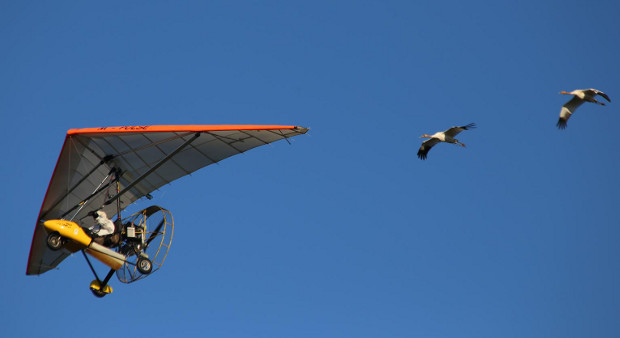
OPERATION MIGRATION – Guiding Whooping Cranes to St. Marks, Florida


ALL IMAGES COURTESY OF OPERATIONMIGRATION.ORG
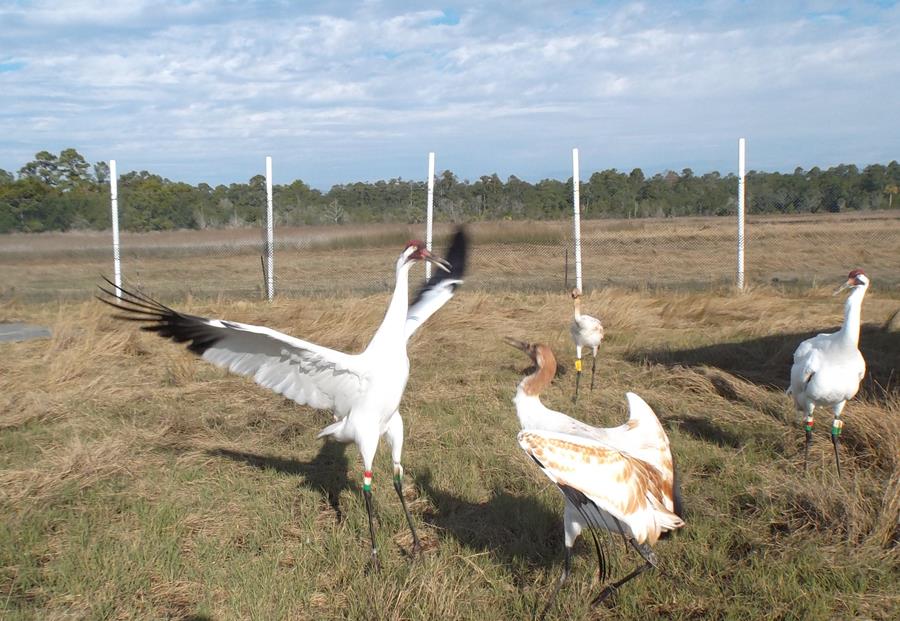
THE WHOOPING CRANE (Grus americana) at five foot, is the tallest North American bird and named for its whooping sound. Whooping cranes have been declared an endangered species since 1967. Before the settling of Europeans on the continent, it is estimated that the population was more than 10,000 birds. The number dwindled to 1,300 to 1,400 birds by the year 1870 due to unregulated hunting and loss of habitat. Only 15 adults remained by 1938. The current population is pproximately 382, which can be credited to extensive conservation efforts.

Birds such as cranes and geese learn to migrate by following their parents. The routes they use may change over the years but it is passed from generation to generation. When the last bird to use the route dies, so does that knowledge.
Through extensive work done in the 1980s by Canadian naturalist Bill Carrick, it was discovered that ultralight aircraft could be used to fly with the birds and guide them to their winter home. By 1998, Joe Duff was able to demonstrate that he could imprint a crane species and lead these birds along a preselected route. In the spring, the birds would initiate their own return back to the introduction area. Operation Migration, the non-profit organization that organizes the ultralight migrations, has played a lead role in the reintroduction of endangered whooping cranes into eastern North America since 2001. All aspects of the Eastern Introduced Flock are overseen by a larger group, WCEP, the Whooping Crane Eastern Partnership, an international coalition of public and private groups.
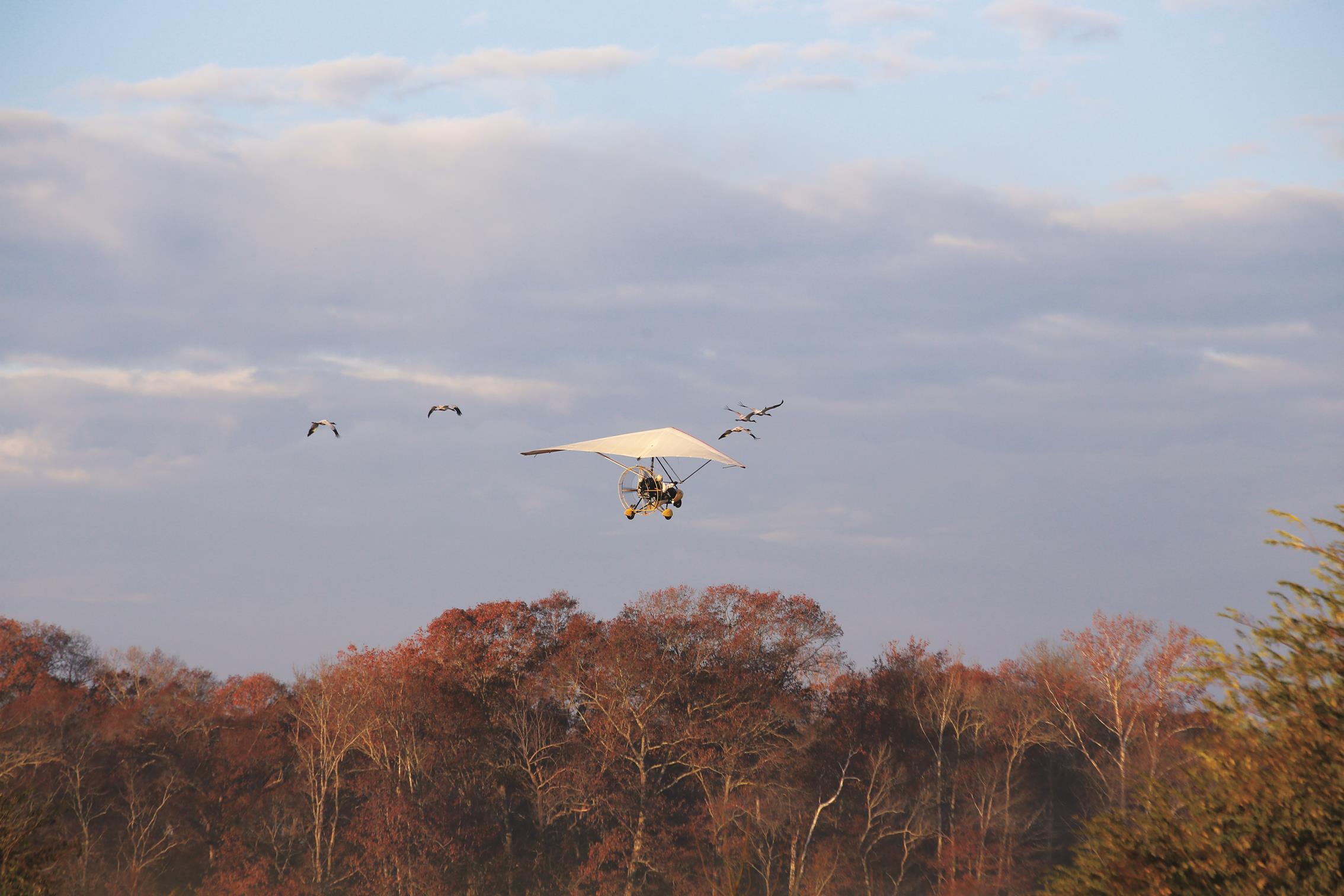
Every spring/summer Whooping crane chicks are hatched and imprinted to follow a small aircraft. These chicks are initially raised and trained by costumed humans at the U.S. Geological Survey’s Patuxent Wildlife Research Center before being brought to Wisconsin where they continue training. This technique repeatedly proves effective because of the birds’ natural instinct to imprint on the first creature that nurtures it.
On December 12, 2014, seven whooping cranes arrived at the St . Marks National Wildlife Refuge, a marshy area that is considered to be the specie’s historical range. The juvenile cranes could be seen flying in formation behind two ultralight aircraft steered by two pilots in crane costumes. Volunteers and spectators assembled for the landing to see the juvenile cranes take up winter residency. The cranes started out on October 10th in Wisconsin but bad weather made the flight difficult in the beginning and the cranes had to be driven part of the way, through Illinois and Kentucky to Tennessee. The flight took 63 days from Tennessee to Alabama, Georgia before the birds finally arrived in
Northwest Florida.
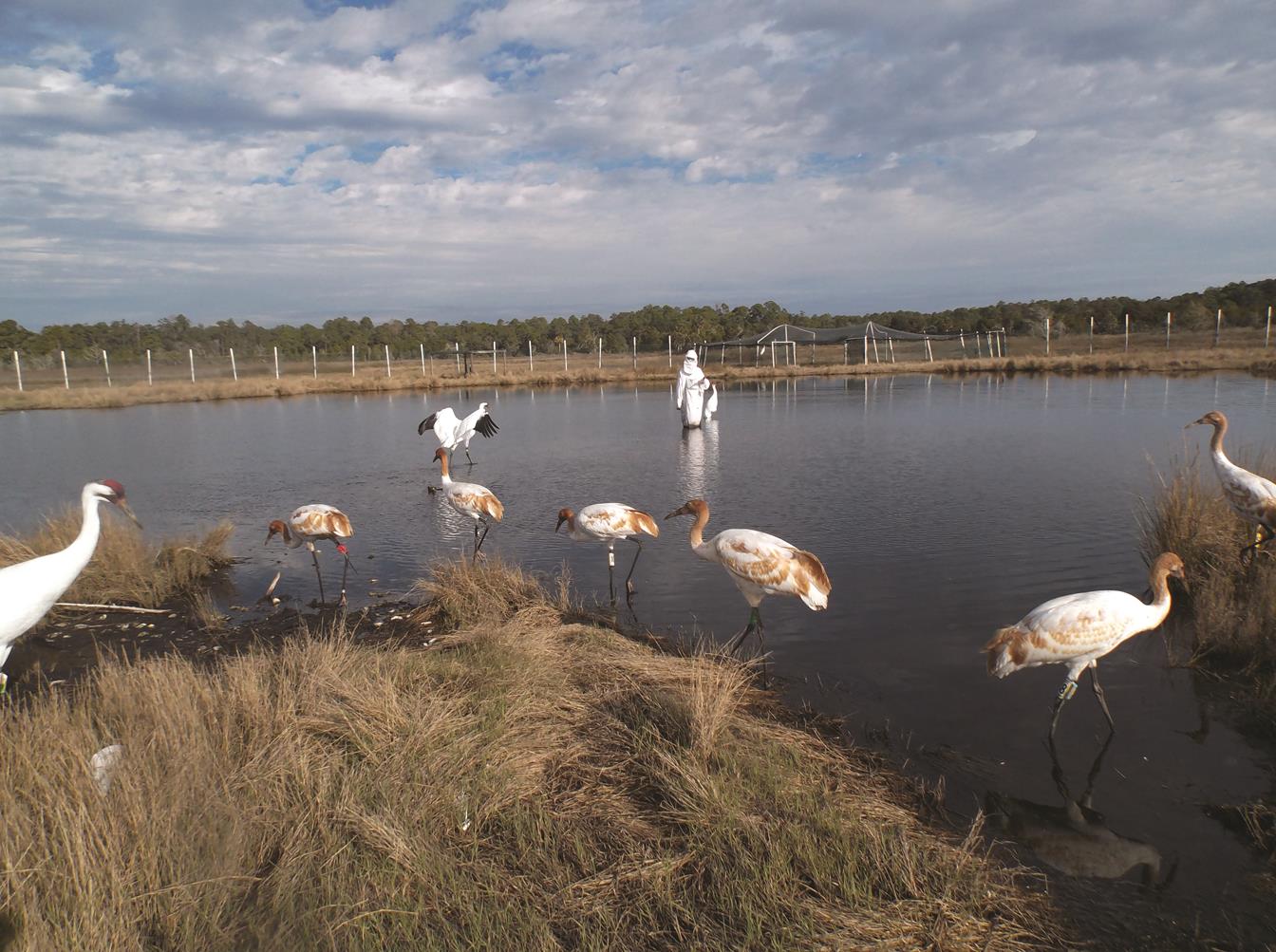
According to Heather Ray, Operation Migration’s Director of Development, the St. Marks National Wildlife Refuge was chosen because it closely resembles the natural habitat of the Whooping Crane with brackish marsh, open areas and tide action.
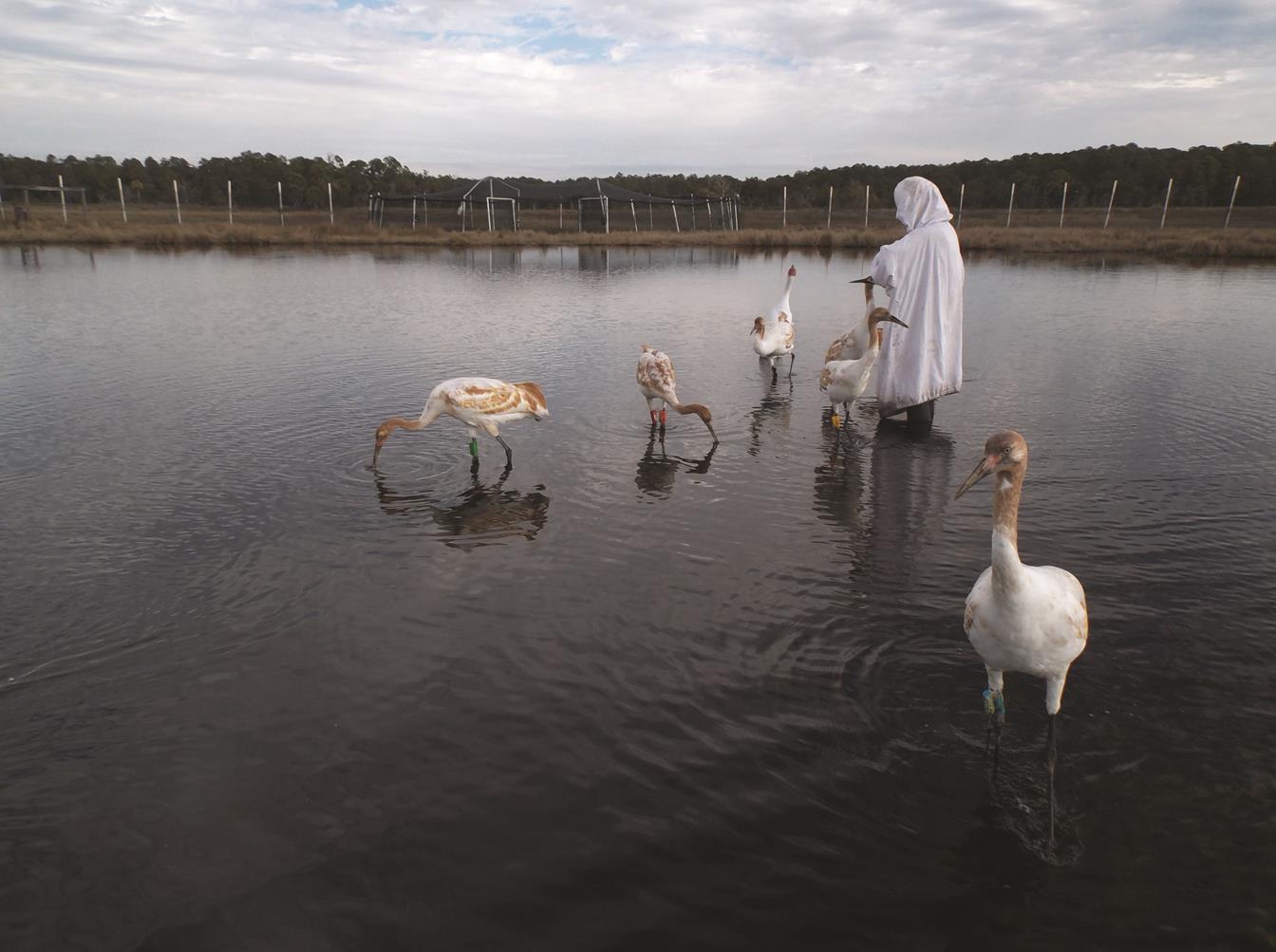
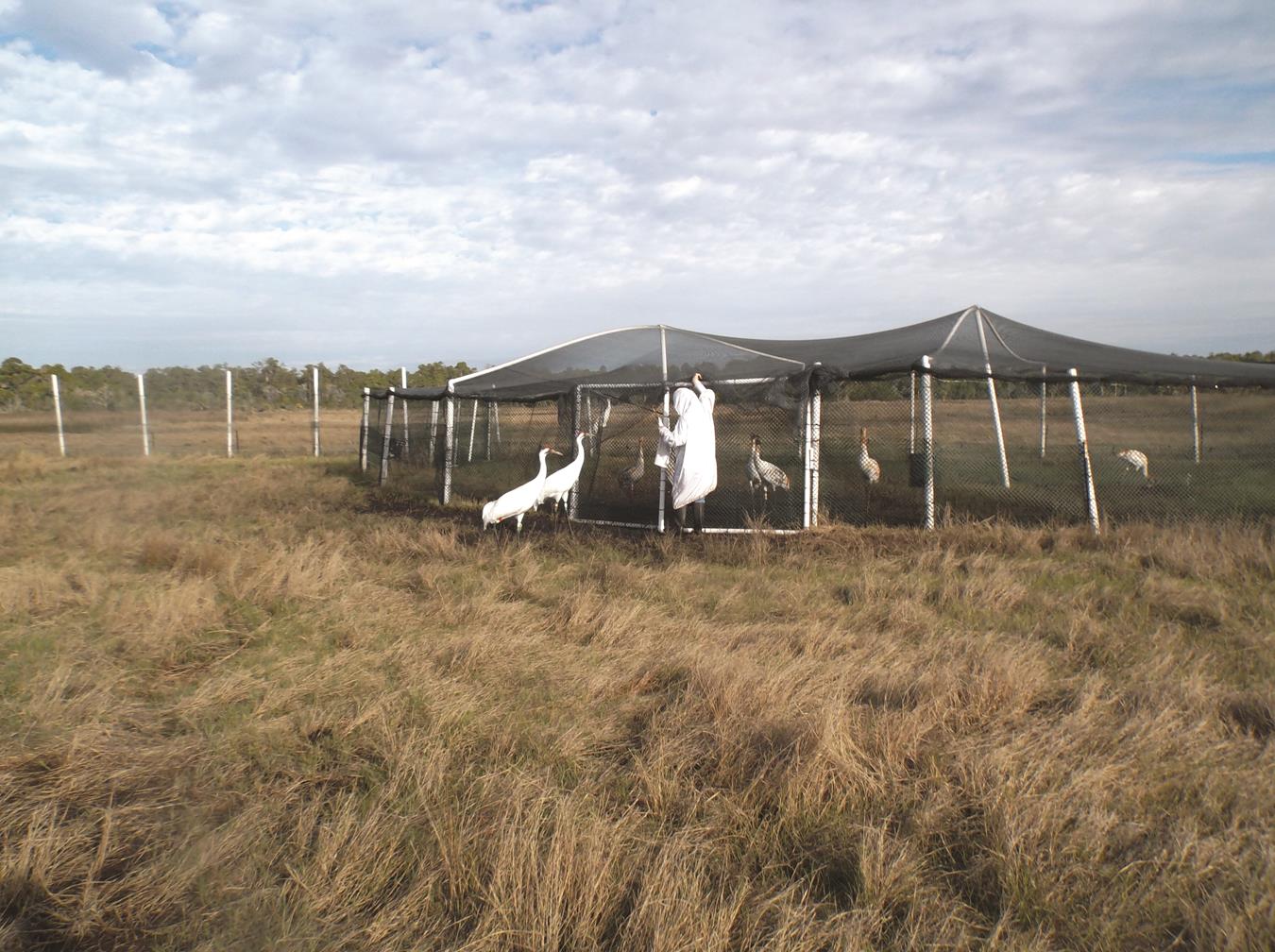
Several groups and volunteers helped build a pen for the cranes in St . Marks but the birds are free to fly in and out of the cage. The population counts now 104 birds and they are monitored in two ways – by satellite tracking device at a cost of appoximately $3,000 per unit and another $1,000 per unit for data acquisition or by VHF radio transmitter.
Heather Ray reports a 100 % return rate – the migrated Whooping Cranes see the route one time, remember it, and can fly back home to Wisconsin in the summer months. The cranes are not being monitored on a daily basis when back in Wisconsin.
In a recount of the long journey, Joe Duff wrote into the field journal at www.operationmigration.com “The migration team consists of anywhere from 10 to 12 people depending on the success of our volunteer campaign. Each member plays a critical role from releasing the birds to fly with the aircraft, to tracking them from below. The pen that the birds just left must be disassembled, cleaned and transported to the next site while our fleet of trucks, trailers and motorhomes is prepared for the move. The outreach staff run the cameras and post the updates that keep our online audience informed as well as answering questions at the public flyovers. At the end of the day when the birds are safe and the camp is ready, stories are exchanged and I am always amazed at how much can happen in the twohours, while we are airborne. Pen trailers get stuck in the rain soaked fields where they have stood for a week and generous farmers with tractors are cajoled into helping.
Trailer tires blow on the interstate and other team drivers rendezvous to change them. Birds drop out and the trackers coordinate their retrieval. Birds in crates are passed between vehicles to speed their transport to the next site and free up the manpower in preparation for whatever happens next. If the birds split up into small groups, each aircraft will pick up a few. If we get separated, our resources are spread thinner. Radio messages are relayed if we are out of range, GPS coordinates shared and the entire team is mobilized. On bad days it all happens at once and that’s when the team really shines.”
[box type=”shadow” align=”aligncenter” ]Sources:
1 . Wikipedia contributors . “Whooping crane .” Wikipedia, The Free Encyclopedia. Wikipedia, The Free Encyclopedia, 22 Dec . 2014 . Web . 1 Jan . 2015 .
2 . http://operationmigration.org/
3 . http://www.bringbackthecranes.org/ [/box]