
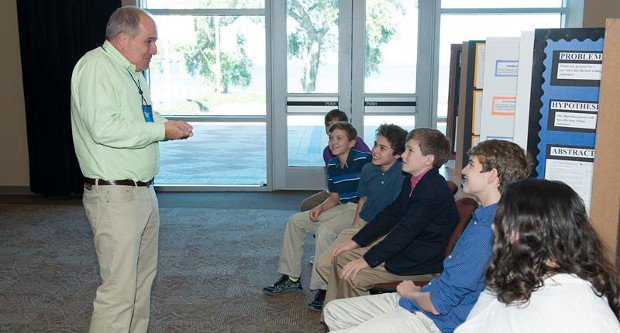
Navy Mentors Students at Three Rivers Regional Science Fair


Naval Surface Warfare Center Panama City Division (NSWC PCD), Florida State University Panama City (FSU PC), and representatives from Bay County District Schools hosted the 54th Annual Three Rivers Science and Engineering Fair Jan. 29, 2015. Twenty students were selected as regional winners to compete at the 60th Annual State Science and Engineering Fair in Lakeland, Florida, March 31 – April 2, 2015.
NSWC PCD Outreach Coordinator Ed Linsenmeyer said the U.S. Navy has partnered with academia for several years with the objective of inspiring students’ interests in science, technology, engineering and mathematics (STEM) studies.
“We want to help interest students in competing at science fairs and encourage them to pursue STEM-related careers,” said Linsenmeyer.
Science Specialist for K-12 Bay County District Schools and Regional Fair Director Katie McCurdy agreed with Linsenmeyer, adding that students are allowed to incorporate artistic creativity into their projects.

“We encourage our students to compete in the science fairs because our nation’s focus on education is shifting toward technology,” said McCurdy.
Linsenmeyer validated McCurdy’s statement about the country’s need to inspire students’ interest in STEM-related studies.
“Currently the United States is not competing well with other nations, specifically with respect to exams focused on STEM disciplines,” said Linsenmeyer. “When compared to countries considered as western economic groups, we’re placing 13th, 14th, and 15th, especially in mathematics.”
Linsenmeyer said this is why the U.S. Department of Defense has been funding STEM-related programs, to turn this educational crisis around.
“Consequently, my funding for this event comes from three sources: the National Defense Education Program (NDEP), NSWC PCD overhead, and for this particular event the Office of Naval Research (ONR) is sponsoring two awards in the Senior Division and four in Junior Division.”
Surfside Middle School seventh grader Sarah Buckley’s project titled, The Power of Oxidation, exemplified how students were learning to conduct scientific research.
“I was trying to determine the percentage of oxygen in the air and if that could be replaced by using the process of oxidation,” said Buckley. “To test this theory, I used a test tube, water, steel or metal, and oxygen. So, when oxygen helps to rust steel or metal then it should leave a space where the steel or metal used to be. According to my theory the water I used in my test tube should be drawn up into that space and my conclusion proved correct.”

NSWC PCD Physicist Dan Flisek judged Buckley’s project exemplary of following true scientific research.
“As judges we’re looking more at students’ abilities for following the scientific method: that is, being able to think scientifically to overcome problems,” said Flisek. “She reported that one of her first calculations indicated a reading of 44 percent, much higher than the 21 percent expected. She reviewed her actions, found she had forgotten a procedural step, and repeated the experiment to find the correct calculation of 21 percent.”
According to Flisek, Buckley’s ability to recognize problems, review and repeat procedures to ensure none were missed is exactly what science fair judges were scrutinizing.
“Judging these students is more about helping them realize the importance of how they go about applying procedural steps to arrive at their conclusions and application.” said Flisek.
Application is the perfect discussion topic to help students focus on their problem solving potential, according to NSWC PCD Project Manager Dennis Gallagher.
“Judging this science fair isn’t about interacting with students to leave them feeling like a number,” said Gallagher. “To get students excited about science is to help them see the potential applications of their work. It’s talking about how their project might be applied to something that’s never been done before or something that has never been built before.”

Like McCurdy, Gallagher said the fair was also a chance to encourage students to use their creativity for their projects’ presentations.
“Besides judging, I also enjoy acknowledging students’ creativeness when they find novel ways to present their findings,” said Gallagher. “When you can help a student see how they’re efforts may have more potential applications than what they originally conceived, it’s what takes the blinders off. It’s where science and inventing merge. And that is critical for science.”