
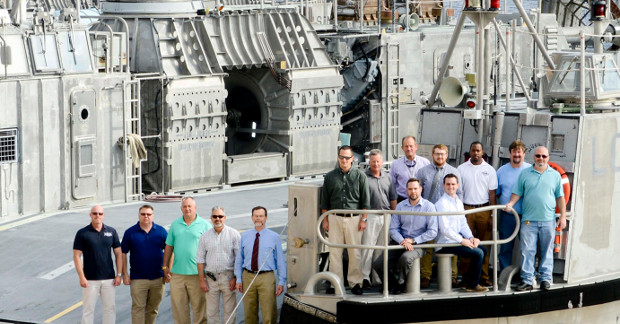
Naval Surface Warfare Center Panama City’s PCD LCAC Teams earn 2013 NAVSEA Excellence Award


The Naval Surface Warfare Center Panama City Division’s (NSWC PCD) Landing Craft Air Cushion (LCAC) Hull, Mechanical and Electrical (HM&E) In-Service Engineering Agent and LCAC Support Services (LSS) teams were presented the Naval Sea Systems Command (NAVSEA) Excellence Award March 19, 2014.
NSWC PCD Expeditionary Systems Development Branch Head David Vickers accepted the award on behalf of the HM&E and the LSS teams.
“NSWC PCD is truly honored to be accepting this award on behalf of the HM&E and the LSS teams,” said Vickers. “Both teams exemplify supporting the Navy through a judiciousness culture of affordability.”
The NSWC PCD team of engineers, logisticians and technical specialists have helped keep the LCAC operating in harsh marine environments throughout the world for over 28 years, according to NSWC PCD HM&E Project Manager Scott Howell.

Howell said the NSWC PCD team has accomplished this by providing depot repair services and developing processes for the maintenance and sustainment of multiple unique air cushion vehicle systems components.
“When there are no vendors, or vendors are charging much higher than targeted costs for components, our technical experts redesign the components or find other ways to identify and qualify new vendors for those components,” said Howell.
LCAC Support Services (LSS) Project Manager John Pipkin said the support provided to the fleet is a concerted team effort between the In-Service Engineering Agent (ISEA) engineers, logisticians and technical specialists located in Panama City and the six NSWC PCD On Site Representatives (OSRs) strategically positioned throughout the Fleet.
The OSRs act as liaisons between the ISEA and the Fleet, and often rely on ISEA expertise to execute maintenance operations on the craft. Most of the NSWC PCD LCAC technical specialists positioned in Panama City and with the Fleet have active duty Navy experience in a variety of LCAC roles including the flight crew, instructors and craft maintenance.
“OSRs are positioned on-site where the craft and crew can benefit from their reach back capability to the ISEA. This structure combines subject matter expertise from the ISEA and the OSRs for a continuous level of support. The OSRs interact with the Fleet continuously and are positioned at Assault Craft Unit (ACU) 4 in Norfolk, Va., at ACU 5 in San Diego, and at Naval Beach Unit 7 in Sasebo, Japan. Having OSRs positioned throughout the Fleet like this creates stability,” said Pipkin. “The amount of LCAC experience in the fleet can change as crew members and maintenance personnel retire or transfer to other areas. The knowledge and experience the OSRs provide adds stability to these transitions.”
According to NSWC PCD Air Cushion Vehicle Branch Head Bob Teer the OSRs, with support from the ISEA team members in Panama City, provide critical on-the-job training to the sailors maintaining the LCAC located at the units, as well as technical reach-back capability to those Sailors maintaining LCACs deployed on Amphibious Ready Groups (ARGs) around the world. Teer said NSWC PCD HM&E and LSS teams are able to achieve all of this while saving U.S. taxpayers millions of dollars each year.
“The NSWC PCD team of talented engineers, logisticians and technical specialists are charged with mandating a culture of affordability. One recent example is the recent development of an alternate source of supply for scavenge fans that is projected to save approximately $49,000 per fan. With a current annual usage of 20 scavenge fans, the expected savings are approximately $1 million per year. Extended through 2028, when the LCAC is projected to reach the end of its service life, total savings could exceed $20 million. This is an excellent example of maintaining a culture of affordability,” said Teer.