
Life BoKx


STORY AND PHOTOGRAPHY BY MIKE FENDER
Kaial Hajik is not afraid of drowning. He is 13, into video games, scouting, and playing soccer. And the ocean—he’s into that, too. Kaial recently completed his scuba certification as part of the requirements to become an Eagle Scout.
Out in the warm waters of the Gulf of Mexico, he had the thought of drowning during his scuba training—but it wasn’t himself he was worried about. He had discovered the long list of Florida-wide drowning victims. There had been at least 23 deaths in the past three years in Bay County alone. The number shocked him. “It’s just terrible,” he says.
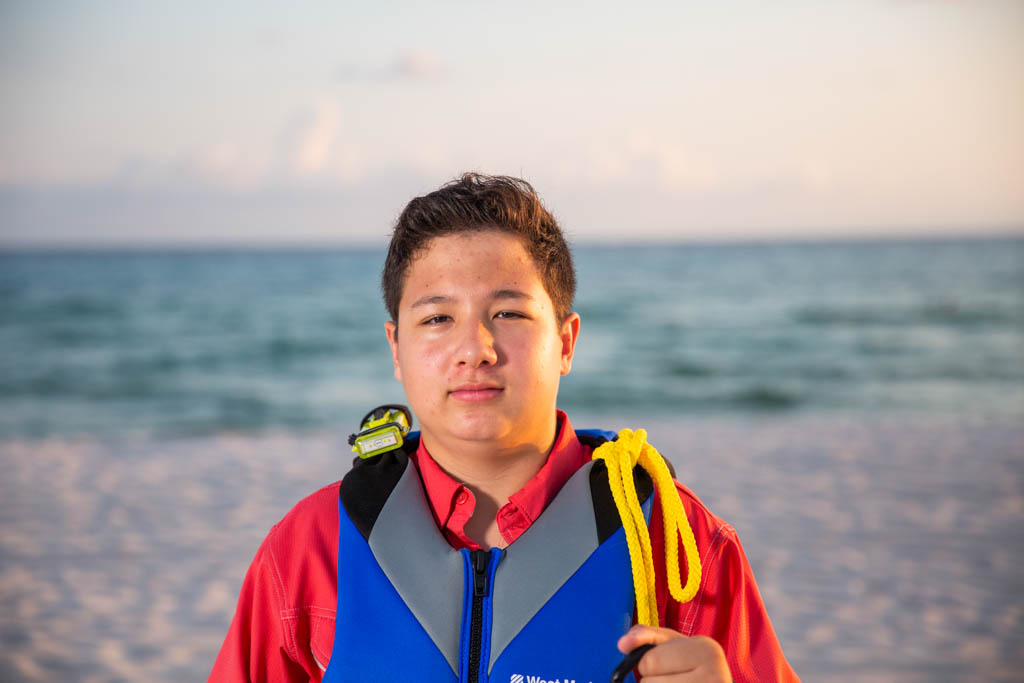 That’s when Kaial decided something needed to be done. As a Boy Scout, Kaial says he tries to live by the words of the Boy Scout oath. “We recite the oath at every meeting and it says we are supposed to help other peo- ple at all times. It’s kind of stuck in my brain,” he says. He found that, in many cases, the victim in a drowning turned out to be the brave bystander or family member charging into the water to save someone else.
Lifeguards do that all the time, but they are prepared, Kaial reasons. But in that time gap between rescuers being called and when they arrive, it is common that someone on the beach will attempt a rescue. It is human nature to help. So, what if the bystanders or family members had access to lifesaving equipment like the lifeguards have? What if they could quickly access the equipment before charging out into the water? Could that make a difference? Could that save lives?
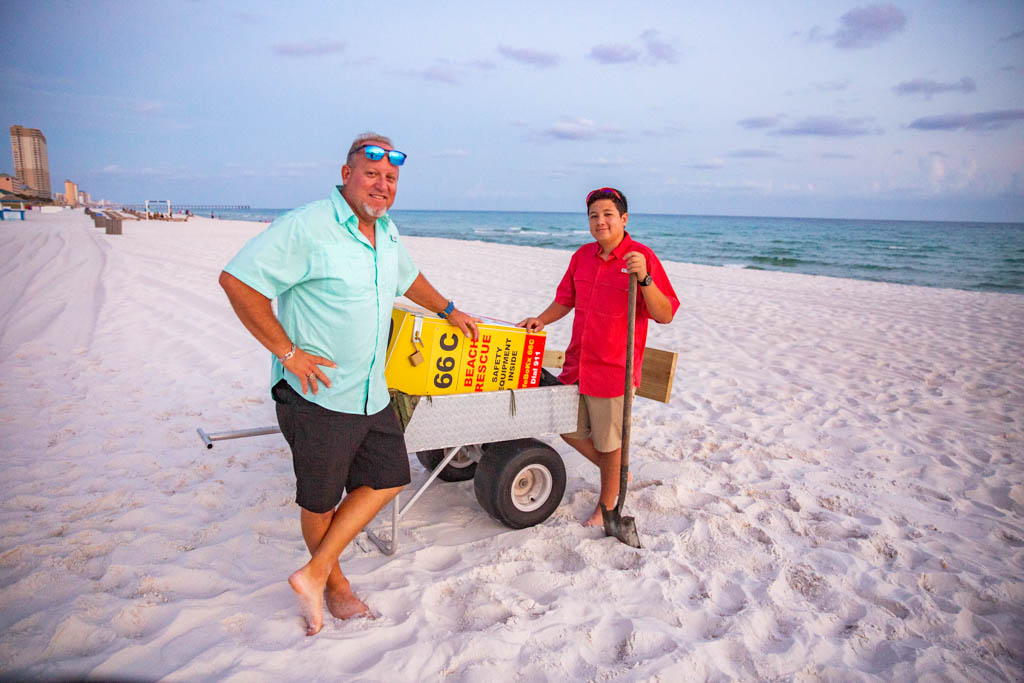
Lots of questions led to two months of brainstorming. Deeper research and a little basic woodworking would follow. Kaial and his father, Joe Hajik, were on a quest. Their first thought was to build a box to house rescue equipment, but it had to be simple and easily accessed. In his research, Kaial learned that time was precious in a drowning situation. Every minute it takes to reach a victim is critical. “It’s probably a ten-minute clock before you see a professional respond,” says Joe, and adds that it’s a golden ten minutes where someone can respond and give the victim a better chance to survive.
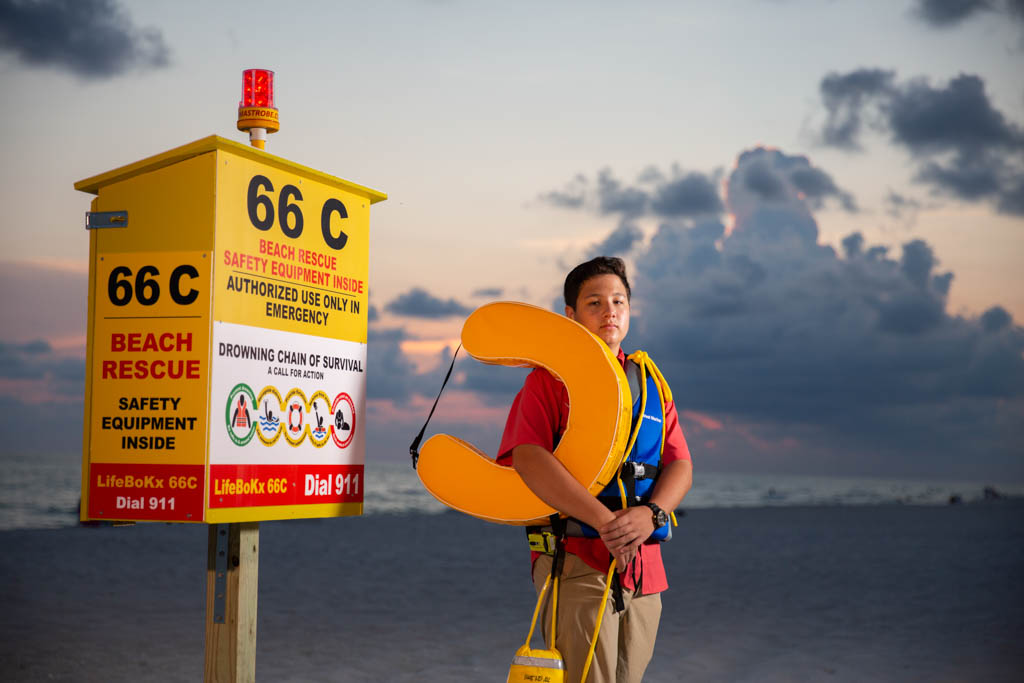
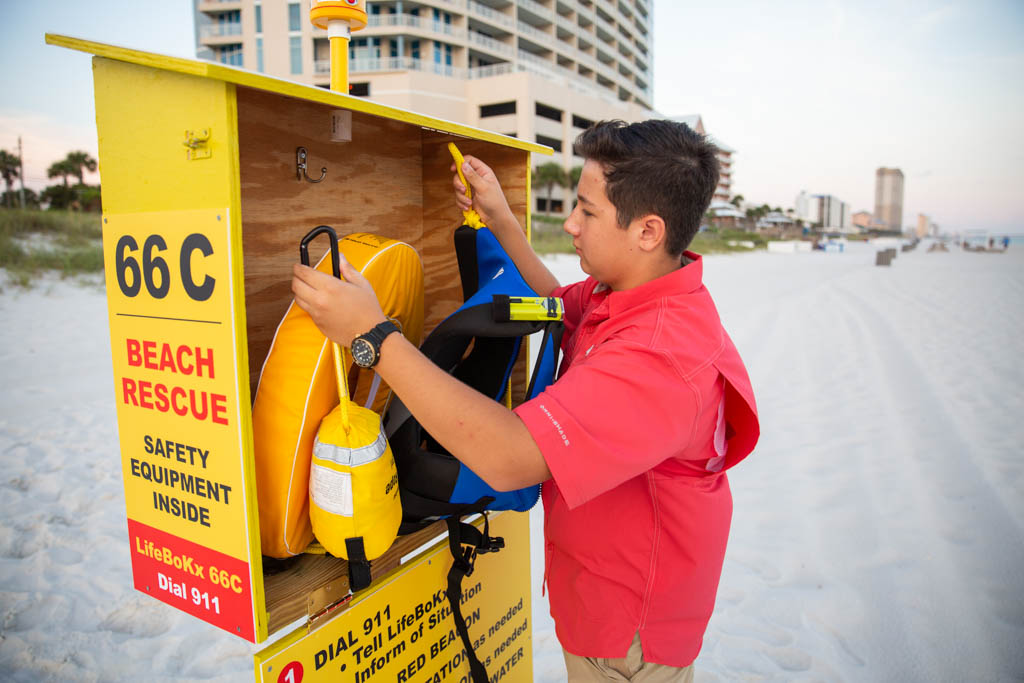
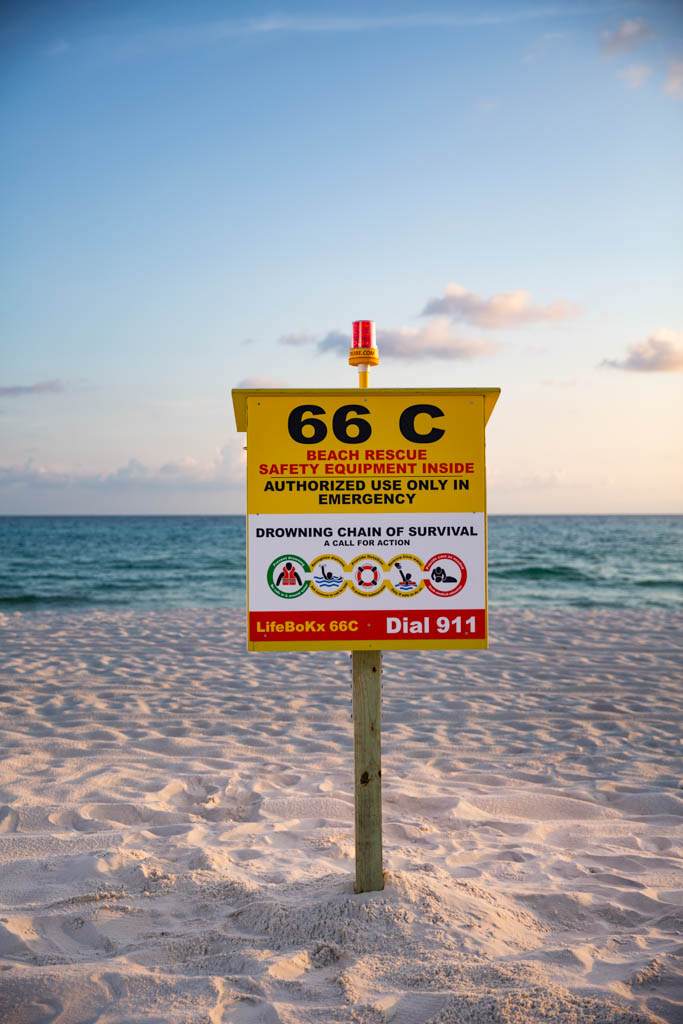
Soon, the problem had a solution and the LifeBoKx was born. Kaial’s in- vention is a moderate-sized box filled with lifesaving equipment such as two sets of flotation devices and a life jacket for responders, as well as a lifesaving ring with a throw rope, used to reach and pull in a victim. The box also has an emergency beacon you activate and put on top of the box to draw attention to the emergency, and a personal beacon attached to the life jacket.
The box needed to stand out so Kaial and his dad found a paint scheme that was hard to miss. They donned the box in red and yellow with large type and graphics on every side. The prototype displays the letters 66 C to designate beach access point 66, which is closest to their home, just a half mile away. Instructions are posted inside LifeBoKx on what to do with the equipment and how to do basic CPR. In his research, Kaial followed the International Life Saving Federation’s “Drowning Chain of Survival,” a series of steps that, when linked together, attempt to reduce mortality associated with drowning and aquatic rescue.
 The chain consists of five steps. The first is to prevent drowning by be- ing safe in and around water. The next is to recognize distress and ask someone to call for help. The third calls for providing flotation to the victim to prevent submersion. The fourth step is to remove the victim from the water, but only if it is safe to do so. And finally, the chain calls for providing care as needed, including seeking medical attention.
The boxes would be 400–500 feet apart, Kaial suggests. One possibility would be to place them at each numbered beach access point along the 21 miles of sand along Panama City Beach. Additional boxes could be placed on the busier beaches and near beach flag locations, piers, condos, or private beaches.
The idea of the boxes in no way replaces the need for lifeguards or emergency personnel to respond to a drowning, Kaial points out. He agrees that trained lifeguards and rescue personnel are the best option for a rescue. But in many instances, people on the beach are not going to wait for help to arrive. LifeBoKx would be an option in the minutes between when 911 is called and when rescuers arrive on the scene. If someone is going to attempt a rescue before professionals arrive, then Kaial wants them to have the equipment to save their own life as well.
 Panama City Beach Fire Chief Ray Morgan was one of the first to get a look at LifeBoKx. While he says his department never advocates for anyone to enter the water during hazardous conditions, he does admit “having the ability to have a life ring or other floating device nearby is a good idea.”
Morgan invited Kaial to show the LifeBoKx to the Panama City Beach lifeguards and says they were impressed with him. “It is not that of- ten that you meet a 13-year-old that has the drive and desire to help
save lives that he has,” the chief noted. He says the guards eagerly listened to Kaial’s idea, demonstrated a rescue for him, and then had Kaial spend the day with them so he could see what an average day in the life of a beach safety lifeguard is like. They even asked Kaial if he wanted to be a lifeguard. Kaial says the feedback from the lifeguards was essential, noting they found the rope he was using with the life ring was too long for a practical rescue.
According to Morgan, the number of PCB drownings vary from year to year based on factors such as the number of red and double red flag days and how many guests are on the beach during those times. “In 2019, we, unfortunately, suffered nine drownings in the city limits. I can tell you that, for me and my staff, one drowning is obviously one too many.” Beyond the drownings, Morgan says the beach safety lifeguards make a countless number of rescues every year.
To figure out if Kaial’s idea for Panama City Beach could work, you only have to look to Grand Haven Beach in Michigan for a possible answer. Last year, officials there installed a series of signs along the beach to serve as location markers for emergencies and added life rings to the sign posts with a rope people could use to help reach a drowning victim.
On June 29, 2019, emergency crews were called to Grand Haven State Park, shortly before 10 p.m., as a person was drowning 300 feet from shore. The Grand Haven Tribune reported that officers arrived to dis- cover good samaritans had already pulled a 17-year-old from the water. Police said that bystanders saw the swimmer in distress, grabbed the life ring from the post, and threw it from the pier to the teen. The report says the teen was too fatigued to hold onto the ring and went under the water but another swimmer was able to reach him. The swim- mer pulled the victim onto the life ring and bystanders were able to pull them both to shore using the rope attached to the ring. In this story, the victim lived and a life was saved.
 Grand Haven had 14 new location markers and life rings installed along the state park and city beach area last summer. They joined life rings already in place on the south pier. The rings were placed 300 feet apart. Their initiative to reduce drownings along the beaches was sponsored by the Grand Haven Rotary Club, the Department of Natural Resources, and the City of Grand Haven.
In 2014, Michigan Sea Grant, a cooperative program of the University of Michigan, Michigan State University, and the National Oceanic and Atmospheric Administration, began working with the Great Lakes Sea Grant Network on a similar idea. With funding from a NOAA Coastal Storms Program grant, they were able to initiate a multi-year project to distribute beach safety equipment and signs for use by first re- sponders in Illinois, Indiana, Michigan, Minnesota, Ohio, and Wiscon- sin. They were able to deploy the equipment at over 50 beaches on the Great Lakes.
A 2017 report from Michigan State University noted the use of a life ring and throw bag were instrumental in saving the life of a 30-year- old male who had jumped into Lake Michigan from the pier in Whiting Park, Illinois. The report says he became distressed and went into active drowning but was saved by first responders using the life ring and rope to pull him to safety. The safety equipment deployed along the Great Lakes beaches included youth and adult life vests, rescue throw-ring buoys and throw bags, rescue boards, and tubes.
Kaial and his family have been to Michigan and have seen the rescue boards there. It helped Kaial design the LifeBoKx.
While evidence supports the fact that having equipment accessible to the public can save lives, the idea is not free of problems. After signs and safety equipment were placed along beaches in Muskegon County, Michigan, officials with the Muskegon Water Safety Task Force turned to Facebook to reach residents about a problem with the safety equipment disappearing from the rescue stations along Lake Michigan. While they noted they were able to replace some of the equipment, funding lacked to replace three $350 rescue boards that were missing. The Task Force appealed to the public for their help in keeping the safety equipment on the rescue stations. “If the equipment disappears or is relocated, the Beach Rescue Boards won’t be any help to some- one drowning,” the post noted. At many of the locations in Michigan, the safety equipment hangs on hooks on a sign board, and is not se- cured in a box like Kaial suggests.
In August, Kaial and his father presented their idea to the Optimist Club of the Beaches in Panama City Beach. In their presentation, they noted the cost to outfit a box would be between $800 and $1,000 each, depending on whether one or two sets of equipment would be used. Placing a box every 500 feet would call for about 200 boxes with a total cost of $200,000. They plan on making presentations to the Panama City Beach parks department and city council in the future. Kaial admits the reality of getting the boxes on the beach may come down to the cost. “But you can’t put cost against saving a life,” he adds.
Focusing on getting the boxes to become a reality is a priority for Kaial, along with starting his freshman year at Bay High School. He has his sights set on the Air Force Academy and would love to become a pilot in the U.S. Air Force. “I love turbulence,” he says. Both his father and mother are Air Force veterans.
Kaial doesn’t see the LifeBoKx as a money-making endeavor; instead, he sees it as just his way of trying to help others. His only mark on the project is the letter “K” in the LifeBoKx name. The “K” is for Kaial.
The hardest part is the waiting. From his research, Kaial remembers the names of people lost to drowning along the beaches. Just weeks after he came up with the idea for LifeBoKx, another drowning occurred near Russell-Fields Pier. A 10-year-old boy was caught up in a riptide while swimming. Flags at the pier were double red. His mother went in to help and was caught in the riptide as well.
Richard Stacey Redmon, 48, was walking along the beach with his family when his wife, Alisha, saw the two struggling and pointed them out to her husband. Stacey, a former lifeguard, went into the water to try and save the pair but he, too, was soon caught up in the riptide. A surf- er came to Stacey’s aid but says Stacey told him to rescue the boy and mother first. The surfer did just that and then returned to help Stacey, but the father of three ended up losing his own life.
“It’s like someone sticking a needle in my back,” Kaial says when he describes how he felt when he heard about another drowning along the beach. His LifeboKx prototype sits in the garage. “I know liability and cost are important concerns,” he says. “But I wish I could just put it out there right now.”
If Kaial has learned anything from this experience, it has to be the importance of time. He knows the difference a few minutes can make in saving a life. Now he is in a race against time to get the LifeBoKx on the beach.
“I feel like if Stacey would have had some equipment, he would still be alive,” Kaial says.