
Into the Blue Sky


BY SUSAN GUNN
PHOTOGRAPHY BY SUSAN GUNN AND MIKE FENDER
Imagine for a moment you are on the precipice of an adventure you never experienced. It could be anything … an African safari, hiking the Appalachian Trail, even surfing a maverick wave. All these things are sure to bring excitement and have the potential to pull you from your comfort zone for mind-bending experiences. But one sport tops the list of items that can create that big adrenaline rush—skydiving. After meeting the owners and operators of Skydive Panama City, Anthony and Jennifer Antonivich, I found out that there is much more than the big rush at play.

Tony and Jen have both retired from the United States Air Force a few years back. Ironically, neither started skydiving until they had left the military. For years building up to 2011, when they started their business, Jen and Tony were skydiving for fun, honing their skills at different skydive locations around South Florida. After settling in Panama City, the husband-and-wife team decided that it was time that Northwest Florida should have a dedicated skydiving location. At first, operating out of Altha, FL at Calhoun County Airport, Skydive Panama City now operates at the Tri-County Airport in Bonifay after Hurricane Michael destroyed the previous airfield.
When you think of describing a person that puts themselves in a dangerous situation for enjoyment, the description adrenaline junkies—people who are highly energized, generally with an amplified effect might come to mind. But I discovered a different world when, on a cloudy Saturday in February, I had the opportunity to look over Tony and Jen’s shoulders and interview them and other Skydive Panama City staff.
When I first approached their hangar, I could hear a distant airplane engine above. Palpable excitement was in the air. The parking lot was crowded with cars. I noticed a few people milling about the area. I looked up, noticing several black specks high in the sky. One by one, colorful parachutes shot open as each jumper floated to a safe landing on the nearby airfield. To the skydivers, the airfield is known as the DZ, or “drop zone.”
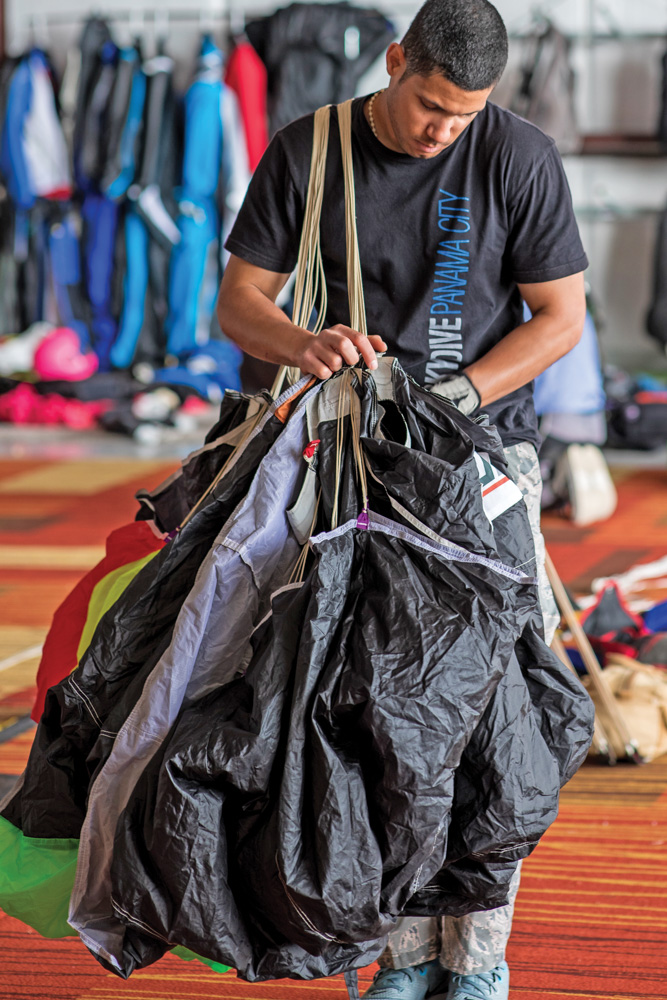
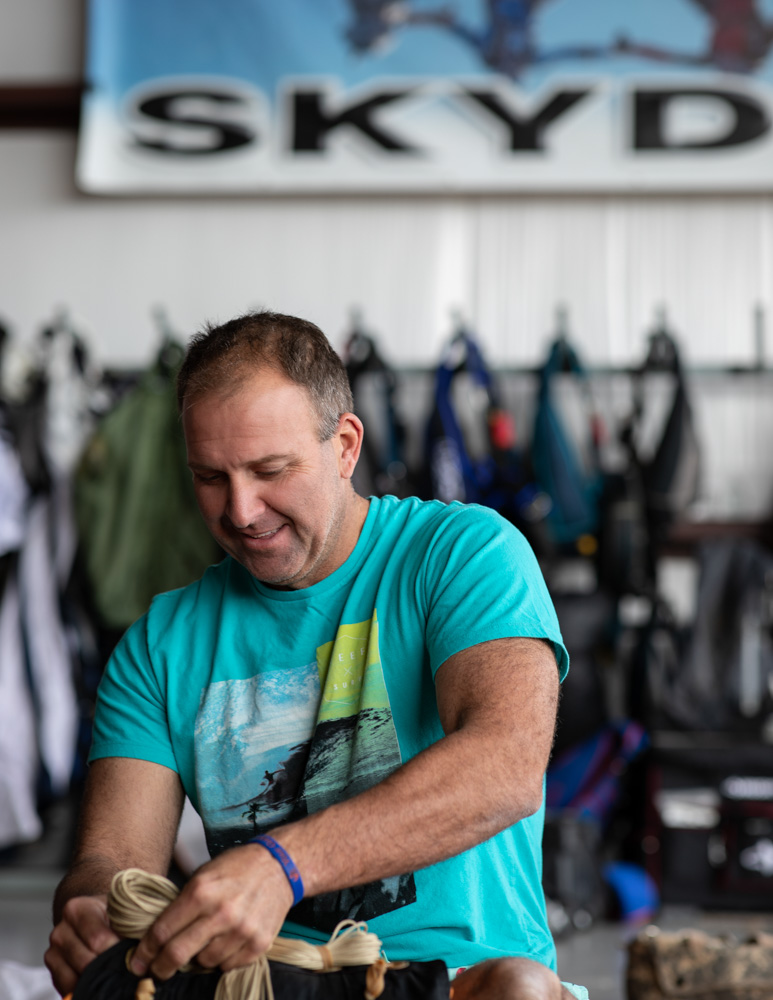
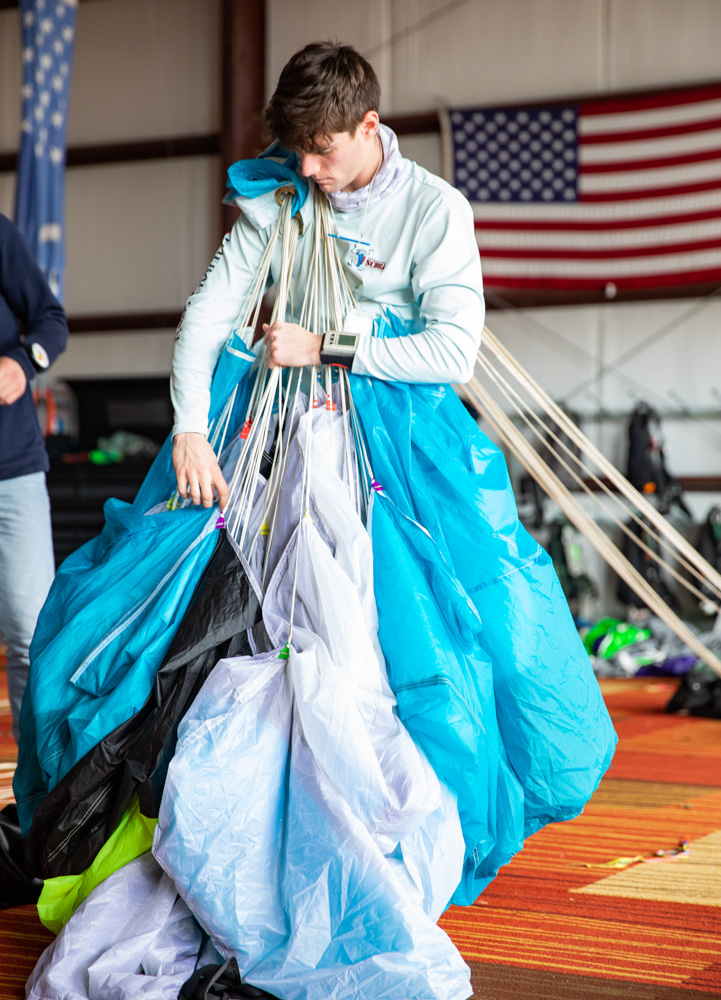
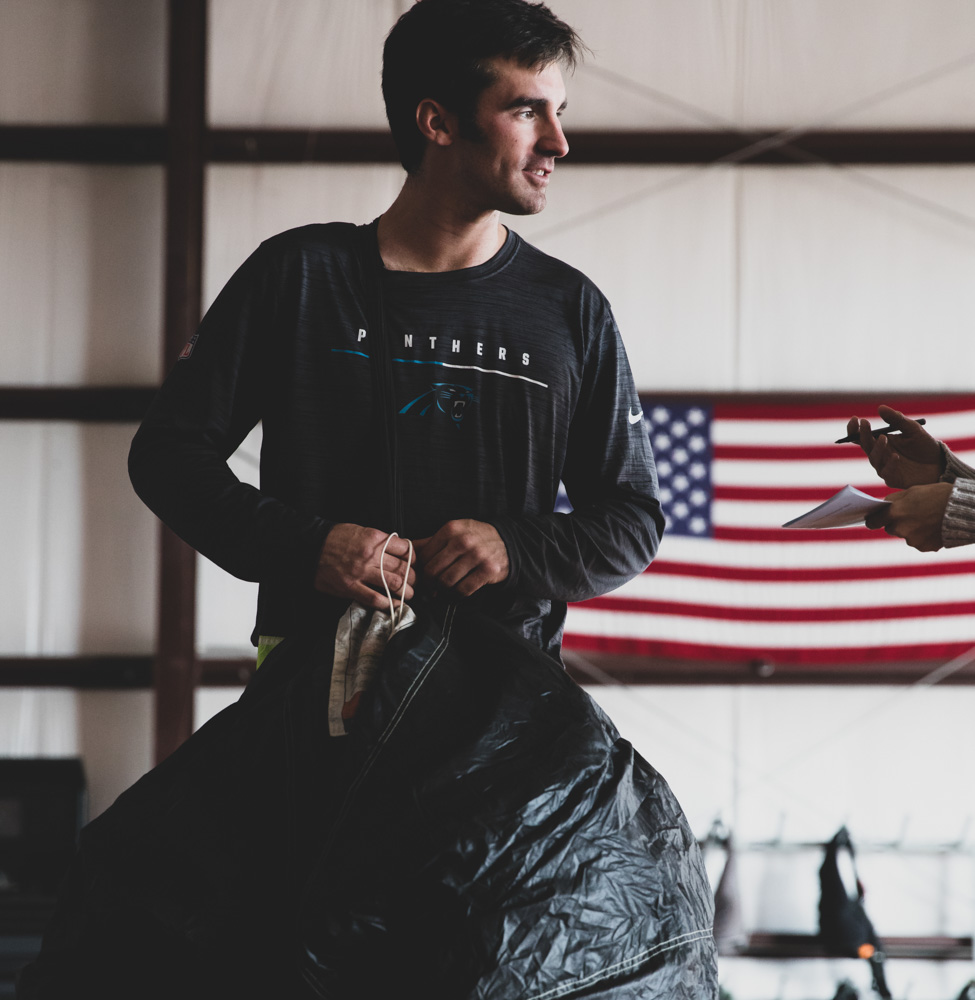
Walking into the open hangar, the atmosphere was a mix of busy and focused, with music playing in the background. Small groups of people had formed, with some of the first-timers clearly stand- ing out with their nervous facial expressions. Several people were fastidiously tending to their gear, crouching on the floor and inspecting the lines and fabric of their canopies laid out on the floor in parallel to one another. I asked one of the instructors, Sean Coots, about the “parachutes.” With a knowing smile, he gently informed me, “In the skydiving community, we don’t actually use the word ‘parachute,’ we use the word ‘canopy.’ So if you say ‘parachute,’ you stick out as a greenhorn.”
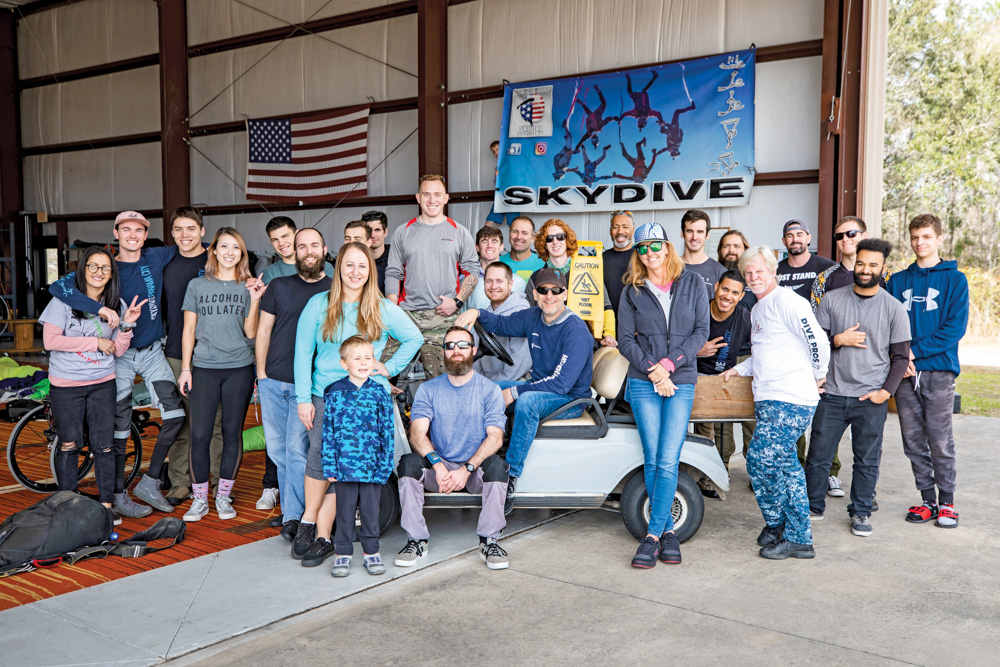
I discovered quickly that the people who associate with Skydive Panama City are a kind and hearty lot, instantly warm and welcoming, a community of people sharing that love and thrill of their sport.
In the hangar, there is a small area with a couch on which to kick back between jumps and a grill out back that serves to provide many a cookout after a long day of jumping from planes. But while it might seem “chill,” I could sense not only a definite concentration through the lighthearted smiles but also a sort of tingle in the air. That palpable excitement in the otherwise calm space.
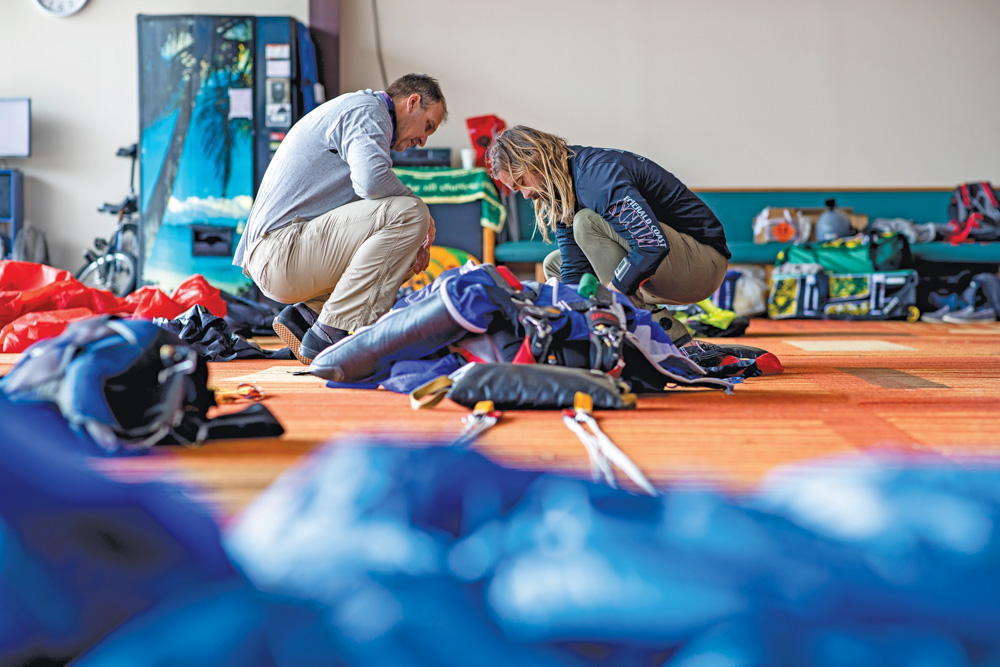
An aspect that became very clear is that everyone in the group of instructors is very comfortable with each other. After all, they jump from airplanes together and solo, side by side, depending on one another to know their own level of training, trusting each other to apply their training to their actions in the air. Safety and training seemed to be the most common thread of importance I discovered as I spoke to each member of what seemed like a large family. That is what they refer to themselves as—family.
There is Judd Buchanan who works in the office, answers the phone, and does most of the scheduling, except when he is freefalling from 14,000 feet. On the weekends, Kayla Robertson, the only female accelerated freefall instructor, works alongside Judd. Kayla is actively enlisted in the military and helps coordinate dozens of jumps. There are those who are there for the one-time thrill and adventure of skydiving, and there are a number of people who are working toward becoming certified AFF (accelerated free fall), solo skydivers.
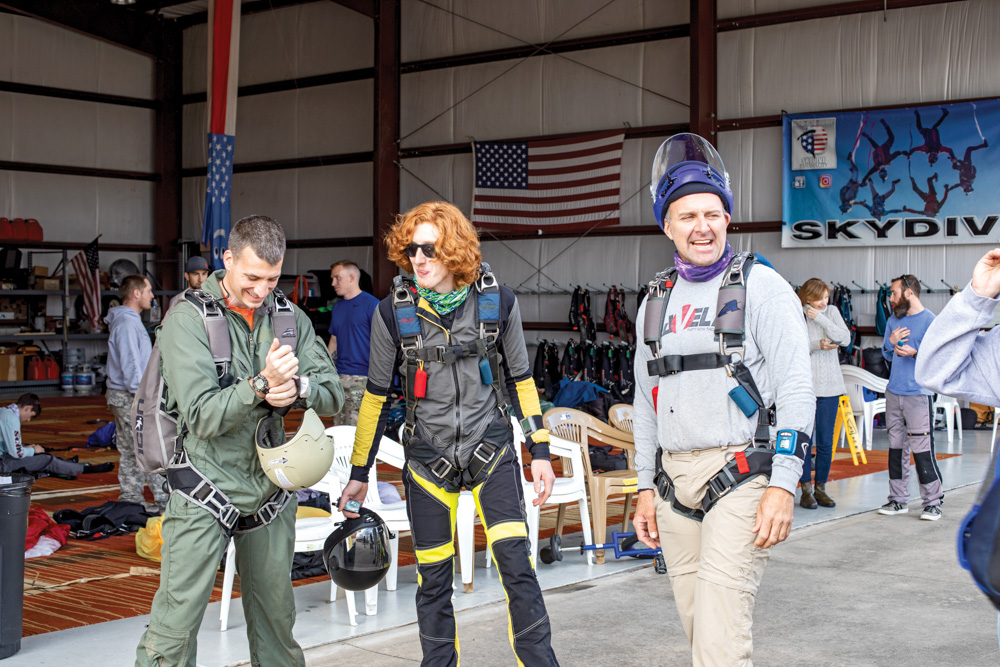
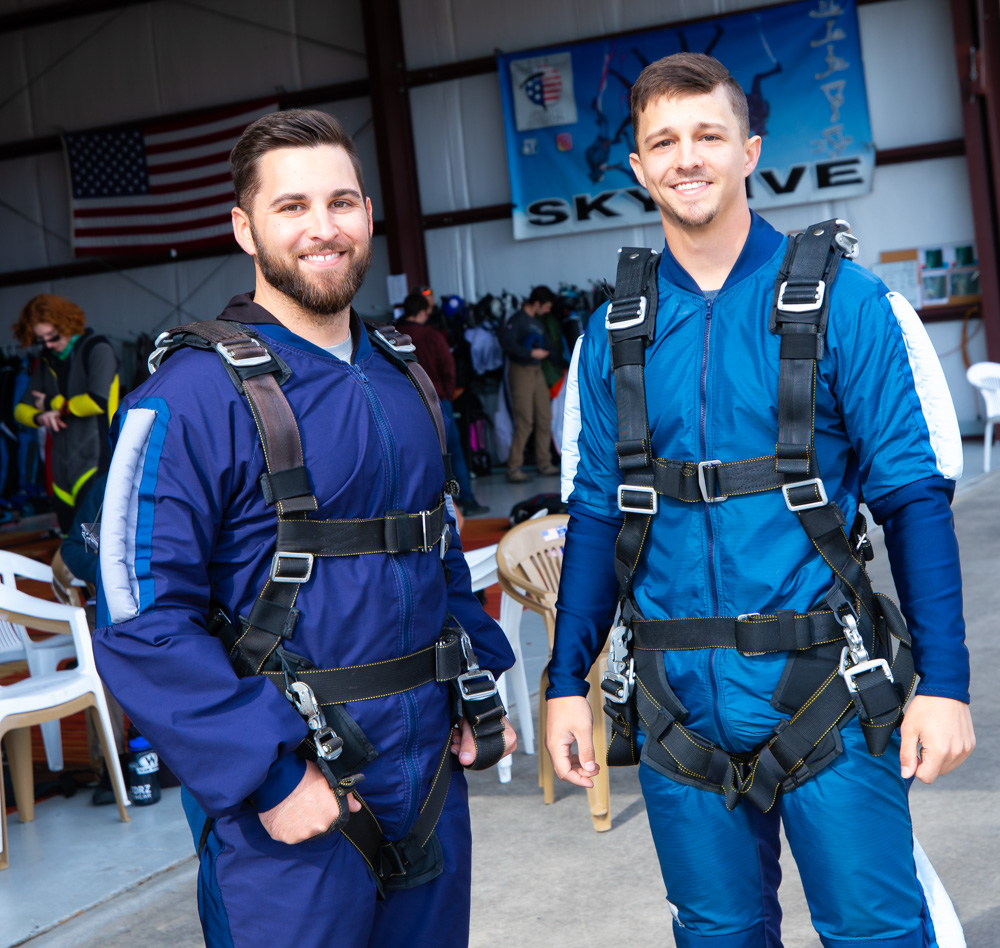
I asked Jen about the reactions she sees from those who are completing their first jump. “Oh gosh, they love it. Ninety-nine percent of the people land and they’re stoked; they’re like “I want to go again!’” As for Jen, she says of her first time, “I was terrified, absolutely terrified.” She and a friend were on a dare. “If you do it, I’ll do it.” She recalls being up in the plane, and that exact moment when she stepped out. “It’s hard to describe … but you go through this range of emotions, and the peak of it [adrenaline] is when you’re in, strapped up, the door opens, the green light comes on. That’s the peak of your anxiety, and after that, it’s just an indescribable thing. Like the second you leave, the second you jump out, all of that goes. As soon as you jump, you’re just doing it, you’re flying! I think at that point your body realizes you’re past the point of no return. There’s nothing you can do now, so enjoy it. It’s just awesome, that freefall….”
At present, skydiving is predominantly a male sport. According to the United States Parachute Association (USPA), the latest statistics show that of their total member organization 87 percent are male, and 13 percent female. Kayla and Jen represent a minority in this sport, but Jen wants women who are thinking of skydiving to know that there’s nothing stopping them. In fact, everyone I encountered at Skydive Panama City was encouraging and hopeful that more women would begin to enjoy the sport. For most, it’s a bucket-list sport. “Some people just say, ‘Hey, let’s go do this,’ then some chicken-out,” Jen says. “But for many, once they do it one time, they just get hooked,” she laughs.
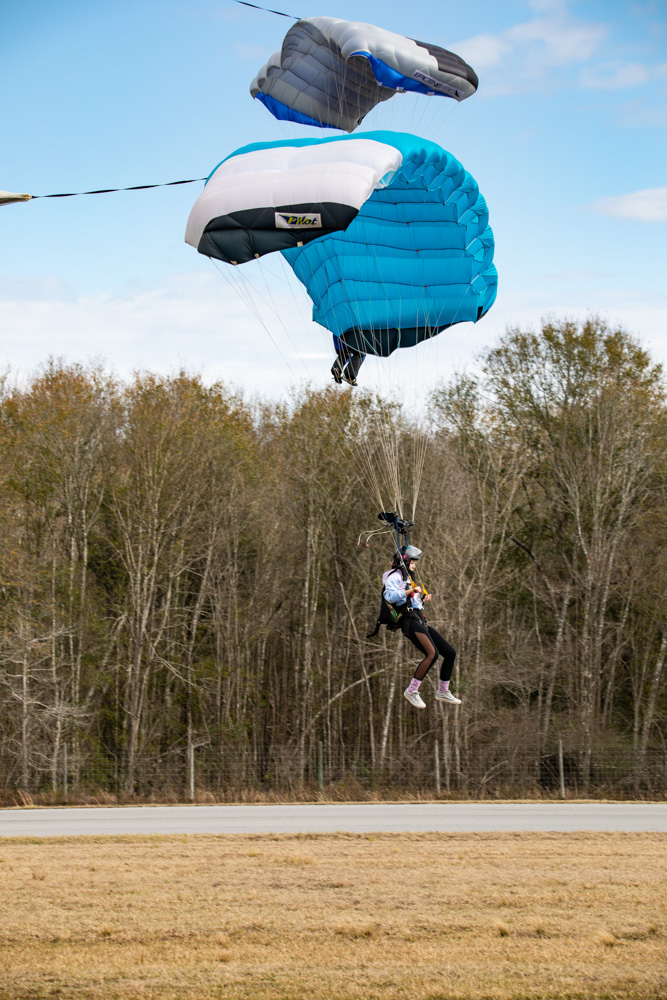
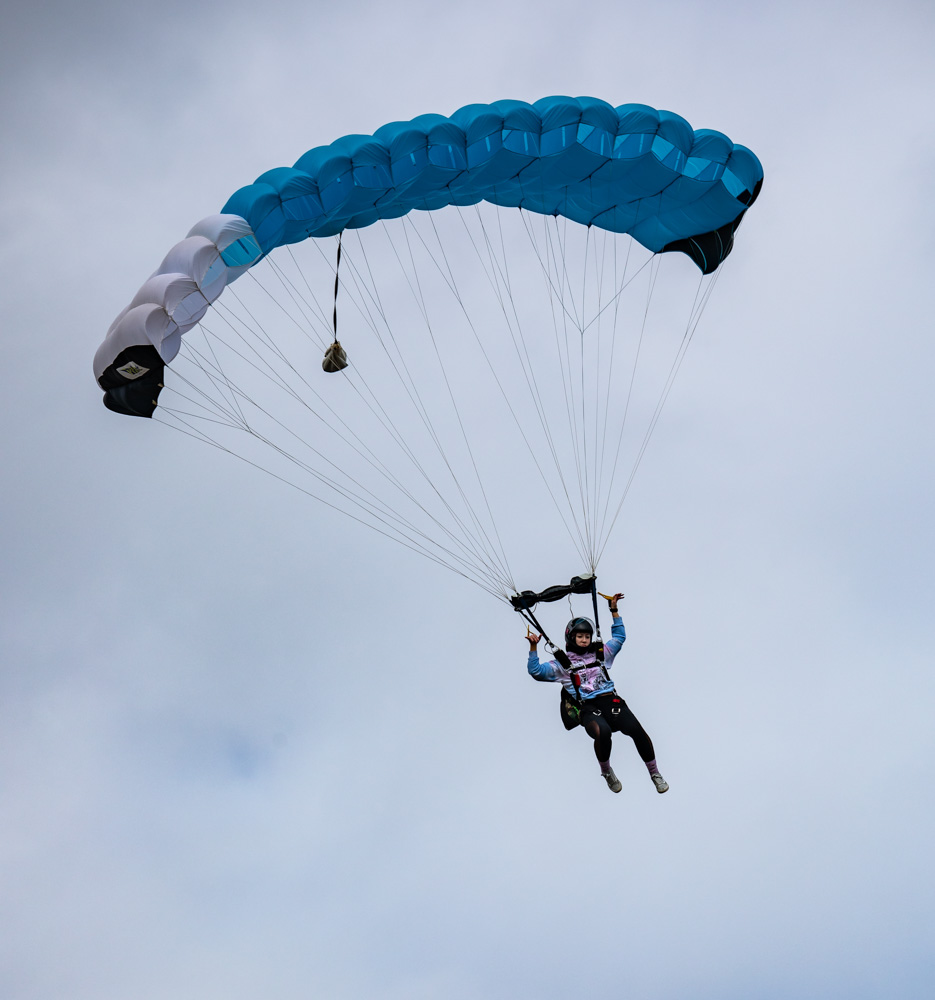

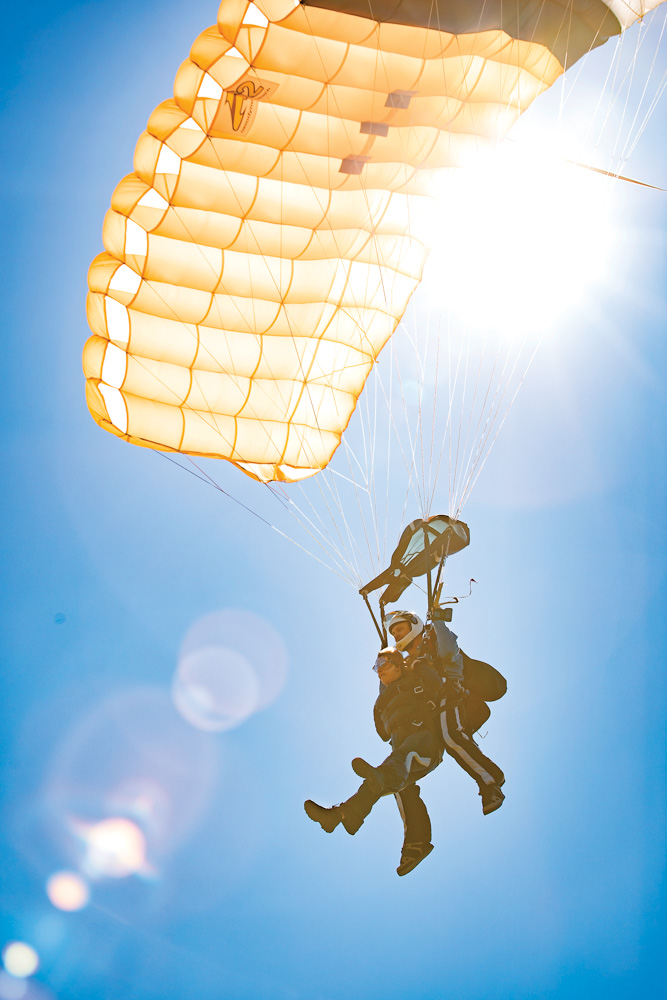
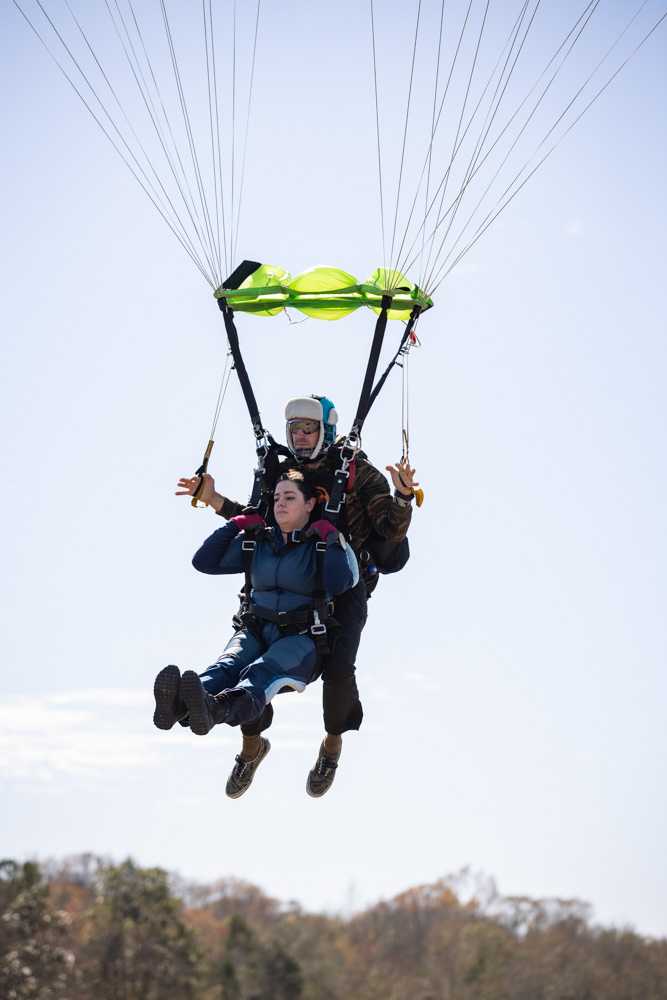
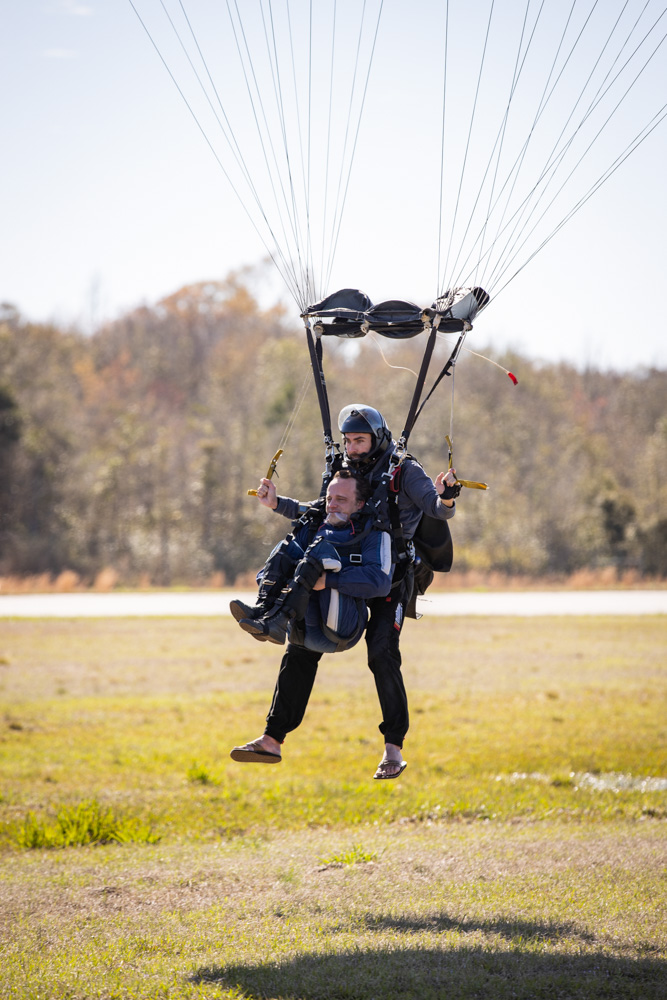
The risk is what creates adrenaline, and the rush comes once you leave the plane. How we need and process adrenaline is unique to each individual. Sean Sylvester, an adjunct professor at the University of West Florida (UWF), and an accelerated freefall instructor at Skydive Panama City enjoys teaching those that want to go beyond jumping tandem. Recalling his first skydive in Alberta, Alabama, almost eight years ago, he says, “You have to realize that fear is a part of it. The way you overcome fear is different for everyone, but I have a more intellectual approach. I want to understand the entire process to get through it, to understand it.” The army veteran professes, “Once you do it, once you are out of the plane in two or three seconds, when your mind realizes, ‘Oh that’s it,’ then you can enjoy it; then it is so exhilarating. All the fear is gone; you’ve already gotten through the hard part. You freefall for 60 seconds. Freefall is fun; under the canopy is quiet and peaceful.”
Jason Dodd is a scuba-diving instructor living on the Emerald Coast who comes to Skydive Panama City, at least twice a month. He loves the adrenaline rush, but like many of his peers, he thinks of it as a release from the stress of everyday life. It’s not only the rush, and the beauty, and the high you feel afterward, but the relaxation that subsequently comes after the day of jumping is done.
During a brief weather hold, a safety halt in operations that can be a factor at any time, I spoke with Youssef, an active duty pilot in the Air Force who is working his way up to a solo skydiving license at Skydive Panama City. Scuba diving was his preferred adrenaline-laden sport until he started skydiving. “I’ve pretty much done it all, and skydiving is the most exciting thing ever, but I’ll always be looking for the next thing,” he said.
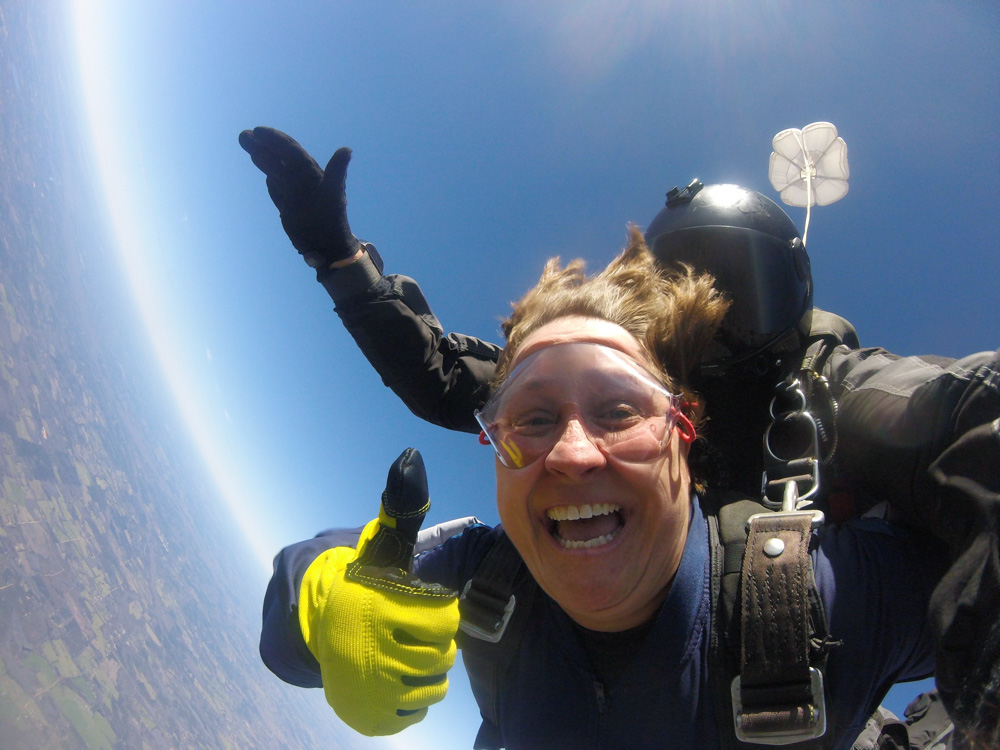
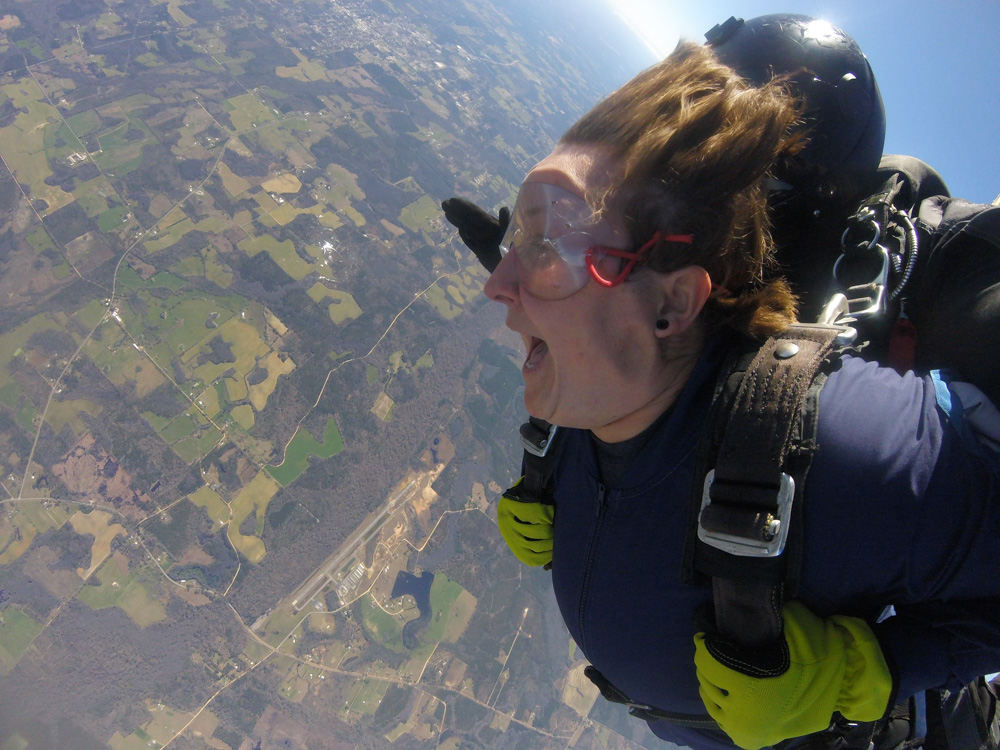
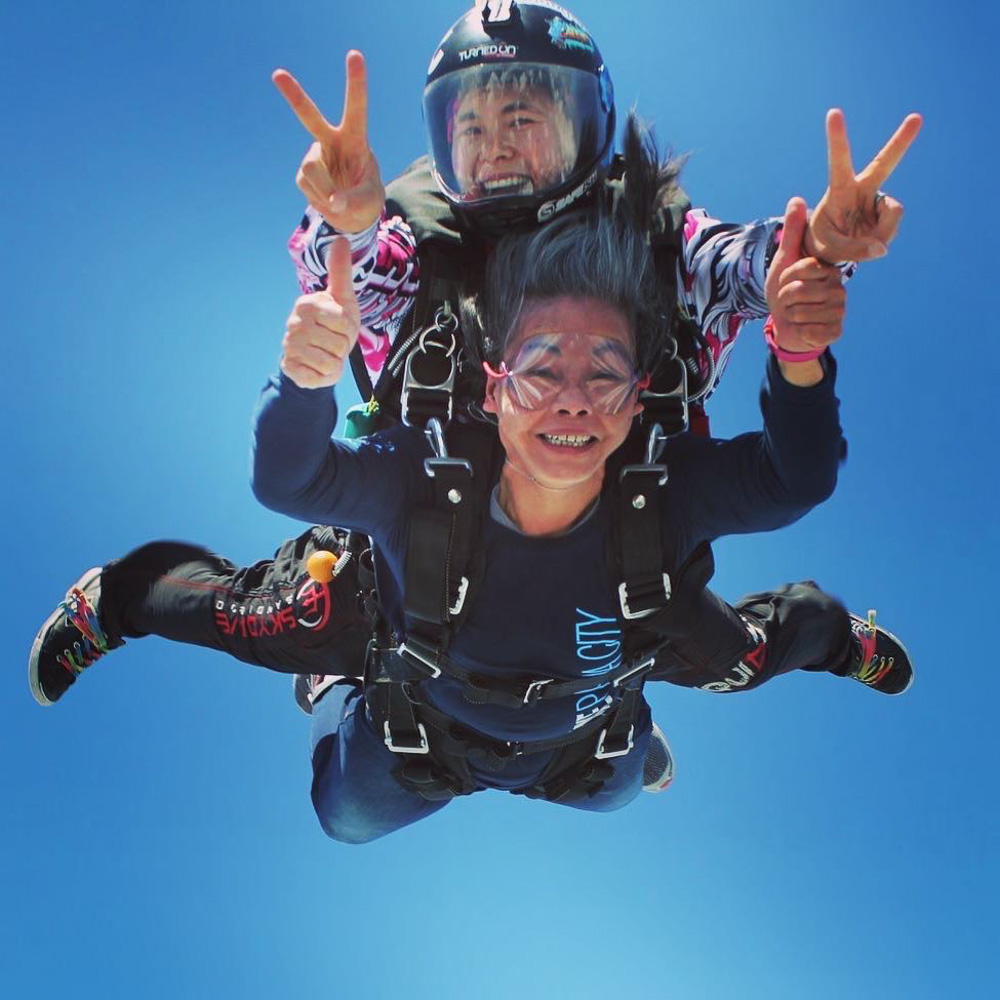
Sean Coots, simply referred to as “Coots,” is a “TI,” a tandem instructor, and his good friend Travis Alexander, an active Army helicopter pilot and instructor, have known each other since 2013. Both are known to push the envelope in the skydiving sport when they solo-jump. Simply talking with these two will speed up one’s heart rate as they describe the more technical aspects of skydiving and the more daring sides of the sport that thrills them. Sean says of his first jump, “It was super awesome … once you get used to it, you enjoy it; it’s just a different sense of enjoyment. I don’t consider myself an adrenaline junkie—I just like an ongoing challenge, and I like to go fast! Here, a hundred and twenty miles per hour is a slow day,” he says with a laugh. With almost 2,300 jumps under his belt, he admits, on rare occasions, something can go wrong that gets his blood moving. He recalls a time, the only time when he had a problem with his canopy and was forced to resort to his backup. Even this he describes as “excitement” rather than adrenaline.
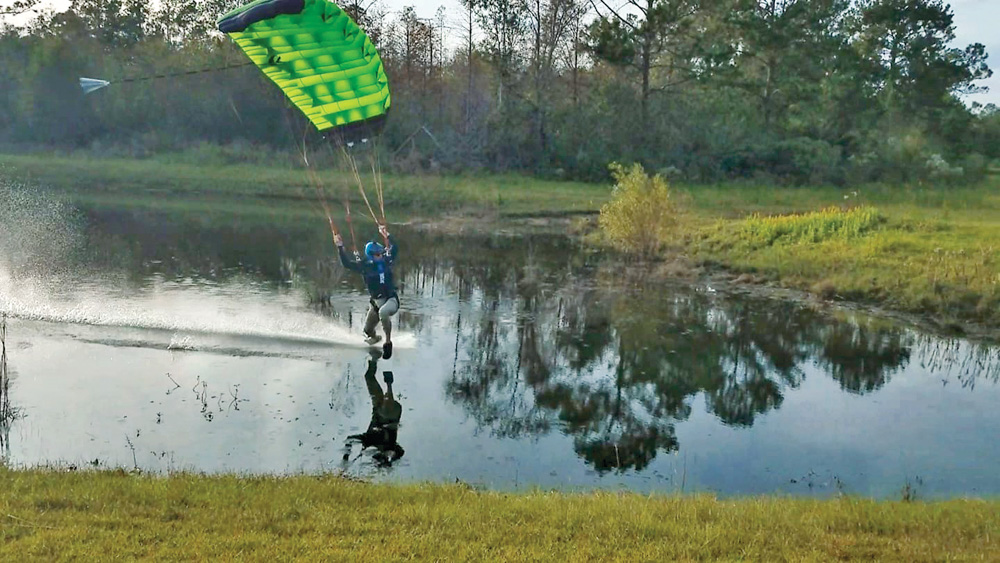
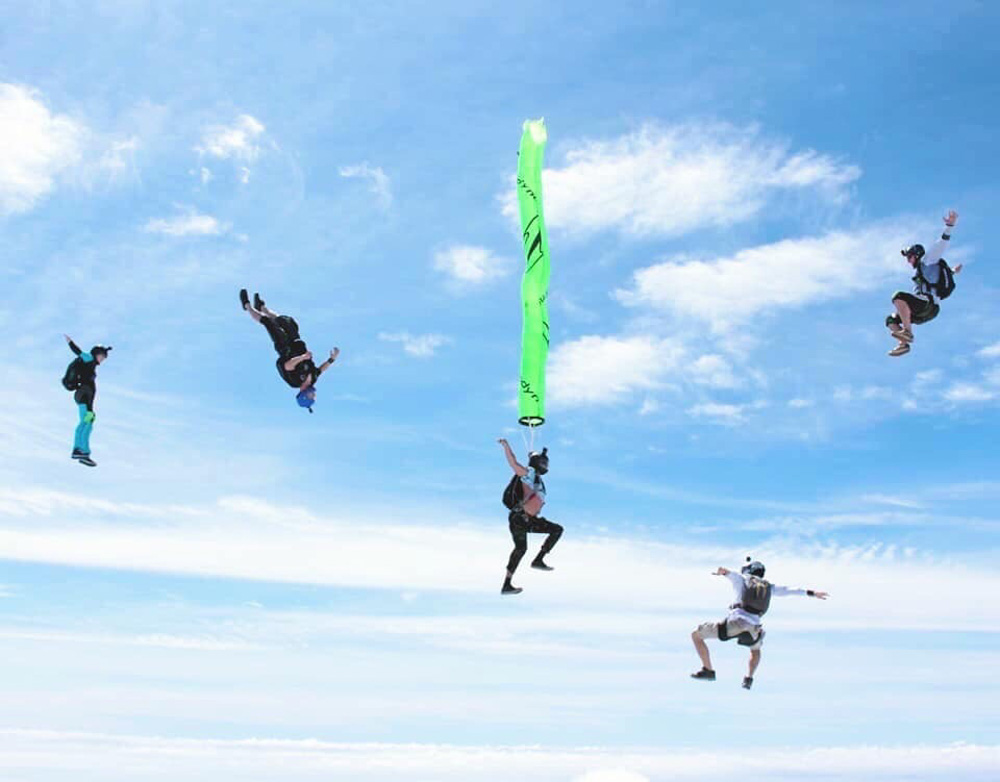
There is skydiving and then there is “swooping,” I learn from Travis and Sean. Swooping is a vein of skydiving in which smaller canopies are used and maneuvered in skillful, radical ways that cause a fast and intense drop in altitude and increase in speed. “The smaller the canopy, the higher the speed,” says Travis, who tells me he has been injured while swooping. In fact, this is where many injuries occur as limits are pushed. Travis goes on to tell me about something called Relative Work, or XRW, when several skydivers coordinate formations while freefalling.
It takes extreme skill and concentration to get to the point of perfectly coordinating each other’s flight and speed to form a conjoined circle or perform other extreme maneuvers. Travis and Sean have impressive footage on their social media pages in which they can be seen joining their skills to achieve stunning tricks at high altitude.
When the day comes to an end at Skydive Panama City, when all tandem flights have been completed, it’s time for the instructors to have fun. The last flight of the day usually carries only the very advanced skydivers, many of them instructors, who show off their swooping skills, try to do relative work, or are suited up in a wingsuit to achieve speeds of up to 160 miles per hour. It’s a fascinating thing to watch.
As my day at Skydive Panama City came to a close, I strolled through the hangar for a few last looks. Some of the folks I did not have a chance to speak to but wanted to mention were busy working or jumping. Sonny Honnen is one of the packers; Liam Alexander is another packer and is in the military as well. And Mike Prindle, also a packer, is a rigger for the DZ. Mike also does all the reserve, repacking, inspection, and maintenance on the gear.
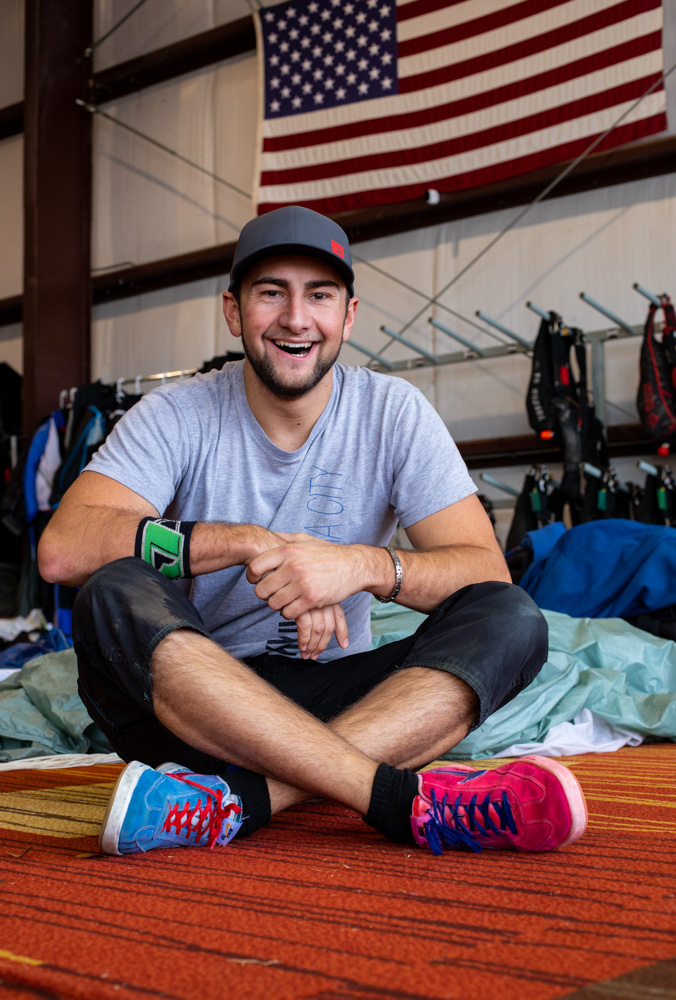
My last encounter of the day was with Austin Crandall, a TI for Skydive Panama City, who wore a big smile and one red shoe and the other blue, which, I found out, speaks of his philosophy of competitive skydiving. Austin took third place in the U.S. Indoor Skydiving Championships for both Freestyle and Dynamics. In 2019, he was a video winner in the Million Dollar GoPro Challenge. Just watching his video footage in the freefly chamber and in the sky is an adrenaline rush in itself. I asked Austin about his shoes. “Oh, the shoes? Well, there’s a comedian I like, his name is Bill Hicks, who did a rant on the difference between love and fear, like the philosophy of it. The red shoe represents fear, and the thought that living a life of fear would make you live negatively and closed off. The blue-colored shoe represents love, respecting one another, living a life being caring and kind.” In my brief time spent with Austin Crandall, the smile never left his face.
[box type=”info” ]For all the adrenaline junkies who have not been skydiving, if you should choose to jump into the blue, it’s my hope that you do it at Skydive Panama City. I found this to be a place of sheer positivity, where negative feelings are chased away by joy, and there is mutual admiration and encouragement all around. If you get a little nervous when you start to feel the adrenaline build, you can ask owner/operator Tony, who I’m told has upwards of 8,000 jumps behind him, and he’ll tell you his crew has your back. When you’re falling from an altitude of anywhere between 14,000 to 8,000 feet at average speeds between 120 to 130 miles per hour you want to know that you are in good hands, adrenaline junkie or not. Statistics show your chances are much better than average that you will go home with a smile. Find out more about Skydive Panama City at xtremeskydivers.com If you would like to know more about the sport of skydiving please visit uspa.org[/box]