
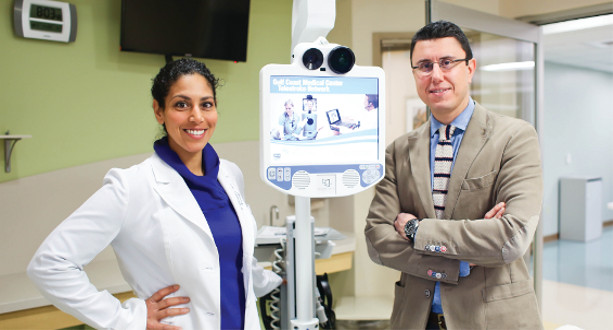
Innovation in Healthcare – Telemedicine


Telemedicine helps Bay County Neurologists provide fast care for stroke patients – remotely
Providing fast diagnosis is the one most critical factor in saving a stroke patient’s life. There are two types of stroke, hemorrhagic (injury due to bleeding) and ischemic (injury is due to a blood clot) and the treatment for each is significantly different. The drug administered for ischemic stroke, tPA (tissue plasminogen activator) can literally stop the stroke in its tracks by dissolving the offending blood clot that is causing the problem. In addition to the obvious advantage of foiling death, it also prevents the devastating and crippling impairments that many stroke-survivors experience. But tPA can be deadly if administered to a hemorrhagic stroke patient. Since tPA dissolves blood clots, it is likened to “throwing gasoline on a fire” for patients with hemorrhagic stroke.

Fast examination by a neurologist is crucial and Gulf Coast Regional Medical Center has made an investment into cutting edge technology to cut down travel time significantly by giving neurologists remote access to stroke patients – this also means that local neurologists will be on-call and ready to go online and treat a patient remotely by carrying a laptop or other wireless device with them at all times.
Local neurologist Dr. Achraf Makki explains, “The involvement of a neurologist in determining what type of stroke has occurred avoids a potentially reckless decision and an examination needs to occur fast. Time is brain tissue.”
Telemedicine is the term that is used to describe the use of telecommunications technology to allow physicians and other healthcare practitioners to access, examine, evaluate, diagnose and treat patients and improve a patient’s clinical health status with medical information exchanged from one site to another via electronic communications. Telemedicine used to improve a patient’s clinical health status.
Using Gulf Coast Regional Medical Center’s Telemedicine system saves a full hour and delivers a window of opportunity to treat the patient with tPA, and stop the damage to the brain sooner. Some patients treated early enough with tPA not only survive but show little evidence that they have ever suffered a stroke. The use of telemedicine is cost- saving as well with the elimination of emergency transport and reduced overall healthcare costs.
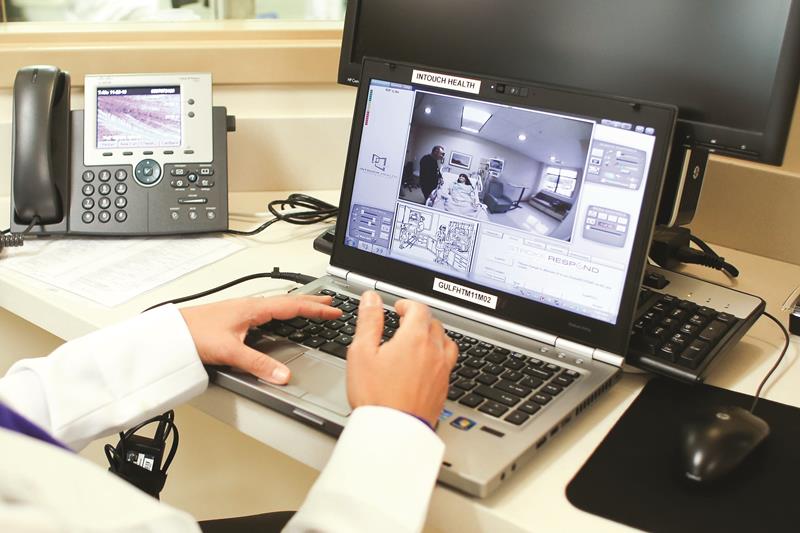
Gulf Coast Regional Medical Center has adopted this new innovation in medicine through their “hub-and-spoke’ Telemedicine system. In partnership with FDA approved InTouch Health, GCRMC will facilitate 24/7 stroke care in the outlying hospitals. InTouch Health currently provides 60% of the TeleStroke networks in the nation. GCRMC’s Andy Long, BSN coordinates the program for the hospital with the medical supervision provided by neurologists Dr. Hoda Elzawahry, MD and Dr. Achraf Makki, MD. The program at Gulf Coast is patterned after the hub-and-spoke system pioneered by The Medical College of Georgia at Augusta.
Here is how it works according to Dr. Elzawahry, “there will be a robot in the emergency rooms of the smaller hospitals in our Northwest Florida region. These robots will be our eyes and ears and link to us through satellite connection to our computers. We will be able to both see and speak with the patient.” With Gulf Coast Medical Center representing the “hub,” there will be spokes to 16 area hospitals. Most of these hospitals do not have a neurologist.”
This collaboration between Gulf Coast Medical Center and the rural hospitals is crucial as the Florida Department of Health reports 217 deaths by stroke in Bay and the five surrounding rural counties in 2012. The establishment of a telemedicine system is costly with the necessary robotic equipment, technical support, training, and HIPAA compliant secure network system. The Florida Legislature has been a leader in recognizing telemedicine and passing laws to compel insurers to cover its usage. Early support from the legislature is important as telemedicine may prove to have uses beyond stroke diagnosis for residents in rural areas.
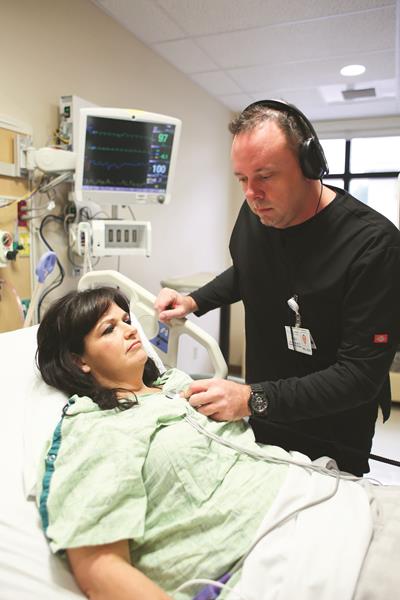 Stroke is a leading cause of death in the U.S. and according to the CDC, Florida was one of the first states to legislate certified stroke treatment centers. While there are two Primary Stroke Centers in Bay County, the county is surrounded by five of the thirty rural Florida counties as identified by the Florida Department of Health. Until recently, patients living in rural counties would arrive at their local hospital and lose precious time during transport to a Primary Stroke Center where the neurological staff could diagnose and begin treatment.
The advantage for the “spoke’ hospitals is that they can retain their patient when possible. In those cases, the families of the patient also benefit in avoiding long commutes to see their loved ones. The spoke hospitals can run all appropriate tests including the CAT scan and these tests can be read remotely by neurologists based in Panama City so that the best decision can be made for the patient.Dr. Makki warns that there are some conditions, such as severe hypoglycemia that can mimic a stroke that need to be ruled out. The entire process focuses on making the best informed decision for the patient.
For stroke, time-saving equals lifesaving. In times past, a stroke patient in Bonifay, for example, would have to be transferred by ambulance to Panama City, a distance of 49-miles and an expected travel time of one-hour. Time and distance becomes so important because for each minute that a blood clot stops the flow of blood to the brain, brain cells die. Strokes evolve over time – it is not a single event, but an evolving event. The period from the death of the first brain cells and the death of the last brain cells may be as brief as three hours or in favorable cases, up to four-and- one-half hours. Any factor that delays a patient’s treatment increases the patient’s risk of death.
The “virtual presence” of the doctor at the patient’s bedside albeit remote can save lives and avoid devastating outcomes. Dr. Elzawahry recounted that in one instance she treated a patient while she was shopping at Publix supermarket. She can see and hear the patient in real-time and consult with the local Emergency Room doctor. Dr. Elzawahry states “The patient is just as close as my iPad.”
By Dr. Dan Finley and Connie Head, Photography by: Savannah Jane Photography