
Highly trained dogs


Several people approach Peggy Wilson even before she steps through the doors of Gulf Coast Medical Center – not to talk to her but to swoon over her four legged companion, her dog Frosty.
Peggy Wilson with her big smile and bright blue eyes, and with a very likeable personality, looks on as strangers pet Frosty’s head. The 9-year-old rescued female golden retriever gets all the attention.
Wilson and Frosty visit patients every Thursday evening at the hospital as part of a small team of volunteers with the SPOT program (Special Pets Offer Tender Loving Care).
“There’s nothing more energizing than bringing smiles to people and making children happy most of all,” she said. “Sometimes patients will open up more to the dog than they will to a person.”
The positive affect an animal can have on a patient’s well-being keeps the SPOT program alive. That and the dedication of its human and canine volunteers, said Julie Lemasters, volunteer coordinator at GCMC.
“These pets provide pain relief to patients and visitors,” she said.
Studies prove that pet therapy often provides “wonderful healing powers” and can indeed lower blood pressure and cholesterol levels and improve the overall psychological well-being of patients, Lemasters said.
“Peggy was one of the first members of our SPOT team,” Lemasters points out. “She is entirely dedicated to the program and a true asset to the having this program Peggy does.”
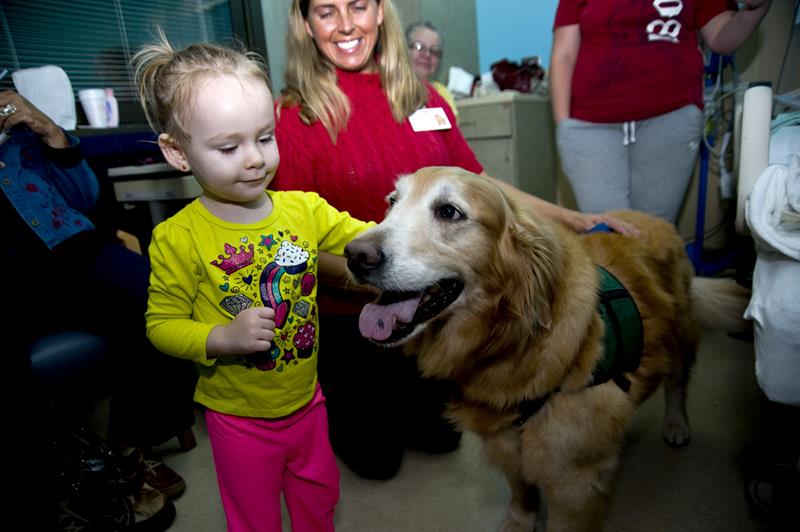 It can be magical to watch as the science becomes reality when Wilson and Frosty enter the room of a patient as witnessed with 2-year-old Aurora Slinger. Aurora jumps out of bed after waking from a nap. Before long the child is all over the dog giving her hugs and kisses. She lifts her head back as Frosty returns the kiss one big lick at a time.
The child had already been in the hospital for nearly six weeks, first in Pensacola and then Panama City. Her mother, Tara Slinger, said it’s been difficult on everyone.
“Life’s not normal yet but it’s getting there,” she said as she watched her little girl giggle and squeal with absolute delight. “This is so nice. It’s been really hard on all of us. She has really been missing our dogs at home.”
Working with children can be especially rewarding for Wilson.
“Patients tend to open up more to the dogs than anyone else, and it’s worth it if we can make them happy for one moment,” Wilson said. “But it’s even more important when we can make children happy.”
The next stop was with patient Carl Beasley and his wife, Karie Beasley. Frosty greeted Carl with her front pawwho seemed to light up the most. “We had a dog just like this one but we had to put her down this year,” she said choking back tears. “I love it. I think it’s awesome, we’re both dog lovers.”
She said if she were the patient she would allow Frosty in bed with her.
Wilson takes Frosty to visit patients at GCMC, Covenant Hospice or nursing homes. “In some cases we don’t know how much longer someone will be with us, but the dogs can sense that,” she said.
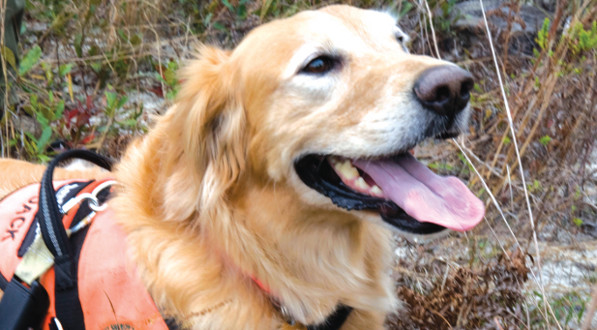
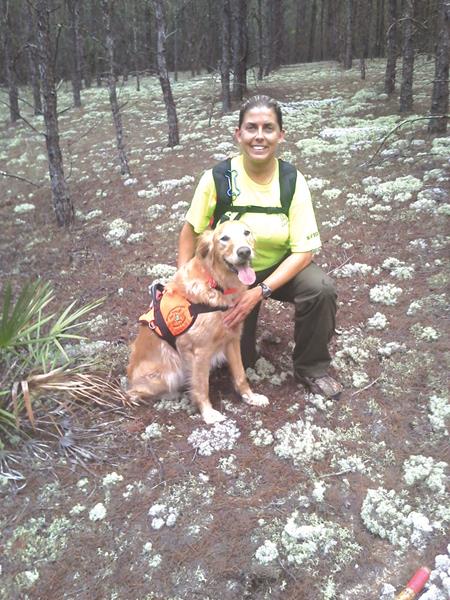
Her other dog, 8-year-old Jack, another rescued golden retriever, is certified for search and rescue missions for the Bay County Sheriff’s Office.
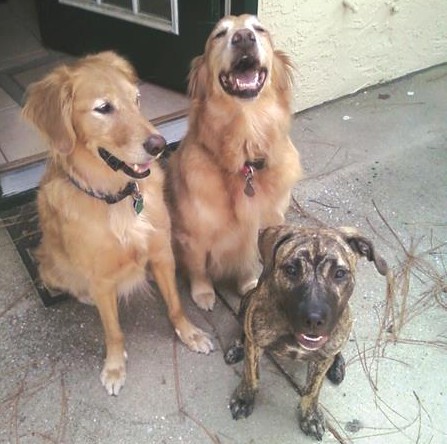
At age 39, Wilson maintains a full schedule working, running in 5-13 k races and volunteering with her dogs at the hospital, Covenant Hospice and the BCSO and participating with her retrievers and Cali, her 3-year-old pit-bull mix, also a rescue, in various agility and flyball competitions. Jack and Cali have reached champion levels.
Wilson has been a resident of Panama City since the 1980’s having moved here with her parents as a teenager from her native Spokane, Washington. She has worked her way up and since 2006 she is the practice Manager at Breeze Animal Hospital in Panama City Beach.
She serves on several boards: Humane Society of Bay County, Greater Panama City Dog Fanciers Club, PAWS (Pets Are Working Saints) and is a member in good standing of the Pet Partners, formerly Delta Society. All three of her dogs have earned the American Kennel Association’s Good Canine Citizen ranking.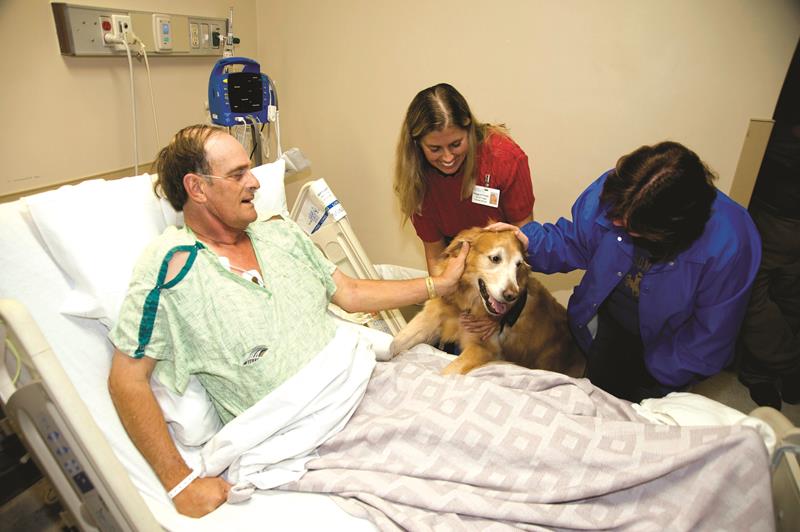
Volunteering has become a way of life for Wilson and her dogs.
Whether working inside with people or outside in a rugged environment, training remains an important part of the equation for the dogs to participate, especially for a K-9 search and rescue team, which can be quite rigorous.
“We started in 2004 and all our volunteers are well trained and highly dedicated,” said Lt. Jack Balch with the BCSO.
There are about 35 volunteers on call who may assist in search and rescue operations, but only about seven who work with their dogs, Balch added. It takes a special kind of person to volunteer, especially with the BCSO search team.
“It doesn’t matter whether it’s 3 a.m. or 3 p.m. I have people who will come out and do what they can,” Balch said. “They might end up tangled in briars or hike through mud. It doesn’t matter. It’s all about the return of a missing person or finding answers to give a family the satisfaction of knowing their loved ones have been found.”
Volunteers can save county resources as well.
“Our search and rescue volunteers relieve our deputies and investigators so they can continue with their normal duties while we conduct the search, which could tie up our people for a long time,” he said. “A search could be for just about anything, a live person or a cadaver, trace evidence from someone who is missing or evidence used to commit a crime.”
Wilson and Jack specialize in live searches.
“She is as good as anyone I have,” Balch said about Wilson. “She goes whenever she can and always responds.” Her partner in the searches rates highly too.
“Jack is an expert in live finds,” he said. “He’s so good no one can hide from him.”
Training can be the key to any successful volunteer partnership with a dog. To visit hospitals, nursing homes, hospices and rehabilitation centers, therapy dogs must be certified by Pet Partners, formerly the Delta Society. The nationally-recognized nonprofit organization specializes in setting standards of performance and character and conducts testing to certify that all service dogs working within a community meet those requirements. Testing takes place in Fort Walton Beach.
“My dogs certainly keep me busy that’s for sure, but I love it,” Wilson said. “One thing both my parents (deceased) instilled in me growing up was to always help others and I love that I can incorporate my dogs with that.”
By Diane Mercado Photograpy by Sarah Shipes / Shipes Photography