
GONE BUT NOT FORGOTTEN: Shipwrecks on Dog Island


BY LAURA ROESCH AND JACKIE KOLK
PHOTOGRAPHY BY ANDREW SMITH AND CAPT. TERRY MARTIN
HISTORIC PHOTOGRAPHS COURTESY OF THE STATE LIBRARY & ARCHIVES OF FLORIDA
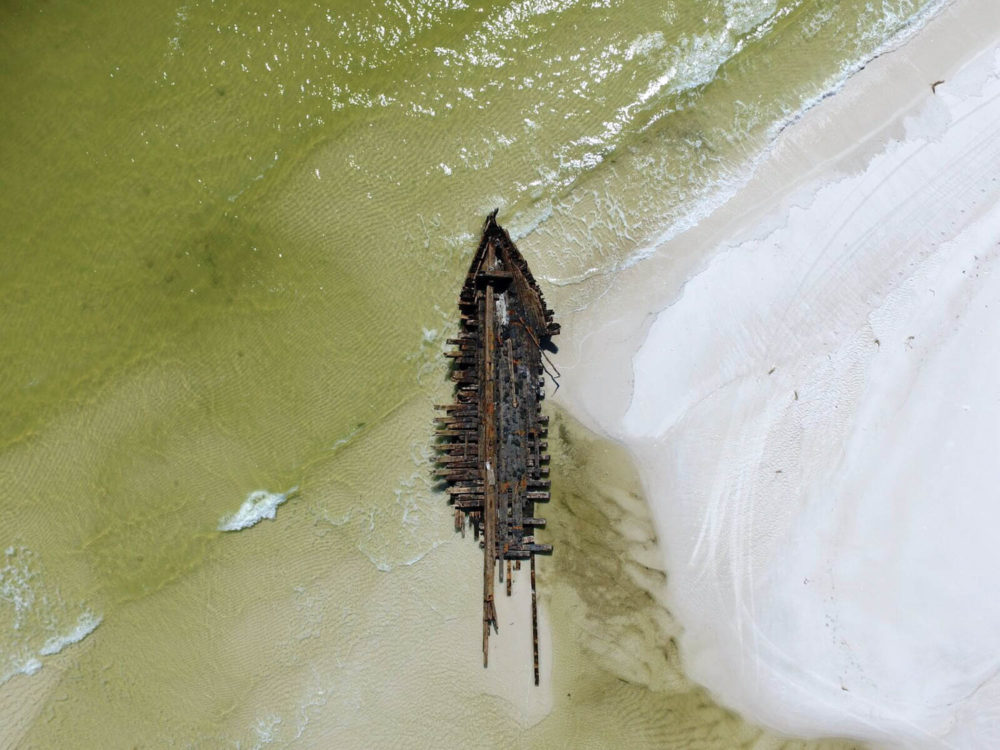
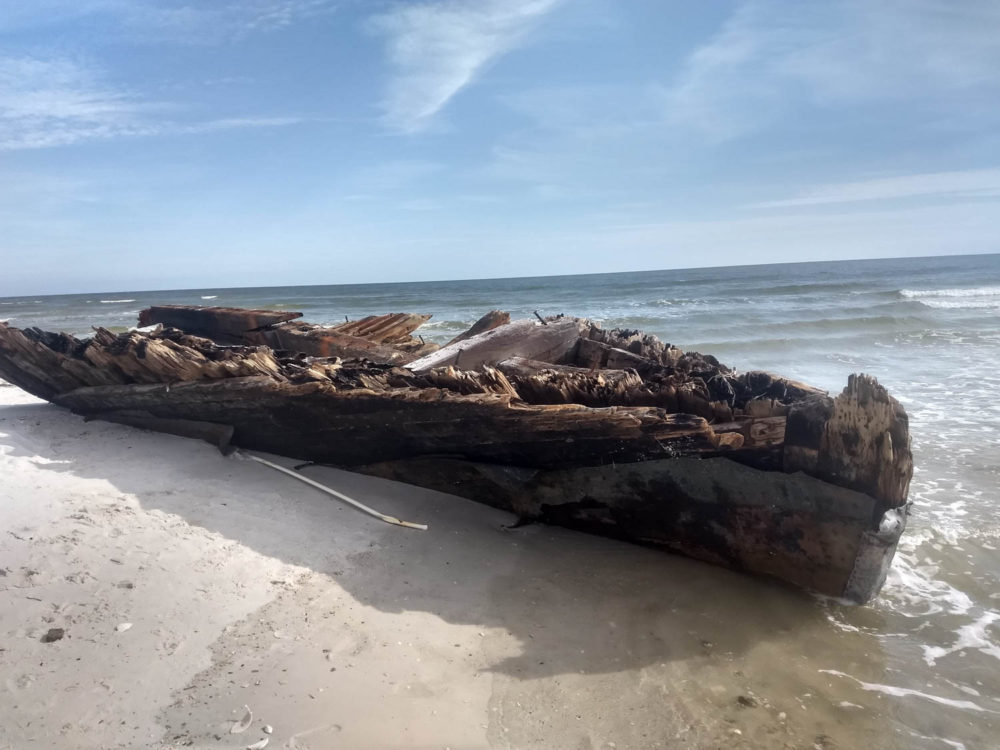
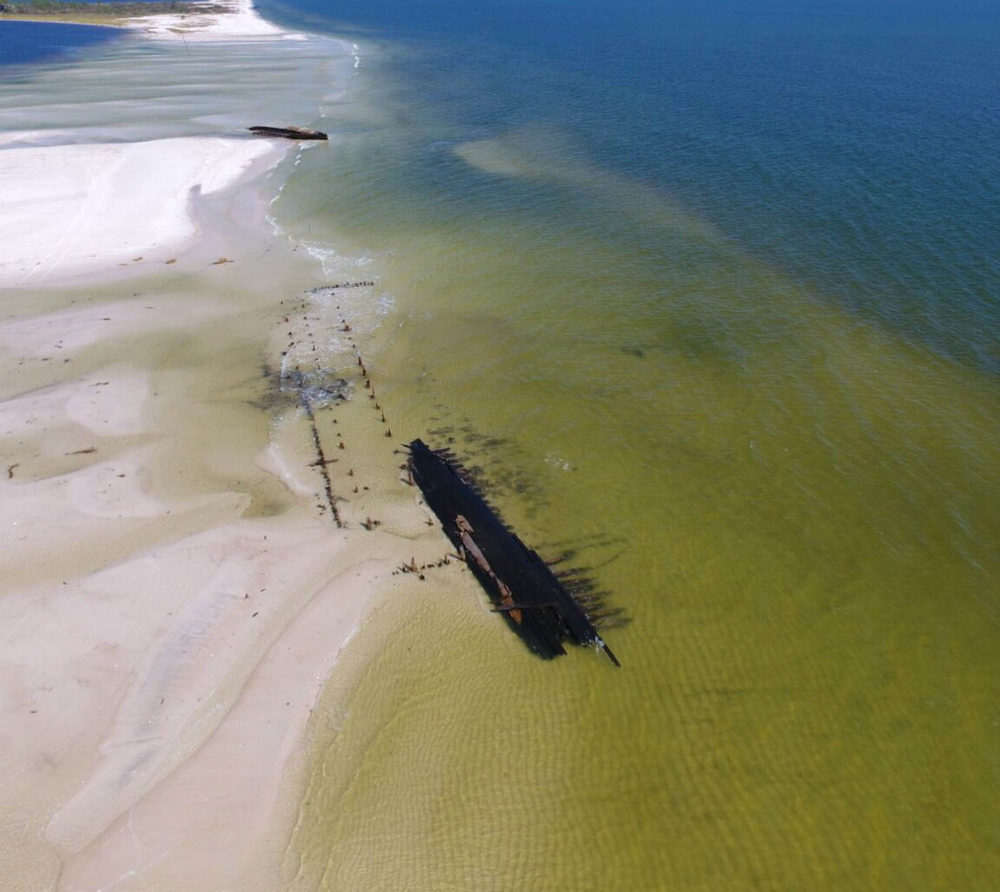
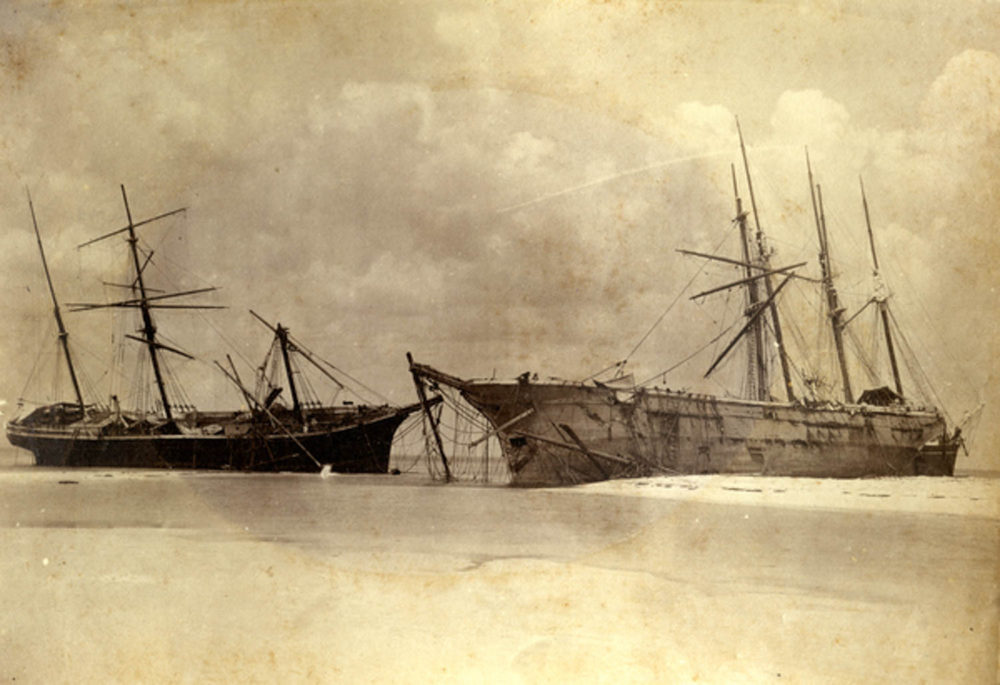
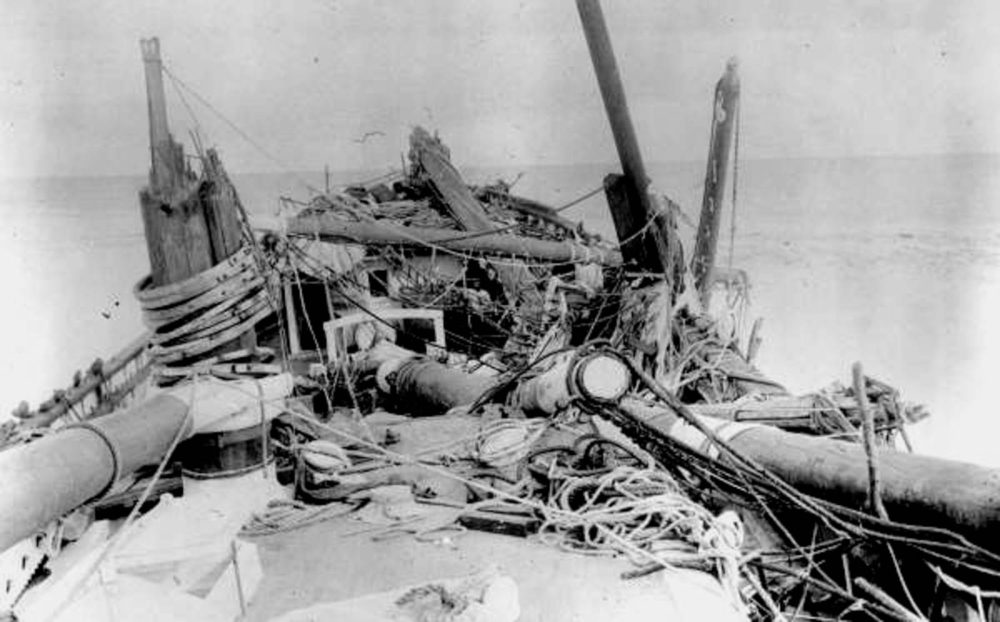
Dog Island, a stretch of land with enchanting wilderness and miles of secluded beaches, found its peace and quiet harshly interrupted in the fall of 2018 when Hurricane Michael roared ashore, leaving a wide swath of destruction in its wake. With its fierce energy, one of the surprising effects of the storm was the exposure of the remains of two ships long buried in the sand on the island’s Gulf side. Protruding from the sand, the wooden remnants caused much excitement and sparked interest in the origin and history of the many ships that met their demise in the northern Gulf, with the first shipwreck
 Dog Island lies well beyond the beaten path; in fact, it is only accessible by boat or aircraft. The barrier island has remained one of Northwest Florida’s best-kept secrets for nature enthusiasts, fishermen, and visitors. But just 120 years ago, large ships frequently came and left the island’s secure anchorages, with its close proximity to the bustling port of Carrabelle.
The origin of Dog Island’s name remains a matter of speculation. It could have been an attribution of its shape, like a sleeping dog; or the assumption that at one time wild dogs were its only inhabitants. Some say sailors, nicknamed “dogs,” were dropped off on the island, preventing them from running off while their ship was in port. Ships’ crews often consisted of unwilling and involuntary sailors in those days.
Although Dog Island is well north of the trade routes that the Spanish Empire had established from 1566 to 1790, it is possible that Spanish galleons navigating between Mexico and Havana made landfall on Dog Island. The island’s fresh water sources and secure anchorages would have been valuable to vessels blown off-course or riding out dangerous weather.
 Just 7 miles long and three-quarters of a mile wide, Dog Island is sparsely inhabited today. With a few homes and an airfield, it looks almost desolate at its widest point—or tranquil, depending on your point of view.
The moniker Forgotten Coast takes on a new meaning once you learn that more than 100 shipwrecks have been documented and lie hidden beneath the blue-green waters of this stretch of Northwest Florida’s coast. Thanks to the fine work of the State of Florida’s Bureau of Archaeological Research and Florida State University’s underwater archaeology program that is charged with locating, protecting, and preserving archaeological sites on submerged lands, extensive historical and archaeological information is available on these shipwrecks and many others. Of the approximately 18,000 square miles of submerged lands that fall within the bureau’s research area in Florida, less than 1 percent have been surveyed for historical and archaeological value.
One of the researchers, Chuck Meide, was a 20-something graduate student of underwater archeology in Florida State University’s anthropology department when he and a team of colleagues conducted an extensive underwater survey, producing 252 pages of documentation published as the “Dog Island Shipwreck Survey 1999: Report of Historical and Archaeological Investigations.” In the 20 years following the survey, Meide has devoted his career to underwater archeology projects around the globe. He is the director of the Lighthouse Archeological Maritime Program, the research arm of the St. Augustine Lighthouse Maritime Museum.
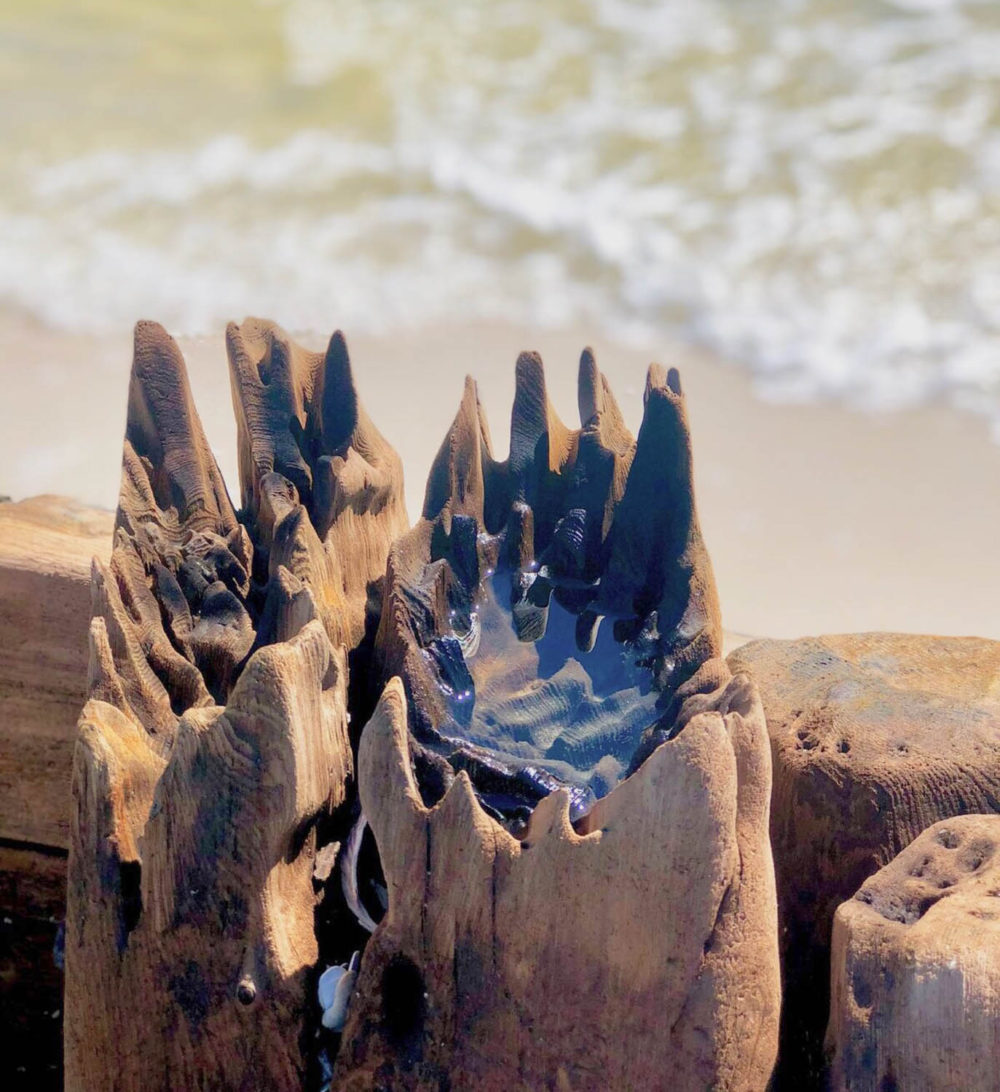
“The question of whether a shipwreck is historically significant is always interesting,” Meide says. “There were no great battles fought in the Dog Island area, but people lived their lives and these ships were part of the day-to-day life in that region. The 1899 hurricane happened to wreck an increased number of ships that normally would not have been shipwrecked there all at one time; that’s an interesting phenomenon.” Researchers and visitors are presented with a number of ships in relatively shallow water around Dog Island. Meide remains fascinated. “These majestic hulks of timber are amazing to look at, whether in old photos or when their massive wooden carcasses are revealed on a desolate beach … it is really something that captures our imagination and gives us great insight into the past that we would not have had otherwise.”
The survey report from 1999 offers a comprehensive account of the search, investigation, and documentation of the area. It involved extensive archival research in Florida, England, and Norway, and confirmed the names of 118 ships and their cargo that were lost in the waters surrounding Dog Island.
Ivor Mollema, senior archeologist with the bureau, notes that although the number of ships documented may seem high, he explains that “a higher concentration is usually found around port areas, and Carrabelle was a thriving port in its day.”
An unusually large number of vessels were lost in one single event on August 1, 1899, when an unnamed hurricane slammed ashore and left the bustling seaport at Carrabelle devastated. Five days after the storm’s landfall, an article in the Daily Times-Enterprise of Thomasville, Georgia, describes the event with the following words: “…most disastrous cyclone that ever visited this section of Florida … completely annihilated Carrabelle, only 9 houses remain, 200 families without homes or shelter … 30 miles of the Carrabelle Railway washed away and a passenger train blown from the tracks, injuring many passengers.”
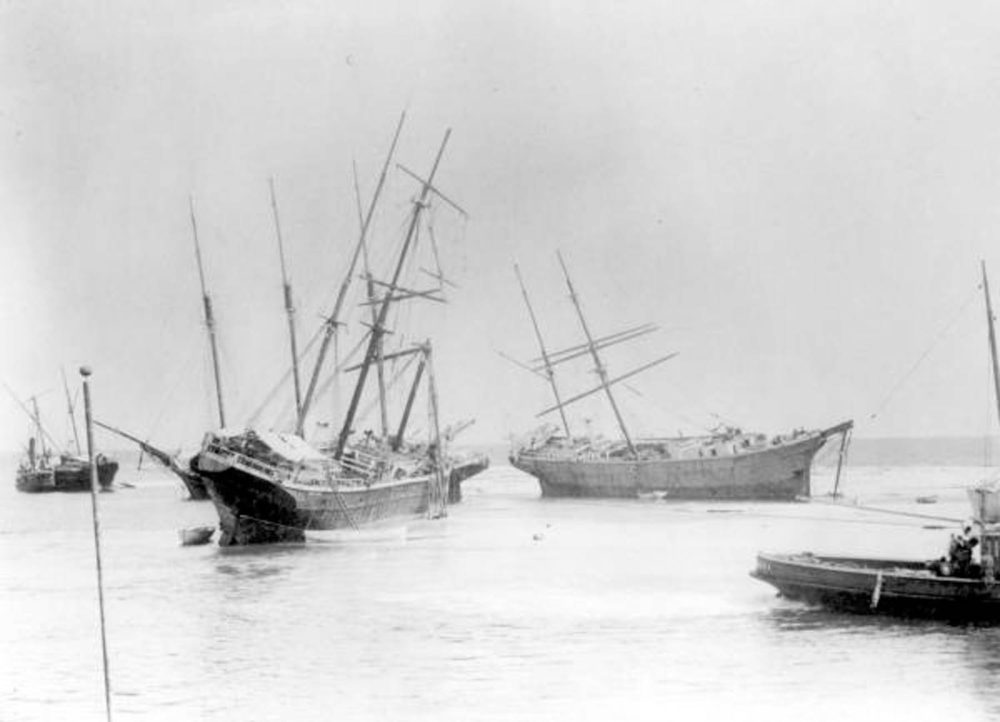
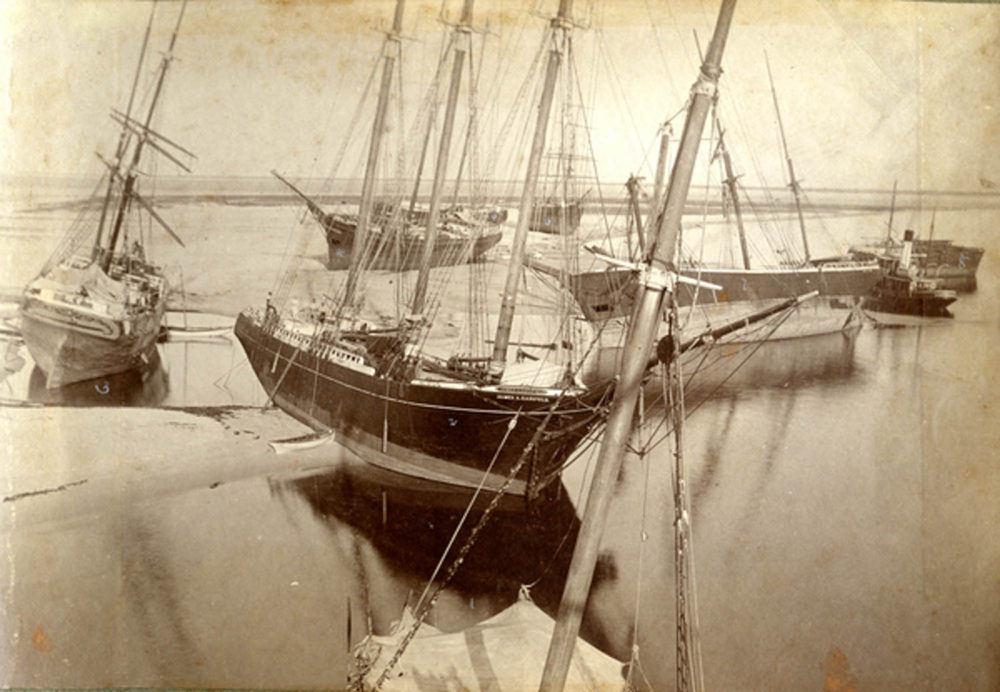
 Thirteen large merchant ships, in various stages of loading cargoes of Florida pine, sawn timber, and planks, were anchored at Dog Island as the storm came ashore.
Nine ships were wrecked in the shallows of Dog Island. The wooden-hulled ships, all between 400 and 500 tons, included six American three-masted coastal schooners, five Norwegian three-masted barks, one Finnish schooner, and one Spanish bark. Of the ships lost, four could not be refloated and their remains likely still rest in the vicinity of Dog Island’s Shipping Cove.
The event is considered a significant shipwrecking event because of the number of ships lost at the same time, greatly impacting what was then a burgeoning international lumber trade.
The Daily Times-Enterprise reported that in addition to the 13 ships lying at anchor at Dog Island, other vessels were lost in the storm. “Not one of the fleet can be saved,” it observed; the losses included three pilot boats, the steamers Iola and Capitola, six lumber lighters, and 40 boats under 20 tons.
According to the bureau’s survey report, in the early 1960s, Thorvald Iversen, a Norwegian man who had once sailed on the Norwegian lumber bark Vale and survived the storm onboard the ship, returned to Dog Island at the age of 86 to see the spot where he had been shipwrecked. He pointed out an area where he recalled the Vale to have beached after the storm. Measurement and analysis of the artifacts recovered suggests that the hull remains identified as Dog Island Shipwreck #2 in the survey is the Vale.
Famed American treasure hunter Mel Fisher, prompted by a tip from a local resident who reported he had information about a possible shipwreck site, visited the area in 1994. The vessel in question was supposedly a Spanish treasure galleon, possibly the Santa Anna Maria Juncal, which is the earliest wreck documented. It is believed that it was wrecked in the vicinity of Dog Island in 1611 while carrying silver bullion believed to be worth millions back then. Fisher conducted magnetometer surveys but was unsuccessful in his search.
While the existence of these shipwrecks is well documented, the final resting place of the vast majority of them might remain a mystery. Mollema says that after a dynamic storm event, there is always an increase in the number of phone calls and emails from locals. “People report ship timbers washing ashore, or erosion will expose new aspects of a site; this is especially true in the area of Dog Island because the bottom is most exclusively sand that gets moved around easily from a storm’s energy.”
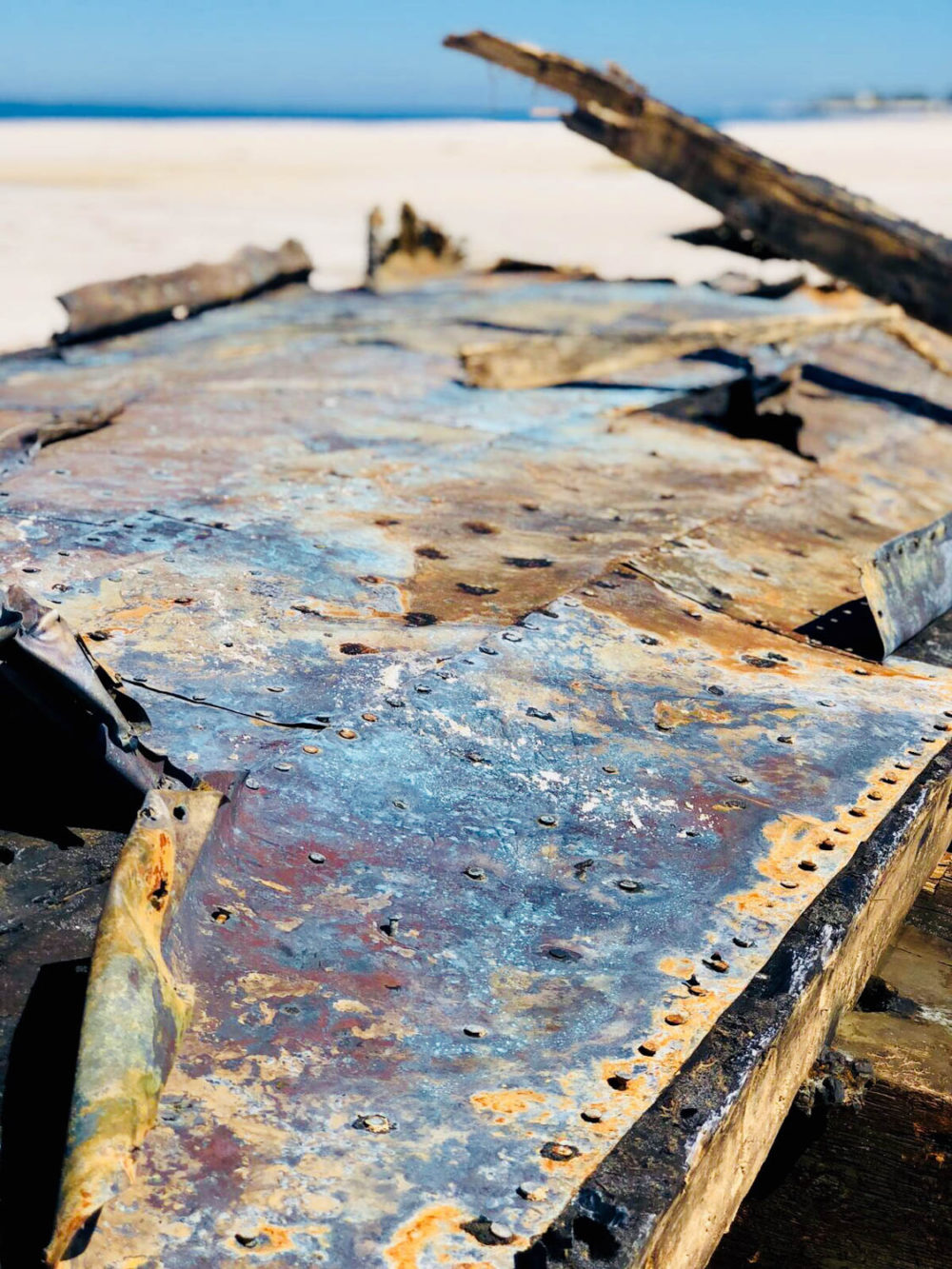
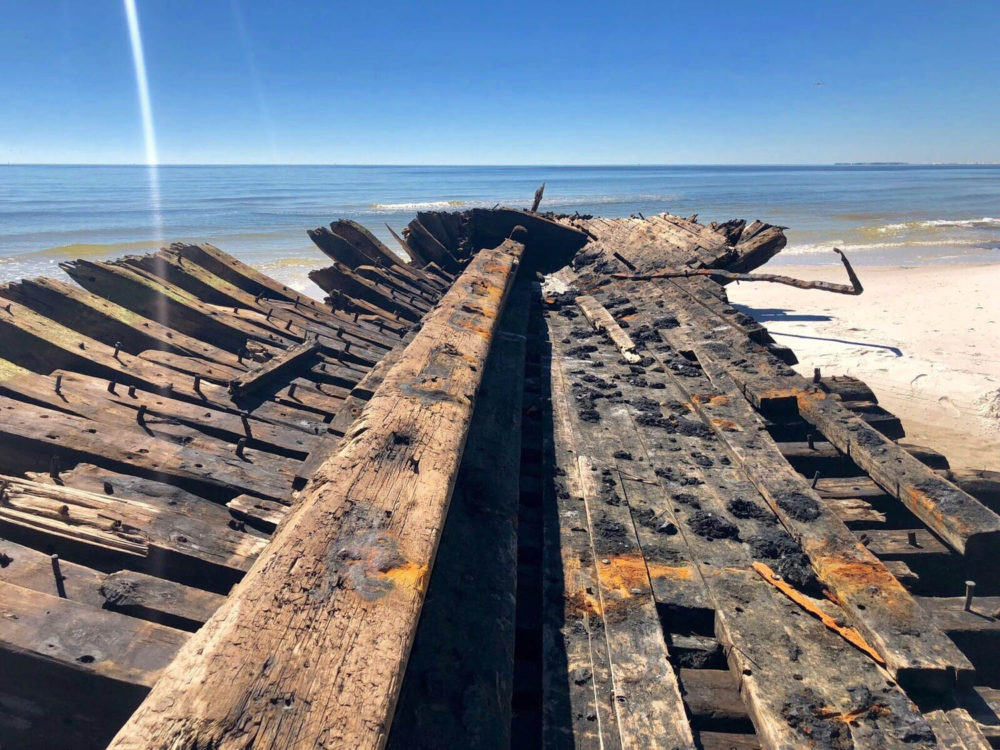 Remains from two different ships re-appeared on the southern edge of Dog Island after Hurricane Michael—portions of a bow, protruding upwards about 6 feet from the beach, and remnants of a hull. The recent events spurred Mollema and his team to investigate further and he describes the analysis as a process of elimination in consideration of the clues presented. “Based on measurements of the different pieces that are revealed, we have a general idea of the size of the ship; the different aspects of ship construction allow us to determine a general idea of the date of the ship’s construction.” In the case of the bow remains, following an analysis of its sheathing, it was determined to be made of Muntz metal, which was not used in shipbuilding until 1832, so we know from the first clue this ship was built after that.” Mollema explains that the timber dimensions offered the next significant finding. “Based on the well-documented insurance requirements of the time, it was a sizeable vessel, perhaps 600 to 800 tons.”
With these two clues, coupled with the fact that the end of the timbers appeared to be charred, Mollema had enough information to turn to historical data available from the Record of American and Foreign Shipping archives. Mollema believes the ship is the 673-ton Fanny Holmes, a coastal trader carrying a shipment of cotton that sank when a spark from a stevedore’s pipe caused a fire on April 3, 1860. The archives revealed that it was the only ship lost in the region at that time that fit the clues.
Mollema notes that one of the hulls revealed by Hurricane Michael is still mostly buried in the sand, making it impossible for him to take measurements sufficient for comparison. Without such information, he cannot attempt an identification and explains, “It did appear to be fairly large, perhaps a 800- to 2,000-ton ship. There are many ships that would fit that profile, but without more information, we simply cannot say more.”
Perhaps the two most historically significant wrecks are Le Tigre, a French merchant brigantine lost in 1766 enroute to New Orleans from Haiti, and the HMS Fox, lost in 1799. There were few survivors following Le Tigre’s foundering just offshore Dog Island, and those who did survive experienced a harrowing ordeal after finding their way across St. George Sound to the mainland, and then getting lost in the Apalachicola forest for 81 days. Pierre Viaud, an experienced French sea captain sailing onboard Le Tigre, survived and eventually made his way back to France. He wrote a firsthand narrative of the experience, describing the outfitting and loss of the vessel in great detail.
The HMS Fox, a British warship, was directly associated with soldier-of-fortune William Augustus Bowles, a colorful figure in Florida history. Le Tigre and the HMS Fox have not yet been conclusively located, according to Mollema.
A great number of vessels were lost from August 1861 to 1863, due to Union blockades during the Civil War. The large number of sunken vessels dating to the late 19th and early 20th centuries represents the exploitation of local resources (fish, lumber) that played a principal role in the rapidly expanding economy at the time. Although the vast majority of these ships may never be found, artifacts continue to resurface. Mollema says, “If someone stumbles across something of interest, don’t touch it; take a photograph for us, note its location, and call us.”
Mollema recommends contacting the Bureau of Archaeological Research at (850) 245-6444, or the Florida Public Archaeological Network (FPAN) at (850) 595-0050[box type=”note” align=”aligncenter” ]DOG ISLAND FACTS
THERE IS NO BRIDGE, NO STORE,
NO RESTAURANT,
AND NO PUBLIC FACILITY OF ANY KIND.
A dirt road runs much of the length of the island, through pine flatwoods and oak scrub, next to tile marsh and sandy shores.
THERE ARE NO PUBLIC FACILITIES ON THE ISLAND.
NO RESTROOMS, NO RESTAURANTS, NO STORES, NO FOOD, NO WATER.
YOU CAN WALK ACROSS THE ISLAND FROM THE FERRY LANDING TO A BEACH CROSSOVER.
NO CAMPING IS ALLOWED.
Visitors have two options available to them for traveling to the island: A small, private airfield allows visitors and homeowners to land on Dog Island after calling and obtaining permission, with visitors paying a $10 landing fee, and owners paying a $150 annual fee to access the area.
The airfield has a maintained 2,800-foot-long grass landing strip, making for a quick and easy landing. Ivan Beckerman, the volunteer manager of the airport and full-time island resident, also says there is no fuel station or mechanical services at the airport and encourages incoming aircraft to make sure they’re good to go and fuel up while in Carrabelle. Those taking their personal boat can leave it at the island’s yacht club for $20 a night.
A passenger ferry, which started in 1955, travels from Carrabelle, Florida, to the island. (Schedule: https://sites.google. com/site/dogislandbeachhouse/ferry-information) Call Captain Russell “Rusty” Cohoon for scheduling and pricing; (850) 697-8909.
Private charters (confirm local charters in Carrabelle): All-Aboard Cruise & Tow, Capt. Rusty Cohoon,(850) 697-8909 Capt. Chester Reese, naturalworldcharters.com Captain Tim “SGT” Peterson, captsgtpetersons.com Captain Terry Martin, gritwateroutfittersusa.com
What do you do on an island with nothing to do? Walk on the beach; you will often be the only person there.
Hike the nature trails (if you can get someone to tell you where they are).
Fish, sail, kayak, swim, read, barbecue, or bird watch. Over 200 species of birds have been seen on the island.
Dog Island and Audubon’s nearby Lanark Reef are dedicated to preservation.
Dog Island sits along the Eastern Flyway, so one may see peregrine falcons, spoonbills, bald eagles, songbirds, and many different types of shorebirds migrating through.
Sage and rosemary grow wild all over the island in and among the pines and oaks. Several ponds harbor alligators in the salt marsh looking to feed on fish. And speaking of fish, the island has some of the finest grass flats in all of Florida. Redfish, Sea Trout, and Tarpon are but a few of the species that can be caught from shore.
Stargazing is a favorite pastime on Dog Island. If you have a house there, you work on the house. It is a long-standing island joke that island property owners don’t have time to go to the beach—they have to keep the house and water system working.
The island now has power and phone service, but no water system. Islanders learn to be very self-sufficient. A handful of people live on the island full-time. Most are there on weekends and holidays. [/box]