
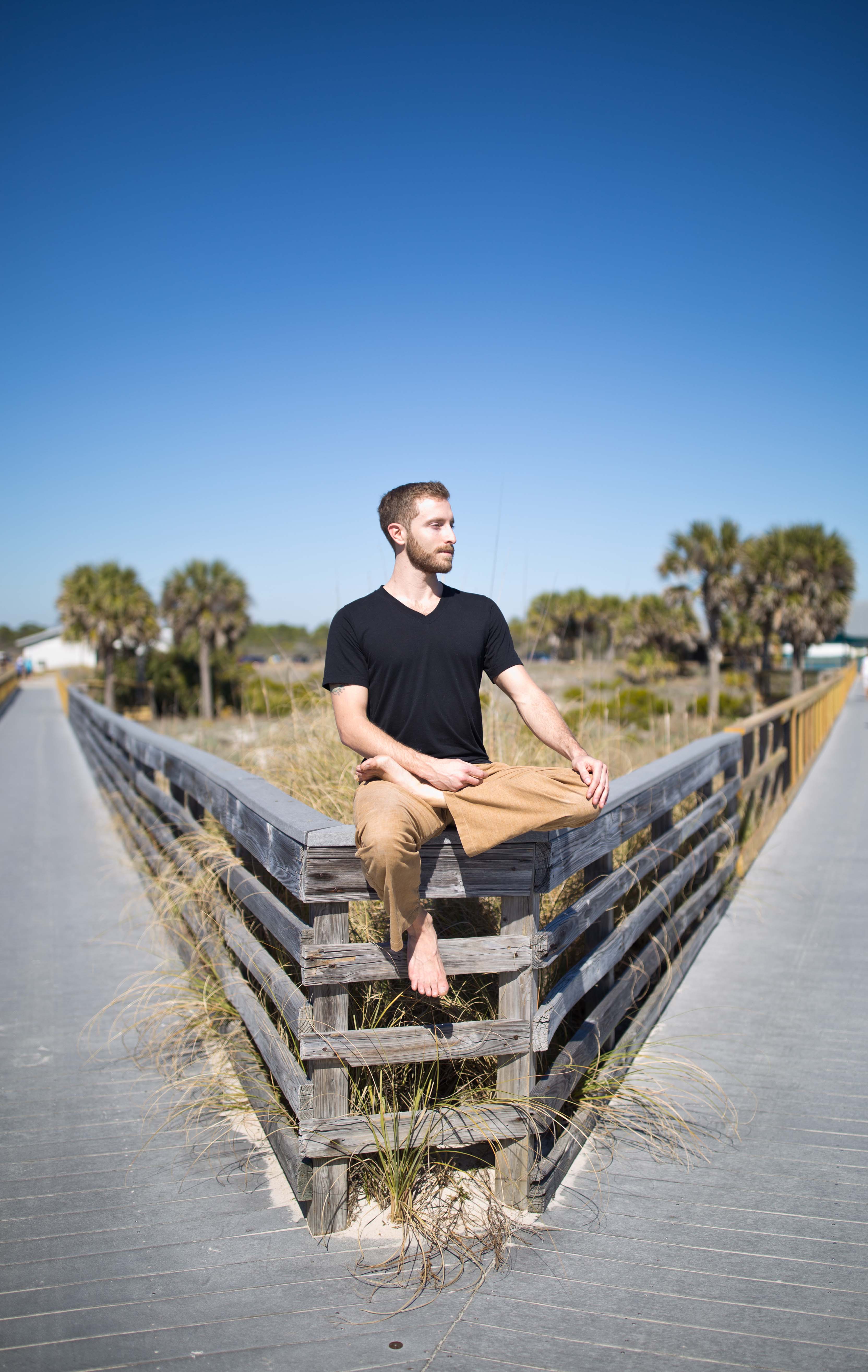
Are you man enough for yoga? Interview with David Bulger


By Val Schoger
Photography by Michael Booini
[dropcap]M [/dropcap]oving from Louisiana to Panama City Beach with his family when he was 6 years old, he grew up with sand between his toes. He remembers tranquil summers on the beach with a sense of serene nature and intact environment. It changed as he grew older. When 14-years old, he started working as a lifeguard. He became an exceptional swimmer. After graduation, he joined the Navy and became one of the two surface rescue swimmers on board the USS New York. But he does not quite fit the ex-military image.I THOUGHT I WAS STRONG UNTIL I STARTED PRACTICING YOGA
David Bulger is 27 and teaches yoga in a studio on Panama City Beach. He is soft-spoken with kind, inquisitive eyes. And, according to his students of all ages and genders, he listens as well as he teaches, with profound insight “for his age” and the ability to relate in depth to questions, reflecting on the mind and helping the body.
What brought you to yoga?
There is a saying, “No one comes to yoga when they’re perfect.” I was getting out of the Navy. We had a term in the military, “functional alcoholic.” That was me at the time.
The military places a lot of emphasis on medication and toughening up, but they’re getting better. I hope active military personnel will be offered better solutions to handle stress through effective means like meditation or yoga. So, I think, what originally brought me to yoga, was the question of how can I heal myself outside of just pushing heavy weights in the gym? How can I heal myself–and the group is amazing, but–without having to go to something like Alcoholics Anonymous, or without having to see a counselor. I think the final driving force for me was, as I was putting on my shoes one day, I could not bend and reach my feet … I had to sit down on the ground, bend my knees to get to my feet, and there was a constant pain in my neck. I realized, I felt like I was 70 years old. I was 24 at the time and getting out of the Navy with chronic neck pain. So, I started watching YouTube videos, and within two weeks of watching and copying what I saw, the neck pain dissipated. It was almost completely gone. So, that’s when the physical aspects connected to something different for me.
What do you think caused the pain?
It could’ve been my personal transitions because I had gone from being a life guard on the beach who never wore shoes to having my feet cramped up in steel-toed boots. I was sleeping in a rack, literally. My cot was as big as a yoga mat, and it rocked back and forth on the ship. I was not getting any sleep, and I was over-caffeinated… it’s the same in business life as it is in the military; it keeps us drinking coffee… . So, it could’ve been that, it could’ve also been the years of pushing the body to lift heavy weights and train for special operations and try to be a real man.
 Your students say that you have great insight? Do you think it’s a talent or something you acquired?
Perhaps a bit of both. Every individual is certainly inclined to have a unique talent or two, but almost any skill can be developed, to a certain degree, with consistency and time. I think that’s something I took away from a lifetime of lifeguarding–being a professional people-watcher. And essentially, that’s all I do as a yoga teacher in my class. I show poses, I give my students verbal cues and explanations, but I’m kind of holding space for their experience… I have this general “script,” an idea of what the class is supposed to look like. I get my students to move a certain way but I am always adjusting what I’m saying and what I’m doing based on their Biofeedback. I can hear across the room if someone is holding their breath. Or breathing too quickly. So … that’s all I do.
How many male students do you have?
You’d be pleasantly surprised with the number of Navy divers who come over from the base. Usually, the younger guys who are in the spec ops programs take yoga classes at night. They see the benefit of achieving better range of motion, and functional mobility, being able to get off the ground when falling, being able to move in all directions. I think these guys are gravitating to finding solutions, but also, they are in high-stress environments all day long.
I think yoga is less about lengthening your muscle fibers… it can teach your nervous system to relax. Turning that parasympathetic nervous system on, so we are not stuck in this coffee-induced fight-or-flight. That we are able to eventually relax into that parasympathetic state, and that is what ultimately, in conjunction with stretching and pressure, the pressure being something like a massage, can release that tension.
I am amazed that you have male students who appreciate yoga. But it’s the exception… most might think it unmanly to practice yoga…
Unfortunately. It’s the same as having the stereotypical perception in western societies that everyone who comes to yoga is athletic, young, and a woman. I would say eighty percent of my clients are middle age or senior citizens. I also work on rehabilitating injuries, I work with professional baseball players who are trying to rehab injuries before the season. I think at the end of the day, whether you’re doing hot yoga or Ashtanga, the real intention, physically, is how to heal the body and prepare it to last for the rest of your life.
In yoga, everything has an emphasis on the breath. That appealed to me as a swimmer and a lifeguard. Every yoga class preaches deep, audible breath, it makes you breathe and become aware of all the happenings internally. It’s like the breath is the mantra to flush out all the b.s. that you’re dealing with every day.
What would you tell a guy who is making fun of yoga?
When I get guys in here who think yoga is “not real exercise,” they will be drenched in a pool of sweat by the time the class is over. If I want to humble a young buck walking in thinking he is the strongest in the room because he’s got the abs and the biceps, because he’s been working out every day, I will place him just behind the 60-year-old lady who has been consistently practicing yoga. At the end of class, he will be laying down panting in a pool of sweat, and she will be gracefully moving back and forth. Why? Because she’s learned, strength isn’t about turning on all your muscles. Strength in yoga is a little more intelligent. You are learning how to turn off the muscles that aren’t needed while turning on the ones that are. You’re learning to regulate your breath and control your pace, instead of just putting it all out there, and I think that’s what guys can learn… especially when it comes to balancing the masculine with the feminine, which is something that’s not talked a lot about. It’s a misconception that a guy cannot be feminine. Showing your softer side makes you more of a man.


Was that something you had to overcome? Did you have to bring up the courage to go to yoga class?
Oh, sure. But not because of the male-female thing. I was just vulnerable and did not think I was flexible enough to put myself in front of a teacher and let them see how inflexible and un-strong I was. And … I think that was more difficult.
How did yoga change your perception of workouts and your abilities?
I thought I was strong … I thought I was strong working out in crossfit gyms in the military. I thought I was strong lifting weights with my professional weightlifting friends. I thought I was strong through my years on the swim team and the soccer team, and all these other sports – until I started practicing yoga and I realized how not-strong I was.
David Bulger’s teaching schedule can be found online at
www.pcbeachyoga.com