CHRIS TIPTON: Man and Machine


BY NICK MAY
PHOTOGRAPHY BY MICHAEL BOOINI
Everything is duplexed, finished, painted, beveled all done by hand. It’s print-making. Not just printing. – CHRIS TIPTON
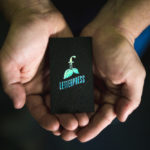
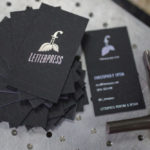
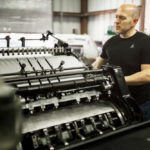
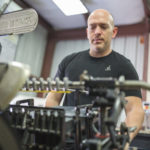
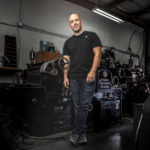
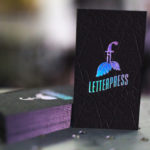
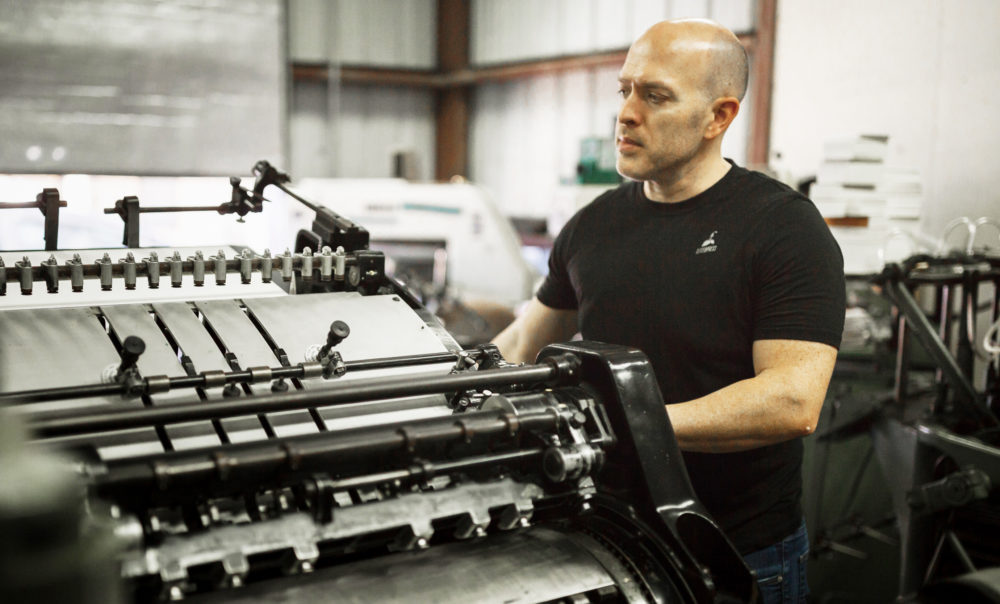
Chris Tipton is old school. He almost has to be, given his profession. His business is cordiality. His craft—leaving a lasting impression. Chris is the owner and operator of Fresh Impression Letterpress Studio in Panama City Beach, the only commercial letterpress printing company on Florida’s Emerald CoaThere’s a good chance you’ve held Chris’s work in your hands before, as demand for beautifully printed materials with keepsake value has greatly increased over the years. Timeless features like premium cotton paper, debossed printing, blind impressions, foil stamping, sculpted embossing and intricately patterned designs are having a new revival. Customers are learning they want unique wedding invitations, business cards, and marketing materials or product packaging on paper of varying colors, shades and thicknesses. And it’s this ever-growing appetite for quality, combined with sensory appeal, that is so revolutionary to a generation whose fingertips are often only acquainted with slick cell phone screens. Whether you prefer eggshell, nimbus, or another of the approximately 256 shades that less-discerning minds might simply call white, every print that leaves F.I. Letterpress carries with it a piece of Chris’s soul—quantified in blood, sweat and ink. His workshop is reminiscent of a classic car garage. Only, the machines parked here never leave.

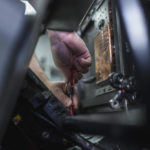
Chris leans back against a turn-of-the-century Heidelberg press with his arms crossed over his chest, the way a hotrod enthusiast might plant himself against a mechanical marvel he’s mastered. This is Tipton’s domain. His crucible. And he knows each piece of intricate machinery, inside and out, like the workings of a finely tuned classic car. “It’s fun to make stuff with your hands,” he says, reinforcing a palpability that can only be truly known in person.
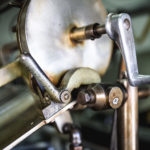
They say it takes 10 years or 10,000 hours to become an expert at something. That’s about how long Chris has been at the craft. “I started learning letterpress printing in 2009, just as a hobby. With this one…” He gestures to an ancient-looking steel behemoth with a gigantic wheel on one side. “That’s a Chandler & Price 8×12 New Style. I luckily found it in Fairhope, Alabama.” This was the first press that enabled Chris to dip his toe into the proverbial waters of printmaking. And though the shop is now packed full of impressively complicated machines as big as Volkswagens, they didn’t all come along at once. Chris is in it for the slow-brewing long game. Each of his presses tells one piece of the story in the journey of his business. “In every major success story out there, you never hear about the ten, fifteen, even twenty years before. The keeping-your-head-down part, putting in the work,” he remarks.
But how did Chris and the 8×12 get their start? Like many meaningful endeavors, it was the result of a spark of interest. And one gutsy purchase. “I was doing web design, when I became interested in letterpress printing. There was nothing like it around here, so I started looking and found the Chandler & Price for about $950 bucks. I said, ‘I think I’m going to buy it…’” It’s not every day someone spends a thousand bucks for a chunk of antique steel on a whim. But it wasn’t long before Chris was expanding his collection. He began buying up different machines, namely those that were bigger and faster and helped him meet the growing demand.

If you’ve ever visited the Panama City Publishing Museum in Historic St. Andrews, you’ve heard about the rich legacy of letterpress printing for newspapers in the area. Though their processes and purposes are quite different, Chris’s brand of letterpress printing shares a distant lineage with that of Bay County’s. Many of Chris’s own machines were even purchased locally. Today, Chris is proud to be one of the few, in a close-knit community of craftsmen, still holding to the old ways of print craft.
Letterpress printing with hand-set type was the standard for books, newsprint and other media, from its inception in the mid-15th century, well into the mid-20th century. As the demand for printed materials grew throughout the years, commercial printers turned to new innovations in offset printing. Offset is faster and able to print a finer halftone. The process transfers an image onto a rubber blanket that better conforms to the surface of paper. These key advancements are why letterpress printing, for a time, ceased to exist on a larger scale.
Now Chris is continuing the tradition. His motivation? Novelty and a level of quality that simply can’t be imitated. Standing in his studio, Chris hands me a piece of delicate wrapping that contains hundreds of tiny, metallic sticks—like a collection of iron teeth—each capped with a single character of the English alphabet. Of course, type like this is merely for show nowadays, but letterpress printing still maintains the same level of tedious precision.
 So, how is it done? “Letterpress printing is a relief process,” Chris explains. “The ink goes directly on a copper plate [which is pre-ordered, having already been acid-etched to design] or photopolymer plate [which Chris processes in-house]. That plate is then smashed into the paper.” Simple, right? Not so much. I asked Chris if he thinks the recipient can tell what goes into something like an invitation or business card. “I don’t think they know what went into it. I think they know it’s special. I mean, you’ve got custom-mixed inks, made ready to achieve a perfectly balanced impression to the perfect depth. Everything is duplexed, finished, painted, beveled all done by hand. It’s print-making. Not just printing.”
While it’s one thing to hear how letterpress printing is done, it’s another thing entirely to learn it. “There’s a lot,” Chris laughs. “There’s a good learning curve, but if you spend the time, you can learn the press. Design can be tricky, though.” That’s the part that Chris says can’t exactly be learned. And it’s where the craft diverges most from something like changing the oil in a car. “There’s definitely a touch to it. There’s definitely craftsmanship here. No, you can’t understand the fundamentals of the press and then just start making nice prints. It does take that attention to detail. Letterpress is also subjective. You have a wide variety of qualities out there. It’s one thing I stress to people—get samples [before you place your order]. You may find something cheap somewhere, and you may like the way it looks online, but you never know the quality you’re going to end up getting.”
Filetterpress.com is where customers can go to order their custom designs and prints. “Everything I do right now is through my website. I don’t have an actual retail store or walk-in location. I’m kind of torn on that. I’d liked to have a little boutique retail store downtown, but I’m also focused on growing out for larger industry work. We’ll see where the path leads. Hopefully both. But, so far, word of mouth has kept me busy.” In such a tactile business, the good word of a friend or colleague is the fuel Chris thrives upon. Coupled with his online presence, it’s the reason he’s been able to put down roots right where he wants to be. “I was born and raised here. I like the area, and I want to make it here. I don’t want to go somewhere else just to go…”
And that’s exactly what Chris Tipton is doing—making it. As a Panama City native, he’s digging in, not only to bring a classic trade local, but also to honor a craft that shares part of its heritage with the local area.
Visit filetterpress.com or Instagram (@fi_letterpress) to see beautifully handcrafted invites, greeting cards, business cards, and other fine paper items from Chris’s Fresh Impression Letterpress Studio.