
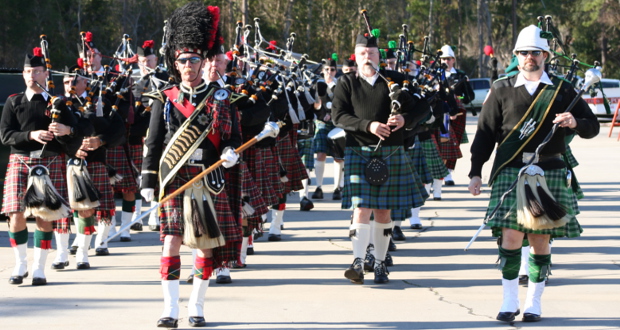
ABOUT CELTS, PIPES AND DRUMS – In Tune and Lockstep


Panama City Pipes and Drums band was formed by two tipsy Celts over a bottle of Scotch.“You want to make a pipes and drum band?”, one Scotsman said to the other.
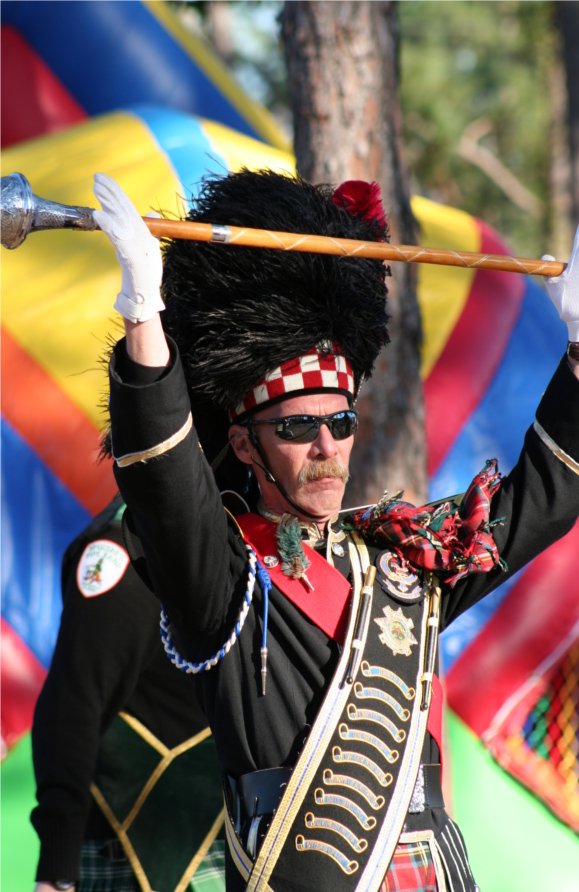
“Sure, why not,” the other responded, and the band was formed. This conversation took place in 1998 between Terry Higbie and John McIlroy, who had met at a Scottish festival the previous year. The two became friends while playing assorted musical instruments at small gatherings in McIlroy’s house.
Within a few short years, the dedicated group of six to eight pipers and drummers, many of whom had been enlisted from among McIlroy’s friends and neighbors, learned the songs and, most importantly, learned to play together. Kathy McCurdy, a young Panama City police officer who had never played the pipes before joining the group, was one of those friends and neighbors.
“I had heard the pipes played and loved them,” McCurdy said. “McIlroy contacted an instructor, got a meeting place and started getting everyone interested together and we began to learn and then formed the band.”
They became so good that they won the state championship for pipes and drums in 2006, beating traditional powerhouse Dunedin on the way to the title.
Saturday, Sept. 21, the group set a new milestone for itself by marching onto the field at Doak Campbell Stadium before the start of the Florida State/Bethune Cookman game in front of a crowd of more than 70,000 people.
Admittedly, only a handful of people in the stands were there to see the band. But for the members of the Panama City Pipes and Drums, the moment represented the culmination of years of practice, fun, hard work and good times.
Higbie explained: “When you’re playing, you’re playing inside the pipe band. You’re not hearing or seeing the crowd. You’re just playing.”
PRACTICE
It seems appropriate that the Panama City Pipes and Drums would hold their rehearsals at the clubhouse of the Panama City Police Department. Where else would you expect the PCPD to practice but at the PCPD?
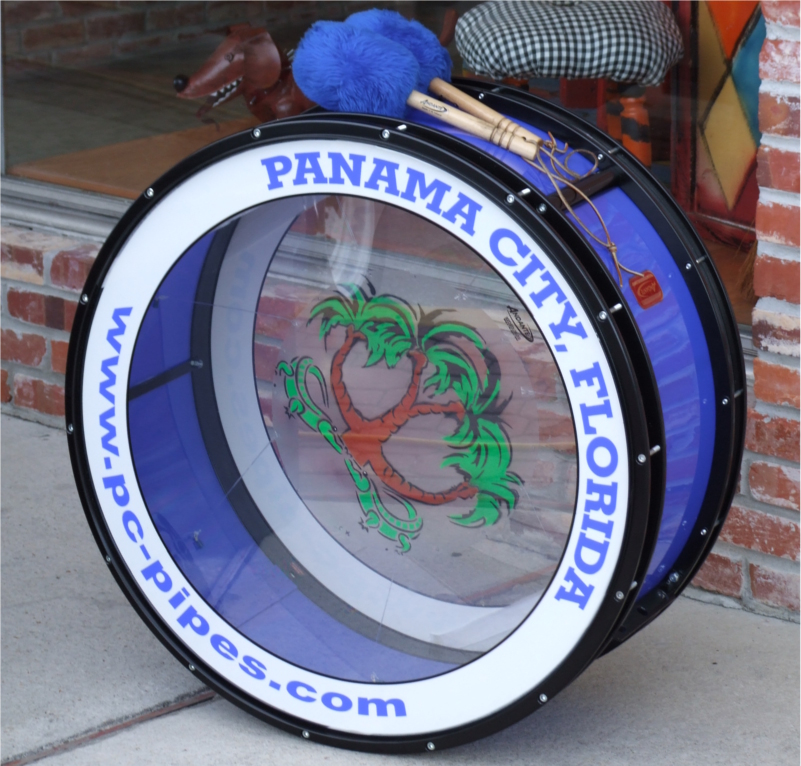
While the drummers – Sebastian Allen, Eden Allen, Malcolm Fisher and Russ Wilson – tapped out their rhythms in the clubhouse kitchen, the pipers sat around a wooden conference table and practiced with their chanters.
The bagpipes are made up of an air bladder, hummers and chanter. The hummers, three long pipes that extend up over the piper’s shoulder, form the background harmony while the chanter plays the tune.
The key to playing the bagpipes is consistency: Maintaining steady pressure on the bag, breathing in time to keep it properly inflated, so the hummers send out a steady, unwavering tone. And all that while trying to play a tune from memory. There’s no place for pipers to carry sheet music but in their heads.
That’s complicated enough for a single piper, but it’s far more difficult when you have several pipers playing together.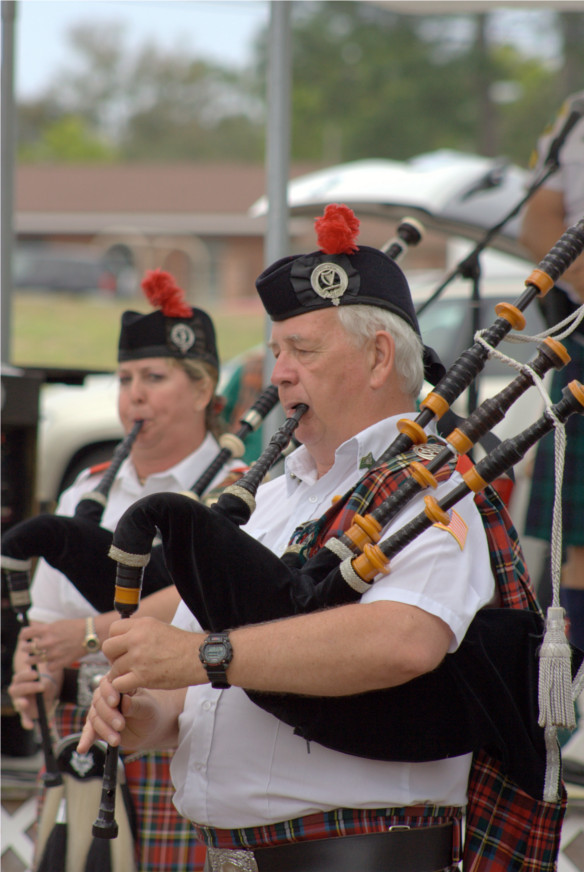
“How do you get two pipers to play in tune?” Higbie asked with a wry smile. “Make one stop.”
Pipe Major John Hawk said rehearsals are all about committing the tunes to memory, then practicing them together. According to him, a pipes and drum band is like no other musical group. Unlike an orchestra, in which individual instruments making unique sounds join together to make music, pipers all do the same thing. To make it work, they must be synchronized and precise. The drummers, snares, tenors and bass, add depth to the sound and keep everyone on beat.
In the enclosed, low-ceilinged clubhouse, the sound of the chanters rising up together is, as Higbie describes it, “haunting.” That is the best word. The sound is ghostly.
The sound of a bagpipe, while not beautiful, is powerfully emotional. Higbie described a competition they went to in Jacksonville. They arrived around daybreak for the start of the contest and in a field was a lone piper greeting the rising sun with a slow ballad.
“Everything,” he said, pointing to the hairs on the back of his neck, “it all stood up.”
The sound had always haunted Higbie, even before he started playing. He took up the bagpipes after a divorce.
“I’d thought about it for a long time,” he said. “Then I got divorced and I was
bored in Memphis. I was moving down here for a job and picked up a practice chanter from a guy in Mississippi who sells them from his house.”
The band has a close association with Beef O’Brady’s in Lynn Haven. The restaurant owner is a strong supporter and the band plays small gigs and meets there for drinks after rehearsals. Whenever they play a gig, whether it’s in front of a familiar crowd at Beef’s or on the field at Doak Campbell, Higbie usually doesn’t look at anything but his bandmates.
“Unless we’re playing Amazing Grace,” he said. “Then I’ll look around the crowd to see who is crying.”
GAME TIME
Eight members of Panama City Pipes and Drums met with the Tallahassee Pipes and Drums at the FSU ROTC building on the afternoon of the game. Because of parking problems, several members drove out together well before the 5 p.m. start time to get the single reserved parking spot. The others made do.
 “We are a marching band,” Higbie joked about the long walk to the stadium.
While the walk wasn’t that long, McCurdy said it was certainly wet.
“The whole way up there it was raining off and on,” she said. “Then when we got there it stopped. We all thought that maybe it would clear up. The minute we started marching, it just started pouring.”
They played, though, through the driving rain with the ROTC color guard and the Tallahassee Pipes and Drums to the stadium. Less than a mile’s walk, McCurdy said, but miserable just the same.
The rain persisted, so the bands set up in the hallway under the bleachers, in the area where the concessions stands are, to play for a small crowd. Then they marched out onto the fi eld and stood by while members of the armed forces were recognized.
Then they got to sit and watch the game.
“The Tallahassee band was able to teach us to play the war chant on the bagpipes,” McCurdy recaled. “That was pretty neat.”
By David Angier, Photography by Jack D. Holt