
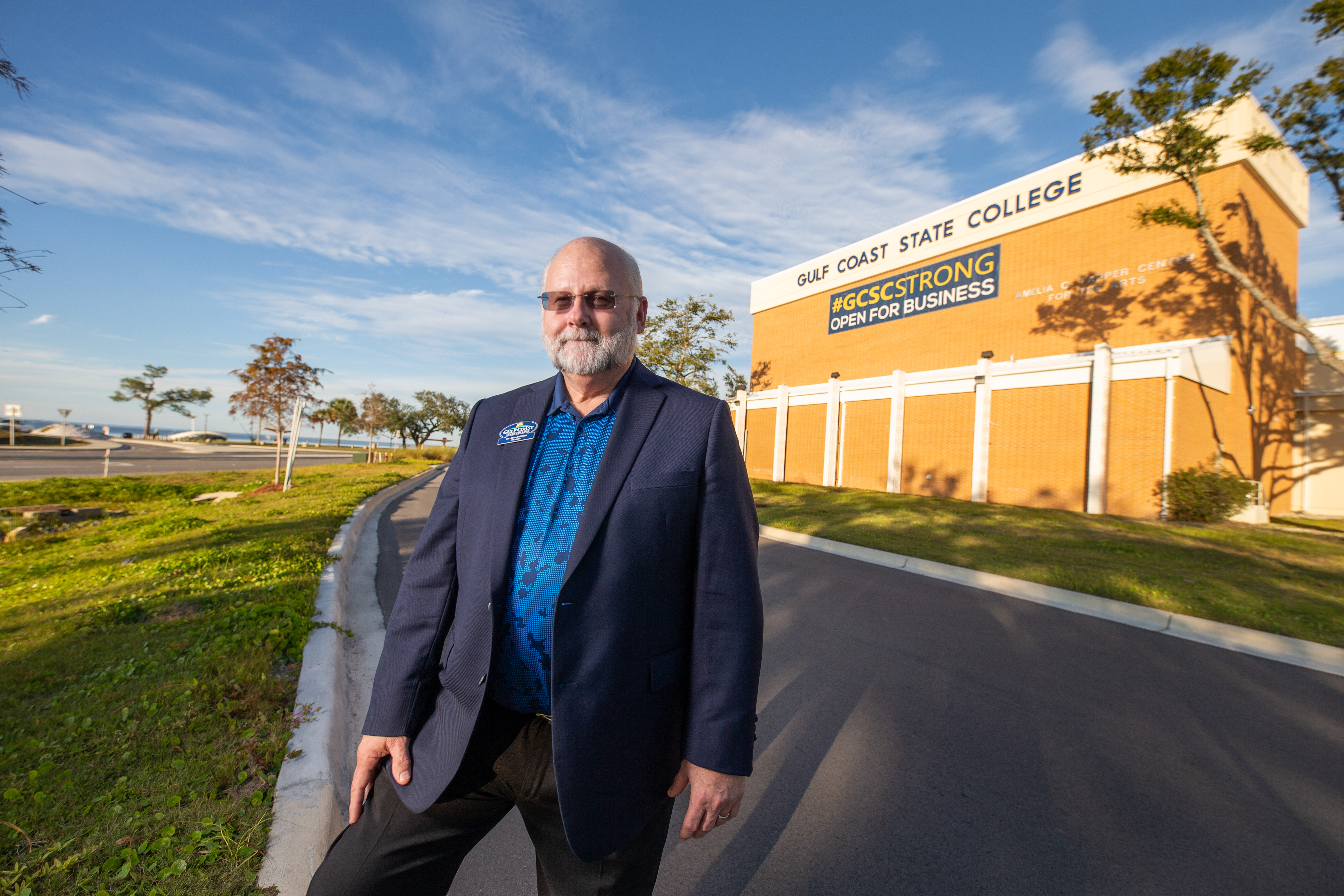
Bay County’s Assets for Economic Growth – Interview with Dr. John Holdnak, Director of Gulf Coast State College

BY VAL SCHOGER
PHOTOGRAPHY BY MIKE FENDER
[dropcap] “L[/dropcap]ife is too short to wear ties every day,” Dr. John Holdnak says and looks over the rims of his glasses with a wry smile. The lack of his usual necktie might have to do with the events that took place during and after Hurricane Michael in October 2018. After riding out the storm in the Bay County Emergency Operations Center that is situated on campus, he and his wife faced 54 hours of uncertainty whether their son was alive. The storm had impacted almost every building on campus and his home had been severely damaged.
“At Gulf Coast State College, we passed the $58 million mark in repairs and reconstruction and we are still not done. For almost a year after the storm, we were a construction zone,” Dr. Holdnak summarizes and adds that the college saw a loss of around 15 percent of its students after the storm. But with dedicated faculty members and staff, classes re-started sooner than anyone predicted, despite the fact that most classrooms were still in the process of having ceilings, flooring, and walls replaced.
With pride for his team, Dr. Holdnak explains that the staff and faculty have overcome the worst. “The students didn’t complain and the faculty didn’t complain. How do you complain when everybody is in exactly the same situation?”
A surprising fact was that the storm had garnered publicity and attention for Bay County. Go-getter Becca Hardin, president of the Bay Economic Development Agency, continued her work undeterred in the Hurricane Michael aftermath. The publicity, or rather the unwavering spirit of our locals, quickly became a selling point in her mission to attract new businesses to Bay County.
“Not even four weeks after the hurricane, there was one day that we had representatives from two major aerospace manufacturing companies on campus in the Advanced Technology Center. One group in one room and one group in another room. This would not have happened five years ago,” Dr. Holdnak reflects. “It was a giddy feeling to get these companies to evaluate us as a possible new location. I think the saying is ‘giving your eye-teeth’ to get one of them to even talk to us. And we had two of them in town …” he pauses for effect and adds, “Becca Hardin is a force of nature.”
Several other companies have announced their visits for 2020. It will be a year of opportunities for Bay County, its economic development team, and its educational facilities. “Ultimately, the entire community will benefit from incoming new businesses,” Dr. Holdnak points out. “For a very long time, this region has been focused on either tourism or military. We provide our students with courses that benefit both. Right now, we are actively investing time and energy to ensure that Tyndall Air Force Base is rebuilt and we are dedicating one full-time staff member to help with the efforts. Tyndall constitutes 30 percent of the economy in this region and our student enrollment is directly tied to the number of personnel stationed here. In almost every class there will be two or three military vets, every time. And they are either interested in something completely different than what they used to do, like expanding on their passion for food and becoming a chef, for example, or they want to use the skills that they were taught in the military for other applications and we help them earn their certifications and degrees. For example, we offer an associate of science degree in Unmanned Vehicle Systems Operations.”
The strong presence of the military in Northwest Florida is a very valuable attribute for Bay County, he points out. “There are a couple of companies that we are attempting to attract that are particularly interested in hiring employees with military background. The particular skillsets and work ethic that retired military personnel bring to the table are in high demand.”
The proximity and good working relationship with the military bases, as well as having a keen interest in new technologies and seeing how they evolved—from prototype to mainstream—has shaped his vision for Bay County.
A cabinet in Dr. Holdnak’s office is filled with mementos of tech evolution. He holds up two small objects—one is a lightweight piece of metal that looks to be engraved, the other is a translucent plastic triangle with another moving triangle inside. “Both of these items are 3D printed,” Dr. Holdnak says. “The metal piece was made just recently by a local company by using an electron beam and a bed of powdered metal. The beam doesn’t melt the metal, it causes it to molecularly bond together.” The technology represents the manufacturing capabilities of the aerospace industry, he explains. “The translucent piece, with its moving two parts, was also 3D printed with lasers and a pool of liquid polymer, building the object, row by row. You might think 3D printing is the latest technology but this plastic piece here was made in the Panama City Navy Lab… in 1984.”
Dr. Holdnak knows that our area is well-positioned to become a player in those industries that have evolved over the years and will grow exponentially in the future. The stigma that accompanied the word “manufacturing” no longer applies, he says. “That manufacturing is not well paying, that it is dull, dirty, boring, or dangerous is not the case anymore. Nowadays it’s exciting cutting-edge technology where you get to make and work on amazing projects, using amazing tools.”
In view of manufacturing trends, Dr. Holdnak knows that there is a shift in the industry. “U.S. companies left to go overseas because labor was cheaper; now we can make labor less expensive in the United States by automating. But where we will excel in the world is in training people to design those automation lines, build those automation lines, and in some instances, it’s machine rebuilding machinery. The United States leads the world in automation.”
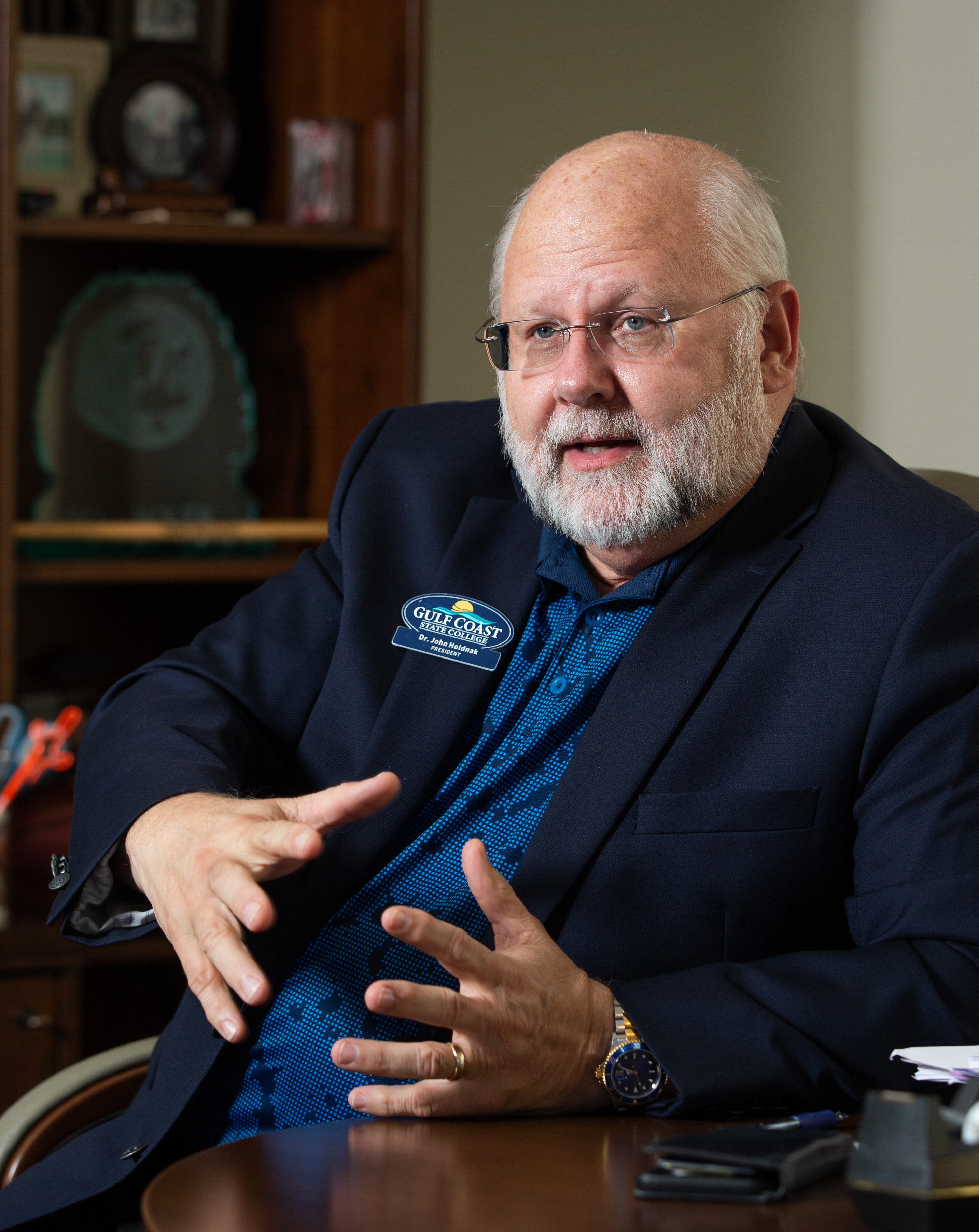
Seeing the trend, he predicts that many manufacturing jobs that were done manually in the past will be performed with automation in the not too far future, and that is a promising perspective for Gulf Coast State College. “The people that we are training are the techs that will install, maintain, operate, and repair that equipment. So now you are seeing manufacturing opportunities that previously went overseas coming back to this country, and that is creating a whole new class of high-tech, good paying jobs.”
Gulf Coast State College is well positioned in its offerings to students to succeed in relevant market segments that promise high-paying jobs, according to Dr. Holdnak. “We teach classes in mechatronics and electronics, in hydraulics and robotics,” he summarizes. “We could establish our area as a central location for high-tech manufacturing. That would be my goal. Creating enough gravity for the field that it would attract companies, job-seekers, and students.”
Dr. Holdnak envisions Bay County as a magnet area that supports and attracts certain industry sectors, similar to Silicon Valley, the research triangle in North Carolina, or the medical research and biomedical research along the I-4 corridor in Central Florida. “I call it critical mass. Enough people who think about similar solutions and projects are creating dynamic growth and creativity. One can argue that if our area was dedicated to specialized and advanced manufacturing, and that could be everything from parts of rocket ships to parts of airplanes to parts of unmanned vehicles that fly, it could be all used to attract the aerospace industry. The manufacturing techniques that are used in that particular industry can also be used in car manufacturing. And the spinoffs of research that could be done in this area, whether it’s done by a university or by a company, that research is directly applicable to other industries. Establishing our area as magnet area, it is a game changer. It would also mean that our area would have a reputation in the field, with the best and the brightest not just in our workforce but also as faculty members. This would benefit our students.”
In view of prospective businesses that the Bay Economic Development Agency has brought to Bay County, there is one frustration that is difficult to deal with for a visionary. In his usual fast pace, Dr. Holdnak explains with mock exasperation, “The one thing that drives me crazy in working with the Bay EDA is that they bring in all these amazing companies and we have to sign nondisclosure agreements. I can’t tell anybody about them. I can’t tell them about each other. In several instances I wished ‘If they could just talk to the people that were here last week, their work matches perfectly.’”