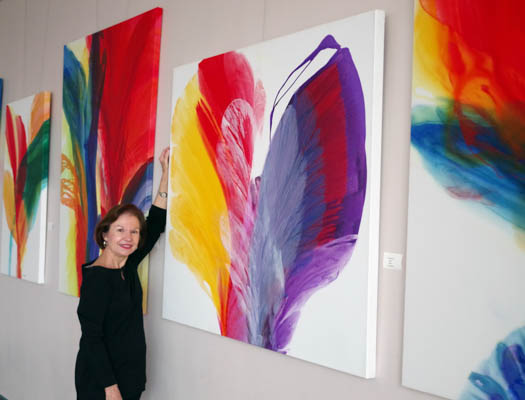
Artist Jane Segrest


By Diane Mercado, Photography By Val Schoger and Ashley Atkinson
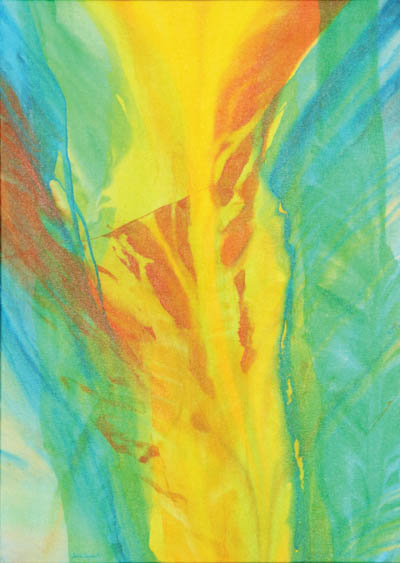
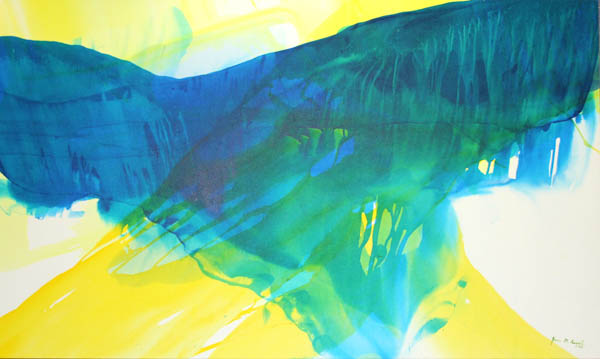
– – The act of pouring layers upon layers of acrylic paint in bold, striking colors leads to stark contrasts of shapes, lines.
These are the signature trademarks of artist Jane Segrest’s abstract paintings.
“I approach my art intuitively, using many layers of transparent and opaque acrylics in a range of colors extending from subtle tones to vivid, flowing layers of brilliant hues,” she says. “The paintings may appear simple when first viewed but the complexity of the colors and forms are revealed the longer one views them.”
“As an artist, my work has moved through stages of realism combined with increasing emphasis on abstract elements. Technically, I strive to develop a relationship between shapes, colors, and textures within the work so the viewer begins to feel an emotional response to the total painting, not just to one part.”
She offers advice for those unfamiliar with understanding or viewing abstract art.
“Don’t look at the painting for what it resembles, instead look at the colors, the lines, and the shapes. How does the painting make you feel? Does it evoke memories?”
Abstract art really represents what the artist feels when she paints, just as what the viewer might feel when standing before it, Jane explains.
For Jane, creating abstracts has been all about breaking rules, rules she spent years learning and practicing. As an abstract painter, Jane’s work has become all about process, what has become her passion, and her motivation to continue creating on larger-than-life canvases.
“When I approach that large, blank canvas, I’m thinking. I may make a mark or two before beginning the process of pouring, but it’s all pretty much intuitive.”

For most artists, regardless of the medium used, three of the most important elements of “good” design revolve around color, design, and value, not necessarily in that order. Jane Segrest says that art is about seeing and it can be difficult to know how to put it all together without overthinking. For instance, her theory on the use of color, “the more and the brighter the better.” Her favorite color is “red, of course.”
Light also plays an important role in when and how Jane’s creations are viewed.
“Light and the time of day one views these paintings can reveal the multiple layers of colors created by overlapping shapes. The expansive size of the canvases also engages the viewer, creating a more intimate closeness with each painting.”
Working on such an oversized scale seems a bold feat for someone so petite, but Jane’s been doing it for several years. She grew up in Hartford, Alabama and graduated from the University of Montevallo, where she served on the national alumni board for 15 years. She taught clothing construction classes at Tom P. Haney Technical Center in Panama City. Then it was called Haney Vocational School. When her sons, Victor and Charles, were born, she became a stay-at-home mom. Her interest in art resurfaced and she started taking classes as soon as her sons, now grown men, began attending school. Her husband, Ralph, has always supported her aspirations as an artist.
She has taken numerous classes and workshops from highly-recognized artists such as Doug Walton.
In the beginning Jane chose oil as her medium, but she soon progressed to watercolors. Through her proficiency in both mediums, Jane has gained signature-membership status into the Florida Watercolor Society, Watercolor Society of Alabama, Southern Watercolor Society, Tallahassee Watercolor Society, and the International Society of Acrylic Painters.
Her work has also been included in several publications. She has won numerous awards in national art shows and watercolor society exhibits. Through this wide audience base, Jane has become a well-known and respected watercolorist as well as an abstract painter, garnering the hard-earned respect of her fellow artists as well as her many patrons.
Just recently, two of her pieces have been accepted into the 75th National Exhibition of the Watercolor Society of Alabama and the 28th Tri-State Juried Water Media Exhibition of the Tallahassee Watercolor Society.
Jane has mostly given up oils and watercolors to try her hand at acrylic painting. She was looking for something new, she says. Now she paints mostly in acrylic, realistic and abstracts, but she still likes to go back to watercolors occasionally.
“Once I’ve done something, I think ‘What’s next?’ I believe change is good and exciting,” she says.
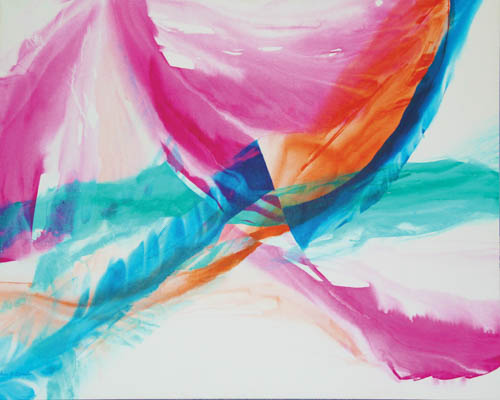
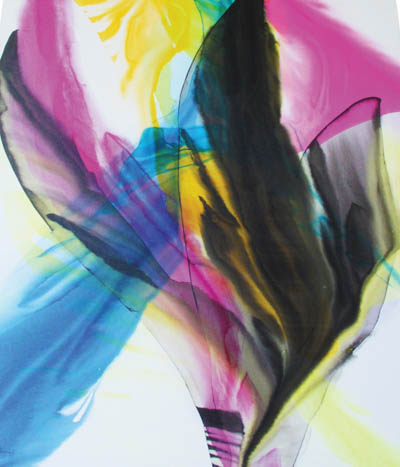
She chose to work in acrylics as much for its similarities to painting in oils as for its differences. Acrylics, like oils, allow a painter to work over an area once it’s painted. Unlike oils, acrylics take minutes to dry while oils can take several days. She remembers a few times when she worked in oil and delivered paintings at the last minute for an art show or exhibit and had to place “wet paint” signs on her work so no one would touch them. “I am an impatient painter,” Jane admits. “I don’t want to wait five or six days for oil to dry. And working with acrylic is very forgiving, unlike watercolors. I can paint today and if I don’t like it I can paint over it tomorrow. ”
Jane’s paintings speak loudly through her strong use of color. “I love color. I have never met a color I didn’t like. There are rules to learn as an artist, but I never assume the rules are the only way to do something.”
The motifs she paints range from large realistic flowers and impressionistic figures to completely nonobjective abstract works. She feels the process of how something is painted is more important to her than the subject matter. Her use of various media allows her work to stay fresh and creative. Her works can be found in numerous corporate and private collections.
“My desire is to continue growing in my art, to go beyond where I am today, and keep my brushes wet with paint,” she concludes.
Her large body of work currently takes up the entire first and second-floor entry halls, as well as two upstairs galleries at the Marina Civic Center in Downtown Panama City. The exhibit will continue until June 11, 2016. The Center is open to the public from 9 a.m. to 5 p.m. Monday through Friday and is located at 8 Harrison Avenue, Panama City. For information call (850) 763-4696.
Jane Segrest, Contact Info:
(850) 326-1140
www.janesegrest.com
janesegrest@yahoo.com