
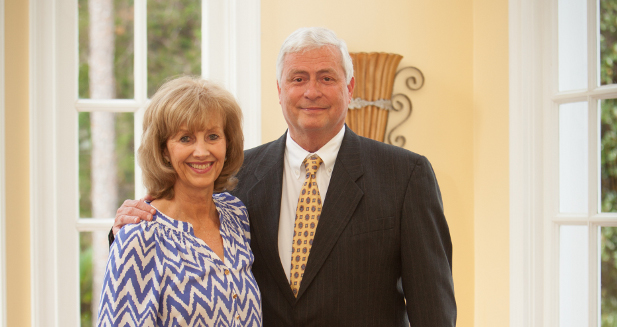
Allan Bense – Standing Tall After Overcoming Guillain-Barré Syndrome


By Val Schoger; Photos by Teresa Tuno
Allan Bense stands 6’1” tall again. For months Guillain-Barré syndrome had a firm grip on his life. Paralyzed and subjected to excruciating pain, it took months-long treatments and physical therapy until finally he would see signs of improvement and could stand on his own feet again.
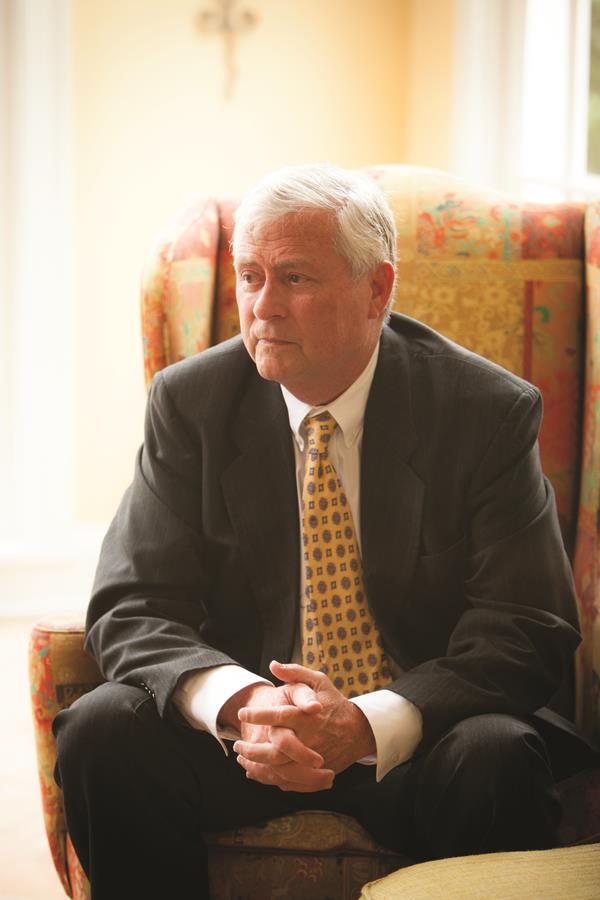
Today, he talks humbly about his recovery. “I am only 95% back to normal,” he states with a smile while looking down at the pair of sneakers that he is wearing during our interview. The training shoes are in stark contrast to his elegant dark business suit. Regular shoes are still too uncomfortable and confining. The choice in shoes, the wheelchair he had to use for months, the shock for the family, the months long uncertainty, the hard work, the pain – the experience will stay with Allan Bense and his family forever.
It all started with warning signs. “Probably mid-August of last year, my hands began to tingle a little bit and my feet were sort of buzzing. Then it was hard to get up and out of a chair. I gradually got worse and one night I just felt really bad. I go to bed around 9 p.m. usually. That night I could not sleep. Then, about 11:30, right before midnight, I said ‘My hands are burning, my feet are burning, something’s wrong . Let’s go to the hospital’.”
It would take two days of painful tests before doctors diagnosed him with Guillain- Barré syndrome. In the meantime, Allan Bense had gotten weaker and weaker and developed breathing problems and had to be placed in Intensive Care.
Guillain-Barré syndrome is a disorder affecting the peripheral nervous system. Paralysis and weakness in feet and hands and pain are common symptoms in GBS . Patients often describe the pain as deep aching pain in the weakened muscles. He describes it “It was the worst pain imaginable. I am not trying to be dramatic but I couldn’t move and the only thing I could feel is pain all over.”
His wife Tonie was with him every minute during the ordeal. She recalls that he would lie on his back and tell her there was a screwdriver under his back. But there would be nothing there. She had to make sure that his bedding was always free of creases. The blanket had to lay open, all sheets were pulled tight, he was surrounded by pillows, and still his entire body would hurt.
There are two forms of treatment for Guillain-Barré syndrome. After identifying the disease two days after admission to the hospital, Allan Bense was administered intravenous immunoglobulins (IVIg) to neutralize harmful antibodies. But his condition got to its worst after seven days in the hospital. Today he has no recollection of the events that followed as his family decided to move him to Shands Hospital at the University of Florida in Gainesville where his condition stabilized but the excruciating pain remained. He spent a week in Gainesville and was told that rehabilitation and daily therapy were needed.
He spent the next four weeks at HealthSouth in Panama City where therapists, nurses, and his wife Tonie would help him exercise his limbs every twenty minutes. It took four people to move him into a wheelchair and he would remain in pain and unable to move. He remembers his devastation after seven weeks when Dr. Elzawahry told him that he was not making progress – the treatment was not working.
“It was living hell. You know, you’re just trying to get through the day; you’re trying to get through the hour. What’s even worse is the uncertainty because while now I know a lot about Guillain-Barré, we didn’t know anything about it then. Here I am. I literally woke up one morning and I could not move anything except my eyes . You don’t know if you’re going to be like that for the rest of your life. For I don’t know how long, maybe a month or so, we didn’t know if I would get better. It’s horrible . It is painful.”
He was admitted to Bay Medical Center to try a second treatment known as plasmapheresis . This process filters antibodies out of the blood stream. Finally, on the tenth day of the treatment he was able to move one leg . With the completion of the treatment, his family decided to have him transferred to Shepherd Center in Atlanta, one of the Top Ten hospitals worldwide for brain and spinal injury rehabilitation.
An electric wheelchair and a Hoyer Lift were making his life easier at Shepherd’s. He had a physical therapist, an occupational therapist, speech therapist, and a physical trainer. He recalls the many people he met at the hospital who were so much worse off. “After two days at Shepherd’s, I stopped feeling sorry for myself. I met so many people who would never walk again. I realized that I had hopes to get out of the wheelchair – so many of the other patients did not. I worked hard and I was determined to get better.” His eyes wander off as he explains how he dealt with the pain. “Well, when you’re in that much pain, you have to go to a different world. You have to mentally go to a different world. It is almost like self-hypnosis. At night, they used to put the patients at Shepherd’s with Guillain-Barré in a wing of their own because they cried and screamed all night. By the time I got to Shepherd’s I was beyond that extreme pain of the first month. Painkillers? They didn’t work. I have a reluctance to use them anyway. I had to occupy my mind with positive thoughts. I would think about the day when Courtney, our daughter, was born. What we did that morning, when it happened. I retraced our steps and how happy we were and it helped me cope with the pain. I wanted to get better. So I worked hard and, if my therapist would tell me to do twenty sets of exercises, I would usually do thirty.”
As he recalls the time at Shepherd’s and the other patients who would show great spirit and great attitude, his emotions are boiling up. “I don’t like anxiety. I don’t like uncertainty. I want to know what my challenge is. Then I can figure out how to beat it.” The day that his therapists told him that he should try to stand up on his own was a breaking point. “The day I stood up was huge. The other patients were so much worse off and some don’t even have a prayer, but they all clapped for me when I first pulled myself up out of the wheelchair and walked two steps. I’m a pretty tall guy and when you’re in a wheelchair, you’re always looking up at people . Psychologically, it is not a good thing. Then that day I walked two steps on the parallel bars, and then the next day I walked to the end of the bars and back, and I kept pushing for more the next day ”
While Allan worked hard on his recovery, Tonie would try to manage the supportive messages and cards that friends and family and people from all over the State of Florida would send him by the dozens on weekly basis. There were just so many concerned people and the support helped him deal with his situation.
Finally, just before Christmas 2013, on December 20th he was released to go home and would continue working locally with physical therapists. He still had to use a wheelchair and a slider board to get in and out of the chair but soon he would try to rely only on the walker and then, by the end of January 2014, it was on to using just a cane.
In February he picked up where he left off and went to the first board meeting at Florida State University where he is the chairman of the board of trustees.
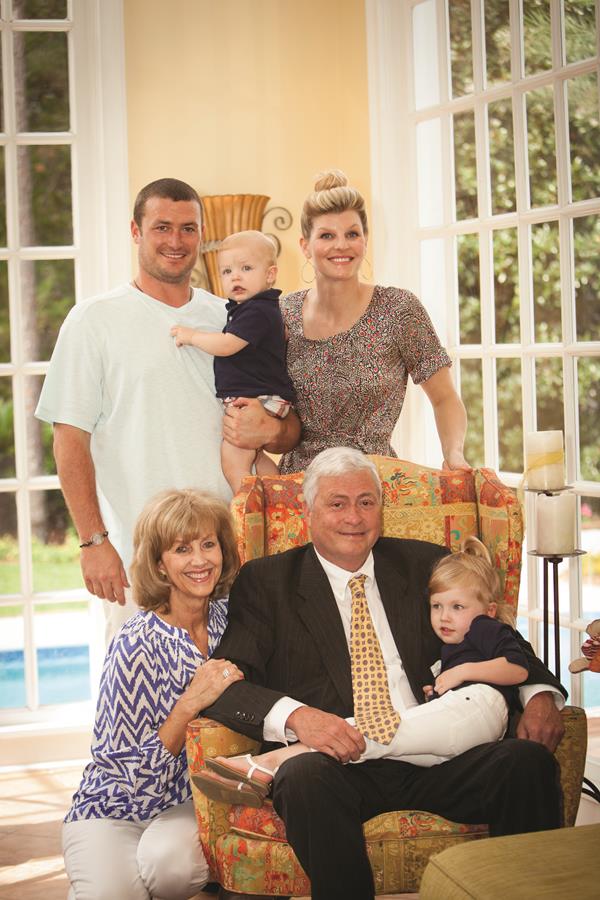
When he thinks back, he remembers his family being there every step of the way. “I wouldn’t have made it without Tonie. I mean I never would have . She was there and I know I was just a pain. Literally a pain, but she didn’t give up on me.”

For our readers, he reflects on the things that are important in his life. “I love my family more. You appreciate them more when you’ve flirted with death and came as close as I came. You have a better appreciation for those who are around you, who are with you. I think I have really put this whole thing in my rearview mirror. I seldom think about it because, if you go down that road, just like today, remembering some of the details makes me very emotional. I’ll tell you what, I have a better appreciation for folks with disabilities. Really, when you can’t do anything, you’re so totally dependent on other people that literally in the morning bathe you, dress you and feed you, you cherish them a lot more than you did before. I got a second chance on life. I worked hard at Shepherd’s because I frankly didn’t want to sit around the house in a wheelchair for the rest of my life . So I pushed. I pushed harder than ever. If you can survive the first two weeks of the disease, then the prospects are fairly good. You can’t let your muscles atrophy because if they do, you’ll never walk again. I had to push hard. I would tell the readers ‘Don’t ever give up’. God is good, and that I do know. We’re just lucky, blessed. God gave me a second chance. I think it was real dicey, and God decided to give me another crack at it. The outpouring of support for me from my community here was unbelievable. I think I was on every church’s prayer list. The caregivers at the facilities I was in were superb. And I know I was real cranky! From the bottom of my heart I thank everyone.”
Allan Bense is a self-made man. Both his parents died when he was a teenager and he worked hard to pay his way through school. He graduated from Florida State University with a Bachelor of Science in 1972 and a Master of Business Administration in 1974. He met his wife the same year and they married one year later. “Our first home was a garage apartment across from the St. Andrew Bay Yacht Club,” Tonie Bense tells us “I owned a stereo and a TV and I had more than he did.”
He started his career as a loan officer and Tonie opened her first dance studio. Three children would follow and life became very busy for them raising a family and venturing out to start several small businesses. Both became very successful with their businesses.
[box type=”shadow” align=”aligncenter” ]Career Highlights – Allan Bense:
- Florida State Representative, District 6 from 1998 to 2006
- Speaker of the Florida House of Representatives from 2004 to 2006
- Chairman of the board of trustee at Florida State University
- Member of the board of trustees of Triumph Gulf Coast, Inc. (oversees spending of the BP Oil Spill claim)
- Chairman of the board of the James Madison Institute
- Past chairman of the Florida Chamber of Commerce
- Director at Northwest Florida Manufacturers Council, Inc.
- Member of the Board of Directors of the Gulf Power Company, a subsidiary of Southern Company (SO; NYSE )
- Member of the Board of Directors of Capital City Bank Group (CCBG: NASDAQ).
- Chairman of the Board of the Bay Economic Development Council
- Past Chairman of the Florida Council on Military Base and Mission Support
- Past Vice Chairman of Enterprise Florida (the Governor is the honorary chairman)
- Past Chairman of the Florida Taxation and Budget Reform Commission
He is a partner in several companies with interests in road building, mechanical contracting, healthcare, insurance, general contracting, golf courses, pavement marking, farming and others such as GAC contractors and Holiday Golf Club. [/box]
[author image=”https://www.panamacityliving.com/media/2013/08/Val.jpg” ]Val studied communications and marketing in Germany and holds a marketing degree. She had a corporate career and has worked for nine years in media, PR and marketing internationally in Germany, England, the Caribbean and the United States. During an extended sailboat cruise n 2003, she traveled to the Gulf Coast and subsequently to Navarre, Florida and was immediately smitten with Northwest Florida. She started her first business in 2004 in Fort Walton Beach and as of July 2013, she became the sole owner and publisher of Panama City Living Magazine. She obtained her Merchant Mariner Credential (Captain’s License) right here in Panama City at SeaSchool and enjoys being on the water when she finds the time. [/author]