
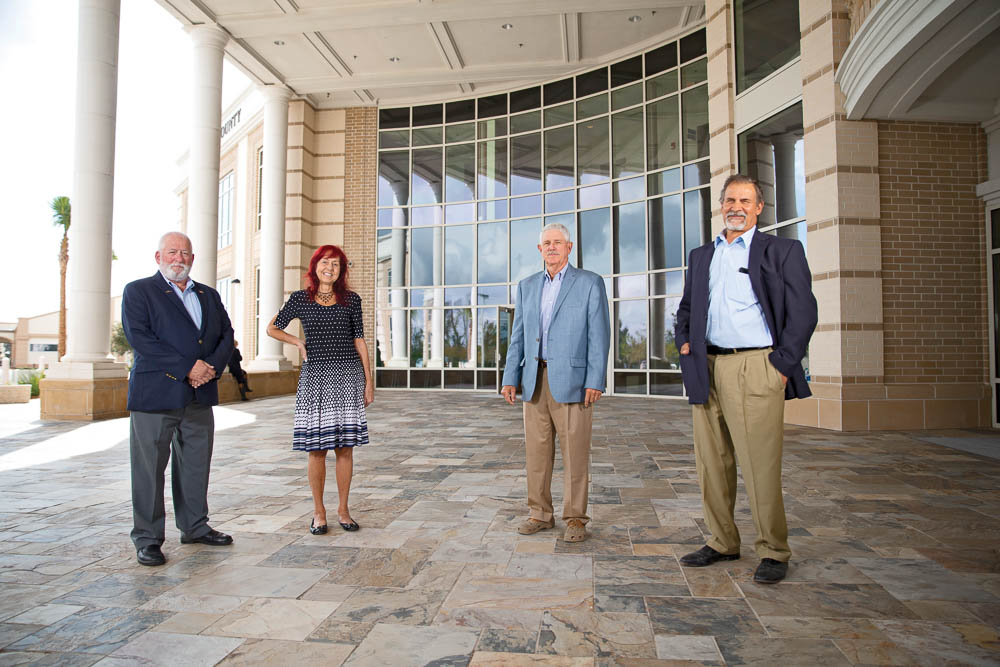
COMMUNITY LEADERS – One Year After Hurricane Michael


BY VAL SCHOGER
PHOTOGRAPHY BY MIKE FENDER
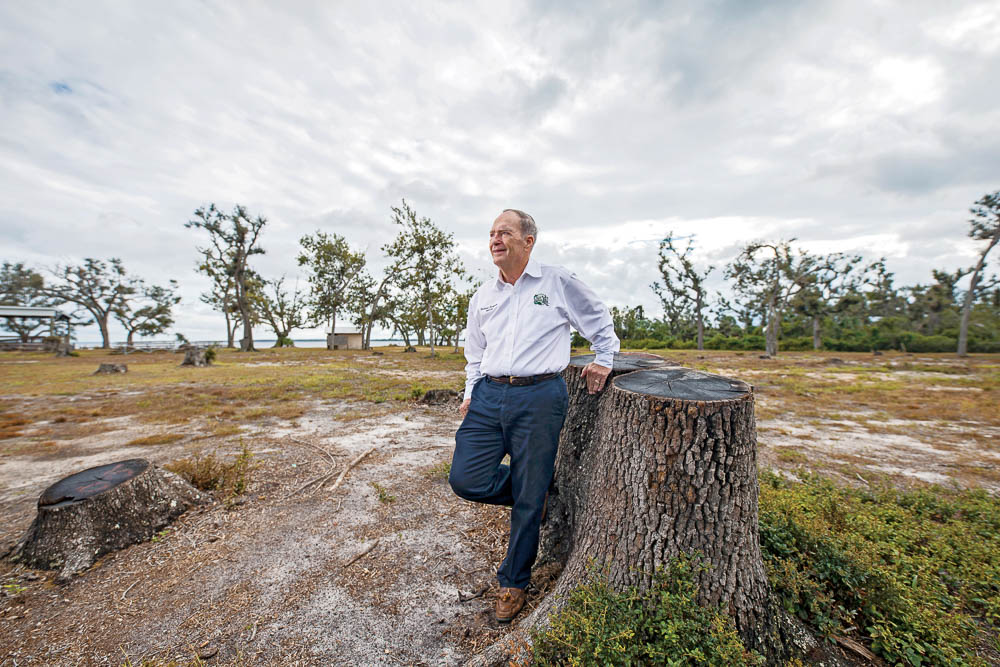 The City of Parker
MAYOR RICHARD MUSGRAVE
The City of Parker fared better than most of the municipalities in Bay County. When Hurricane
Michael subsided, the city’s government buildings were still standing and workable, including City Hall. But Parker’s formerly 4,500 residents faced severe destruction of their homes. “Currently, we estimate we have a population of 3,600 to 3,700,” says Mayor Richard Musgrave. Just like neighboring communities, his city saw a decline in population immediately after the storm.
Many of the residents are in some way connected to Tyndall Air Force Base, whether they presently serve active duty, are employees, or are retirees. Richard Musgrave himself was stationed at Tyndall from 1964 to July 1967 but, at the time, he was not even aware of the small but growing community that would become a city in September of 1967. In 2005, after having owned and operated a business in Atlanta, Musgrave and his wife bought a house in Parker to live here permanently and be close to family.
“My wife and I both noticed when we first moved to Parker that the people here can be identified, for the most part, as being genuine. We have incredibly good folks in our community,” he says. Apart from the people, another distinction that makes Parker attractive is its waterfront. “We are only two square miles in area, but we have 12 miles of coastline,” he points out. “That’s an asset we have that makes us unique. We hope that we can be attractive enough to start drawing people that are coming into Tyndall Air Force Base and seeing us as a viable preferred place to live.”
According to the mayor, Parker is primarily a bedroom community. He adds that the city faces the same problems as its neighbors, with a lack of housing, especially affordable housing—after the storm. But even before the storm, he had a wish list of improvements he hoped to make, with the revitalization of the business district along Business Highway 98 as top-priority item. Just before the storm, the city had replaced and updated some of their fleet vehicles and infrastructure, which proved advantageous post-hurricane.
Before the storm, the city proudly promoted its new dog parks that were unique in the area and drew people from all over Bay and other counties. One was a social dog park and the other a fully equipped dog training park, also called obedience agility park, “So that’s what people miss and they want to have back,” he explains. “It’s one of the design elements that we absolutely have to have in our sports park planning.” National Park Services and FEMA groups are working with the city on concepts for new parks.
With around 630 children currently enrolled at Parker Elementary School, Musgrave is glad to report that the school had only minimal damage from the storm and was selected to take in kids from other schools that were inoperational.
The City of Parker made fast progress in their initial recovery, with most roads passable by day three after the storm and water and sewer operational by day nine. “In the beginning, we had to make sure that we took care of our employees so they could turn around and take care of the citizens. Some of our employees have faced incredible loss,” he explains and adds that the debris pickup was completed around April 15th, with 600,000 cubic yards removed, a cost of about $8 million.
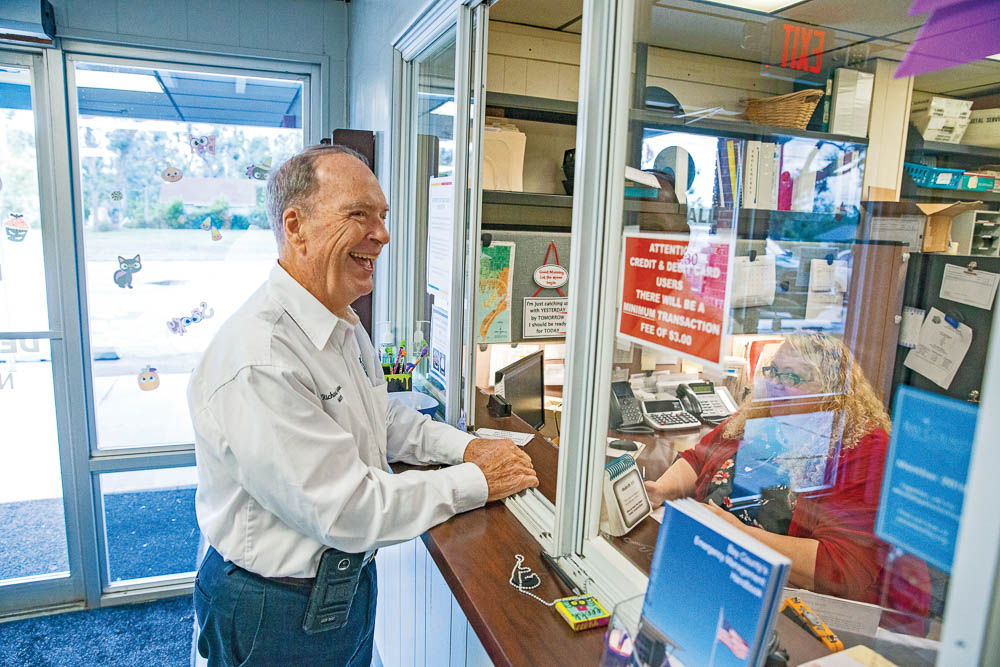 On the lookout for cost savings, the city’s debris hauler came to an agreement with WestRock, the current operator of the paper mill in Bay County, resulting in lower travel costs as chipped wood could be unloaded at the mill. To avoid drawing on its reserve funds, the city negotiated a multi-million dollar credit line for invoices that require immediate payment.
The City of Parker does not impose an ad valorem tax on their constituents, and with a decrease in revenues—Musgrave estimates that around 400 of their 2,000 customer accounts were lost—the city had to file for community disaster loans.
The people of the City of Parker remain one of its strongest assets and Musgrave is full of praise for the community. “The real high points and benefit of a small community, is, for example, having a police department where the officers know many of the residents, and the residents know them. I think our people understand that they get superior service, which makes Parker a great place to come home to.”
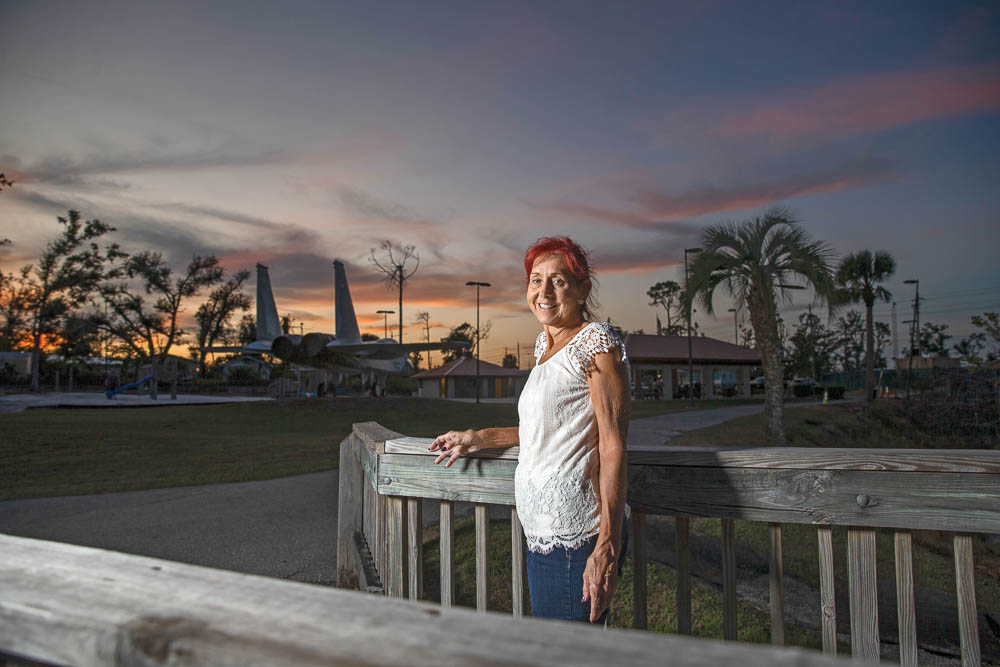
The City of CALLAWAY
MAYOR PAMN HENDERSON
The origins of the City of Callaway can be traced back to the 19th century when the people in the area made their living with fishing, or worked in timber and turpentine production mills. The community grew in tandem with Tyndall Air Force Base, which had started out as a gunnery range in 1941. Within mere minutes of driving time to Tyndall’s main gate, Callaway offered a convenient location and the city, becoming incorporated in 1953, grew exponentially in the 1960s and 1970s. The population within the city limits of Callaway was estimated at 14,500 before Hurricane Michael made landfall.
Pamn Henderson, mayor of Callaway, estimates that 25 percent of the population has moved away after the storm. Blue tarps are still seen on many roofs in the city, and many residents are living in campers and RVs in their front yards while their homes are rebuilt or repaired. This includes the
mayor and her family. “We think that around 90 percent of the residences in Callaway were in some way affected by the storm,” she speculates.
Her own family came to this area in 1973. Henderson was 19 years old at the time. “My father had just come back from Vietnam and he decided to retire from the Air Force. We had never been stationed here, but we had friends in this area, and this is where my parents decided to buy a house. Back then, Callaway seemed like it was a hundred miles away from the Panama City area. You just drove and drove; it seemed like you drove forever.” Henderson’s late husband also served in the Air Force and after moving from base to base with him for 20 years, when he retired, they decided to move back to Callaway, to the same neighborhood her parents and sister lived in.
With a background as a certified public accountant (CPA), Henderson worked as the financial director of the Panama City Airport for 16 years; her role included the administration of the construction finances when the airport was relocated. It is now operating as Northwest Florida Beaches International Airport.
With a passion for her community, Henderson became a city commissioner in 2012 and has been the mayor of Callaway since 2017. “I was heartbroken to see the destruction after the storm,” she says with concern clearly written on her face. The numbers are staggering for a small community. “So far, we have moved over a million cubic yards of debris at a cost of over $19 million. We have 60 properties that we are waiting for approval for demolition. The city will have to pay at least $10,000 per demolished property. Callaway, just like everybody, had to borrow money to pay for all of these and wait for reimbursement from FEMA, which is still in progress.”
Like city officials in other municipalities, she is concerned with the interest for the loan. “With the amount that we borrowed, and although we have a very low-interest rate, we are still looking at a considerable amount that has to be paid out of city funds, as it is not reimbursable by FEMA. So, you don’t want to increase taxes, but we also have to be able to maintain our level of service.”
The positive aspects after the storm include the fact that several residential developments within the city limits are getting started or have been expedited. “One 150-house development will be completed this year, instead of extending over several years. We should have about 900 new houses, 600 new apartments, and about 85 new townhomes completed in coming years,” Henderson states. Construction of a new 159-room hotel is also slated to begin this year.
The city has made investments in the past that are now paying off, she explains. “What
has caused controversy in the past, the city’s costly investment in new infrastructure by upgrading and installing new water lines during the construction boom several years ago now gives the city an advantage. The waterlines ended up not being used after the economic downturn but our investment is now coming back into play. We are in a really good position for new development. Callaway is one of the few cities that has room for growth and the infrastructure in place to do so.”
When at the beginning of 2019 the Bay County Schoolboard had discussed temporarily closing Callaway Elementary School as less than 400 students attended it in the hurricane aftermath, Mayor Henderson successfully appealed for the community school to remain open. She is now happy to see that the student count is increasing, with currently 365 students in attendance. As the city sees new and remodeled homes coming online every day, this number should soon increase.
In many ways, the elementary school is part of Callaway’s history and future. A place for education has been part of the community since its early years of existence when a one room schoolhouse opened in Callaway in 1911. The building remained in service until 1936, until children started attending school in a larger building. The historic one-room schoolhouse can still be seen to this day at Gore Park, where it has been moved and is maintained by the Callaway Historical Society. While the building sustained damage during the hurricane, reconstruction with authentic historical building materials will begin next year. Reconstruction of the school will be closely monitored so that the building can retain its status as a historical monument.
With the ongoing reconstruction efforts at Tyndall Air Force base, Mayor Henderson’s city is well on its way to recovery. She is looking back with pride on a year of exceptional efforts from city employees in all departments despite the fact that many of them lost their homes in the storm. In addition, an unprecedented common effort with neighboring communities was established and there is a new sense of community. “After the storm, you saw neighbors helping neighbors. All our employees at city hall came together and helped each other. This storm has really brought us all together. The county set up a task force for a long-term recovery plan; cities worked with cities more than we ever did before.”
[divider]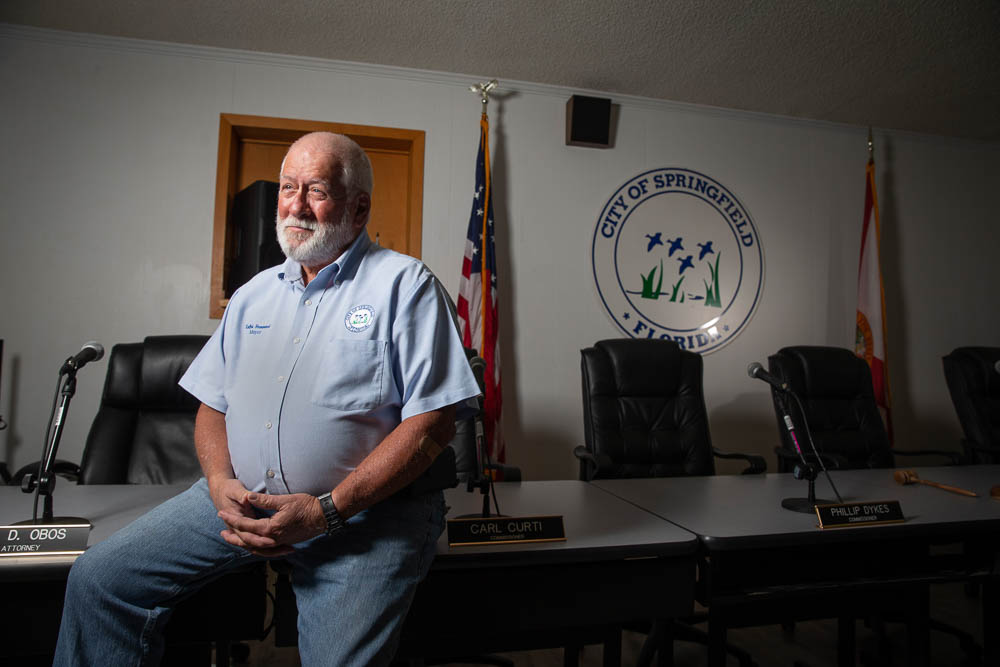
The City of SPRINGFIELD
MAYOR RALPH HAMMOND
The mayor of Springfield, Ralph Hammond, has a message: “Give us 10 years and we will be one of the most beautiful cities in our area.” He smiles his widest smile when he makes the announcement and explains that plans are well underway to completely transform his city. Springfield will have several parks with nature walks, as well as new government buildings
Even before Hurricane Michael had wreaked havoc, city employees and commissioners had secured grants for improvements to the city’s infrastructure. Long-term plans for the construction of new government offices were in place. Now these plans have been expedited and his team, as he opts to refer to city employees, are rallying to make their community a better place.
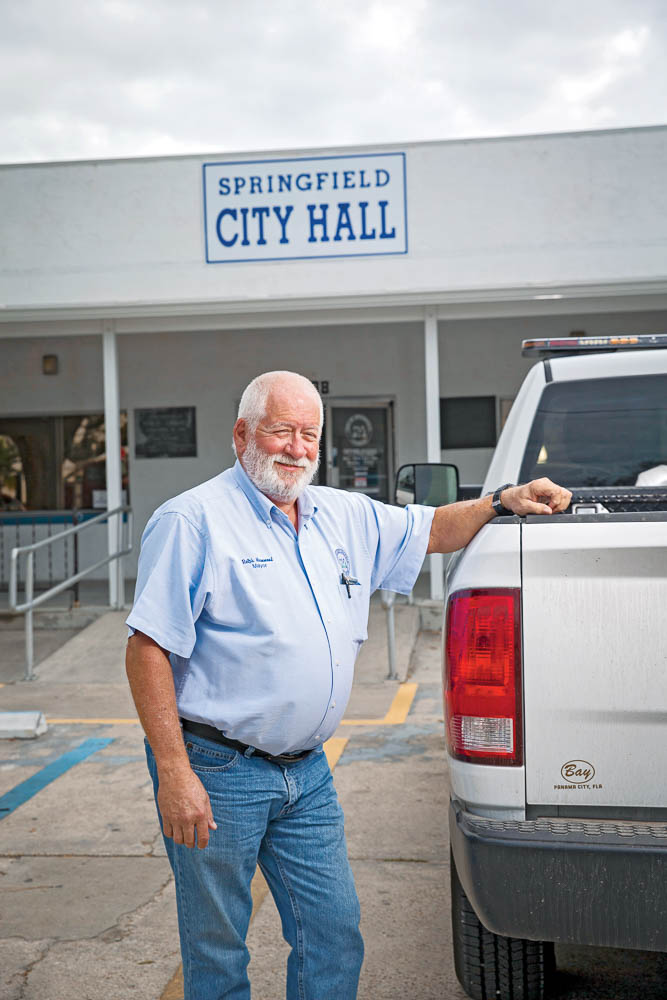
After losing all but one government building during Hurricane Michael, city employees have settled into a building that was last used as the local library; it was once city hall, back in 1961. “This is just temporary,”
Hammond says about the cramped quarters that he and his team are working in. A 28-acre land tract along Highway 22 has been purchased and the city is in the process of requesting proposals for the design and construction of the new government buildings.
Hammond moved to the area in 1981 when he was stationed at Tyndall Air Force Base. He met his wife, a nurse, here and they have been married for 34 years and have lived in Springfield for just as long. In the 1990s, after retiring from 22 years of serving in the Air Force, Hammond started working as a heavy equipment operator, a skill that he is now putting to good use for his city. Nowadays, when he is not attending to day-to-day business or participating in meetings to discuss recovery efforts, he can be found working alongside the demolition crews.
His background resembles that of many of Springfield’s residents. “Many of our residents are connected to Tyndall Air Force Base,” he explains. While the paper mill has been providing steady employment, its need for workers is limited. New jobs only open up when someone retires or leaves. When the City of Springfield was founded in 1935, the majority of its residents worked at the paper mill. Once the gunnery range that would become Tyndall Air Force Base opened in 1941, it brought more population to Springfield. From around 5,000 residents in 1985, the city had grown to around 9,000 residents before Hurricane Michael, with an estimated 35 percent of the population leaving the city after the storm.
When Tyndall Air Force Base announced its “installation of the future” plans for reconstruction, it was the moment of assurance for the City of Springfield. “It was a tremendous relief to all of us. Tyndall is a very important part of our economy,” Hammond points out.
There is still uncertainty about two of Springfield’s schools, Everitt Middle School and Springfield Elementary, which were closed after the storm. Students now attend schools in neighboring communities and Rutherford High School has become a combination school for grades 6 to 12. The reinstallation of Springfield’s closed schools will depend on its re-growing population.
Just like its neighboring municipalities, the City of Springfield faces large expenses for debris removal that are yet to be reimbursed by FEMA. “Right now, we are around $14 million in debt. That’s not counting the private property debris removal yet. By the time that is completed, we are probably looking at $20 to $25 million in debris removal costs.” Hammond explains that the city negotiated a line of credit with their bank and is having to pay interest fees until the reimbursement of the invoices from FEMA comes through. But the good news is, there are residential developments underway. “Growth is planned towards the north and east of the city,” says Hammond. Several developers have announced plans for residential units.
The last 12 months have been challenging and emotional for Mayor Hammond and the entire team. During Hurricane Michael, he and 23 members of the police department were trapped in the now demolished city hall. The terrifying experience is still vivid in his mind. “When the storm raged, the building came down around us. We could not get out and found refuge in a small hallway in the center of the building. We huddled together, sat on the ground and prayed. We thought we were dead.” Even several hours after the storm, the men could not get out. His wife, who stayed at their house with other city employees during the storm, endured several hours of devastating uncertainty until the men were found.
 The events confirmed Mayor Hammond and his family’s faith in God. Around 10 days after the storm, when he went back to salvage documents and personal items from his office, everything was waterlogged. “My secretary, Jeanie, found the Bible that my wife had dedicated to me when I first took office. It had sat in three inches of water. I took it home and laid it out to dry. When I went back to check on it after a few weeks, there was not a fade and wrinkle. You know what water does to paper … but there was no water damage to the Bible. My wife had written a dedication inside and it was clear to read, no blurring. The only thing that was different was the gold foil that had come off from around the edges of the pages.” As the emotions are written plainly on his face, he adds, “It was like a message. It told me that Springfield will make it through. It’s going to be a long recovery but we are up for it. People said 850-strong after the storm; now it’s 850-stronger.”
The City of PANAMA CITY
MAYOR GREG BRUDNICKI
Panama City, one of the most populated and history-rich municipalities in Northwest Florida, has seen much change in the last 110 years since its incorporation. The city is positioned for economic growth. The area’s largest hospitals are within city limits, as is the Port of Panama City, an international seaport administered by Panama City’s Port Authority. Other nearby infrastructure such as Northwest Florida Beaches International Airport and the Bay Line, a short-line railroad, makes Panama City one of the area’s most convenient locations for business and industry.
With Hurricane Michael leaving deep scars on Downtown Panama City and its oldest neighborhoods, the marinas and the 2,000-seat Marina Civic Center remain closed. The displacement of many of Panama City’s businesses and residents after the storm also remains an acute post- Michael status. Panama City’s mayor, Greg Brudnicki, has lived in Panama City since 1965.
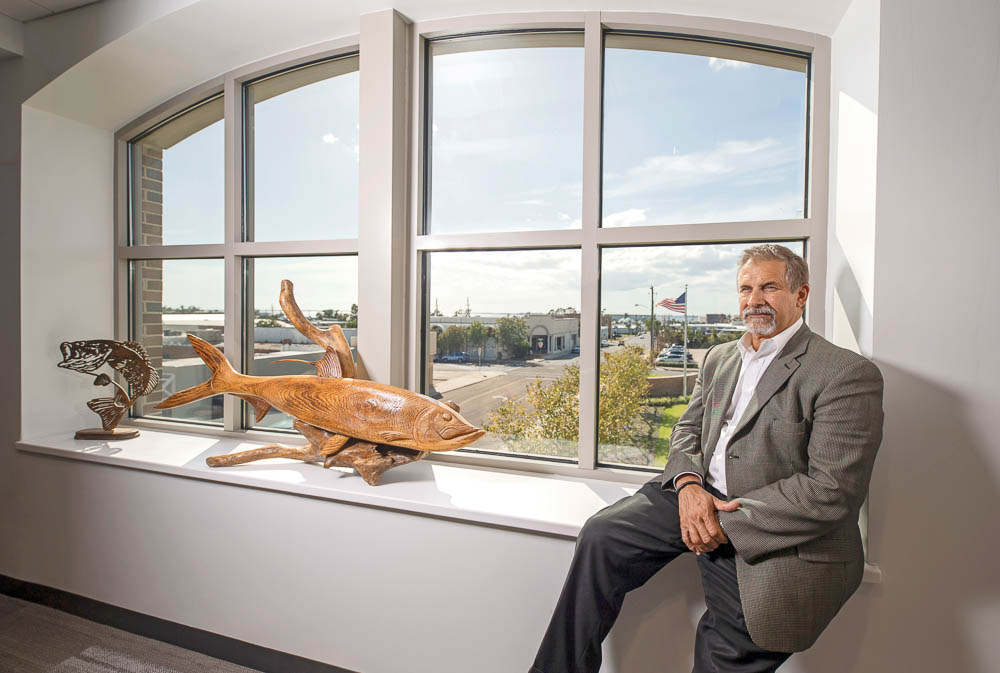
He has a background as accountant and is a local business owner. Serving as mayor since 2011, Brudnicki has started his fifth term in office, doubtlessly his most-challenging. The city government has just moved into the new City Hall on Harrison Avenue and Brudnicki’s office overlooks the rooftops of West 5th Street. “I remember sitting on the roof of one of the buildings here on Harrison Avenue as a boy, watching how the Dixie Sherman Hotel was demolished,” he says, his eyes shifting in the general direction of where the hotel once stood, just a few hundred feet away.
The 100-room hotel was one of Downtown Panama City’s icons and economic drivers until its destruction in April of 1970 heralded the decline of Downtown’s economy, caused in part by retailers migrating to the Panama City Mall that opened in 1976. Today, construction plans by locally committed and invested St. Joe Company, Northwest Florida’s largest landowner and developer, are underway for a new hotel to be built—not too far from the Dixie Sherman’s old location.
The immediate negative effects of Hurricane Michael are certainly not resolved yet. “It’s been a learning experience and it’s one of those things that you hope never happen. We had no idea it would be that bad,” Brudnicki says, adding that the cleanup and debris removal cost has a harsh impact on the city’s finances. “We’ve gotten to the point now where we picked up 36 years’ worth of debris. In other words, we usually have about 100,000 cubic yards a year in the city from tree trimmings. From a cost standpoint, our city has a budget of about $90 million a year and we were adequately reserved, with between $14 and $16 million.
Our debris and emergency expense bill is north of $150 million now, which is 10-times what our reserves were.” The city had to take out a loan to pay the bills and the interest fees are impacting the city’s budget. “I would like to not have that much debt on the books,” Brudnicki says, remarking that all the city can do is file and wait for reimbursement from FEMA. While there is no immediate solution to expediting the reimbursement process, the migration of residents can also not be resolved immediately. “We probably lost 25 percent of our population. 70 percent of the people in Bay County are renters. Which is opposite of most communities.” He hopes to get several destroyed apartment complexes reopened within the next few months. Eight million in funding has been received from the Florida Housing Authority.
His estimate of the current population count is somewhere around 26,000, or around 30 percent less than the 36,000 residents that were counted in the 2010 census. Each resident generates around $1,000 to $1,500 in tax revenues per year in addition to economic impact, according to Brudnicki. Despite the challenges, he remains dedicated and focused. “I treat everything in this city as if it was my personal responsibility to take care of. That’s the oath that you sign. I am very optimistic about the future. I think that there is a silver lining to the storm.
If you are going out to the marina right now, we’ve got about half of the destruction cleaned up and most of the assets that were on the marina that are out in the water were over 50 years old. It needed to be replaced. So, the demolition was done by the man upstairs and now we’re cleaning it up. I will always take the positive approach to rectifying a situation.” He points at the success of the Bay City Point development on 23rd Street that has now entered its second development phase. “We are still the hub for commerce.
Our business corridors are very active. We may have a decline in population but the number of people that go in and out of the city every day is much higher. These are people who live in other parts of the county but come to work in the city. Our government is policing and maintaining a large area that has a huge amount of commerce that goes in and out.” The redevelopment plan for Downtown Panama City was finalized in October by town planning firm Dover, Kohl & Partners. After months of studying Downtown and surveying its residents, the new concept has garnered the highest approval rates from locals.
The hotel development is planned to break ground in 2020, and it is just the first step of many. “With St. Joe Company we finally have a partner with the wherewithal to do something substantial. The construction of a beautiful hotel, a restaurant, and amphitheater on the downtown marina will get the redevelopment started. They are going to do it right and it’s going to be first class and that’s what our people deserve,” Brudnicki states. With long-anticipated plans finally underway, he explains that these are just the first steps.
“One of the goals that I had when I was elected back in 2011 was to redo downtown and take non-income-producing assets and turn them into income. But we still need infrastructure. We have dated water pipes. We are estimating probably $150 million to replace all the outdated infrastructure that we have in the city. Well, you can’t do that without a revenue source. Our goal right now is to make Panama City the premier city in the Panhandle. We have the opportunity now to do it. We will get some help from the federal government, with hardening plans to help us make the city more resilient. This will mean that the Marina Civic Center will be most likely relocated, away from the waterfront. We have just gotten started.”
Find out more about Downtown Panama City’s redevelopment concept online: doverkohl.com/panama-city
For updates on the progress of the St. Joe Company’s Marina Hotel, visit pcmarinahotel.com