
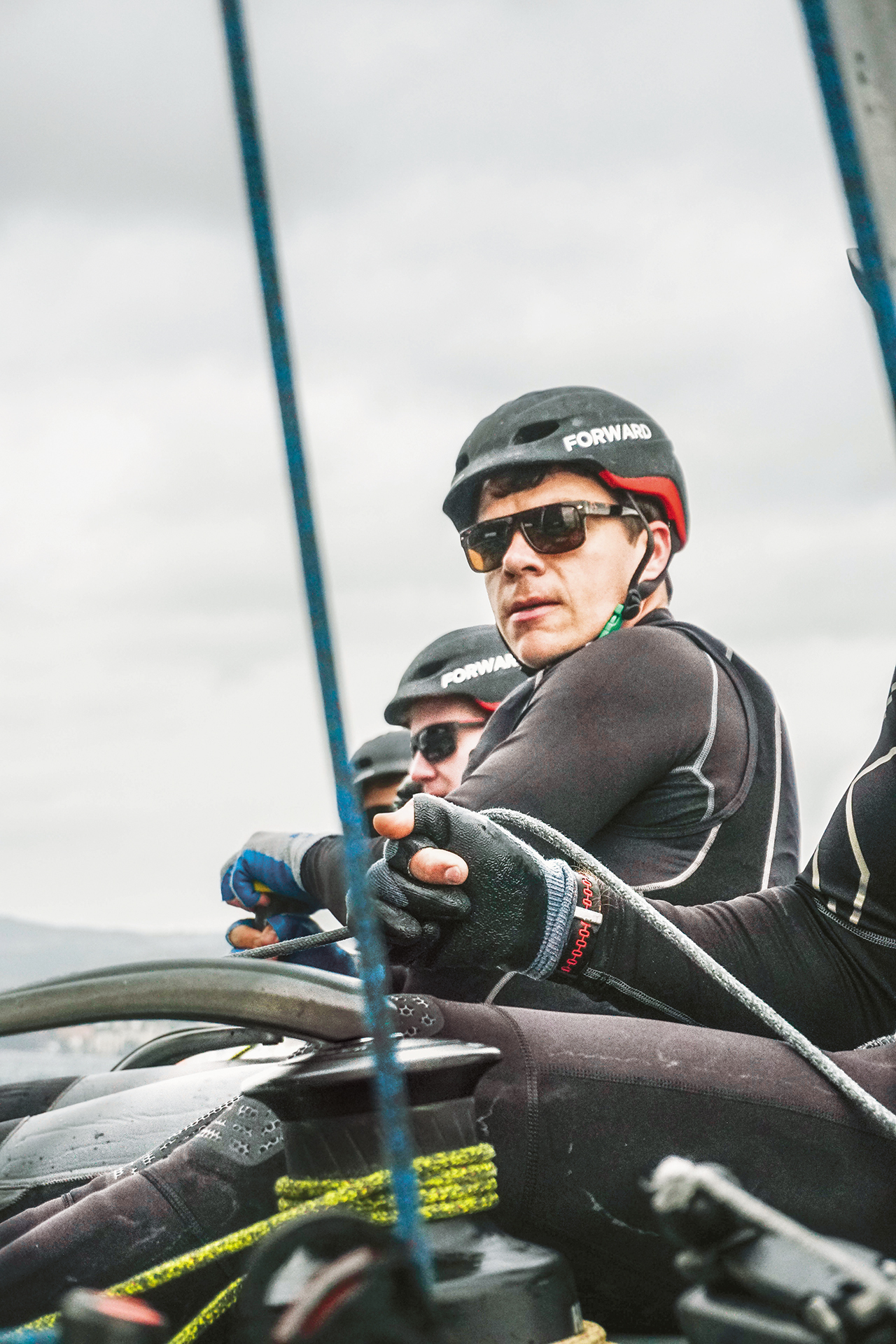
MATTHEW WHITEHEAD – HIGH PERFORMANCE


BY VAL SCHOGER PHOTOGRAPHY COURTESY OF: THEO QUENEE
He has won the F-18 Youth World Champion title four times and competed in the 2016 Olympic Campaign. Matthew Whitehead, 24, is getting ready for the 2017 Youth America’s Cup that will take place alongside the America’s Cup in Bermuda in June this year. He has joined Next Generation USA, the six-man sailing team that will compete against 11 other top international contenders.
You have been training with your new team for months in Palma de Mallorca, Spain… what are the challenges you are facing as a team and individually?
I think the major challenge will be the handling of such a large foiling boat. A few guys on the team are quite experienced when it comes to foiling, but, as a team, we don’t have much time on bigger boats. Luckily we will be doing a lot of training on the GC32 and will probably compete in a GC32 Racing Tour event in Italy this May.
What was your top speed so far with the Nacra 17? Do you think you will be using/racing the Nacra 17 anytime soon again?
I would have to guess around 25 knots (about 30 mph) top speed on a Nacra 17. I may do a little bit for fun/training with some of my Youth AC team, but probably will not start racing until at least this fall. They are switching the Nacra 17 to foiling, so I am going to wait until the new boats are out. The new AC45F vs. your “usual” competition boat, the Nacra 17… is three times as large, with a new style of foils and you need three times the team members.
 Can you give us insights about boat handling and teamwork?
The AC45Fs are going to be pretty intense. The biggest differences between the big and small boats is the physical load of everything on the boat. Each person has an assigned role on the boat and is doing that job full-on all the time. On the Nacra 17, I have a bunch of smaller jobs I have to do and lines I have to pull, but it is nowhere near as physical. Since we all have our defined roles, there has to be a crazy amount of coordination between the six team members. Especially now that we are foiling! Communication is key and making sure we practice a lot to get all of our timing right.
Can you describe what it’s like to race in a team of two on the Nacra17 vs. your team of six during the current training and in the upcoming races? (I have now watched a few videos and as a dummy-onlooker, it looks like everyone on the team is trying to just “tame the beast”… by that I mean the boat).
There are definitely many “hold on to your seat” moments on the bigger boat for sure. The Nacra 17 is fast and fun, but after being on the GC32 and the AC45, it kind of feels like a toy. As for the team aspect, it is nice having a larger group to sail and hang out with, but it takes a lot more communication and coordination. Both team types have their pros and cons.
What differences/challenges do you expect with the bigger AC45F vs. the GC32 you have been practicing on in Palma De Mallorja for the past months… and what will be your first maneuver to get to know the AC45F? Do you anticipate times during the race where you will be able to reach the proclaimed “potentially 35 knots” speed of the AC45F?
I think the biggest differences between the two boats are the size and the wing. The boat will definitely be more physical, and trimming the wing sail is a bit different, easier in some ways. I’m sure we will go straight to practicing foil gybing (turning the boat downwind while staying on the foils.) Well, considering we hit 35.1 knots* on the GC32 last week in Palma, I think we have a pretty good shot to do the same or faster on the 45.
Do you analyze your competitors – the other teams you will be sailing against? Can you predict which teams might be the strongest? Do you see a big advantage in having a local Bermuda-experienced sailor on your team?
Yeah, we have done a little research on the other teams. I know a few of the sailors from a couple of the teams. It’s really hard to know what teams may or may not be good though because there is so much more that goes into a big campaign like this than just sailing skill. I definitely think having a local is an advantage. Preston has sailed in Bermuda a lot and knows the area we’ll be sailing in, but, more importantly, he has connections in Bermuda and has been super helpful in our team’s fundraising efforts.
Provide a few insights about the physical demands and boat capacity… is there any special diet or do you have to watch your weight?
The physical demands of the boat are pretty extreme. We are working on the boat non-stop to make sure the boat is going as fast as possible. We will usually be on the water training and/or racing full-force for up to for or five hours.
Do you have to do special training, weight-lifting or prepare physically in any way?
We have individualized workout programs and diets depending on what we do on the boat and what our target weights are. We have to be below a certain maximum weight by the time of the regatta in June so we are trying to lose a little weight while maintaining our muscle strength.
What will your next year look like… personally and/or in competitions…?
Most of this year will be in preparation for this year’s edition of the Red Bull Youth America’s Cup with my newly selected tMotivation-Matthe whitehead-2017-3eam. After that event in June, I will be doing some more F18 sailing and may start getting back into the olympic class. I plan to do the F18 Worlds in Denmark in July.
Where do you see yourself in 3 or 5 years?
In my sailing career, ideally, I would be involved in some way in the America’s Cup or a cup team. But if not, maybe the 2020 Olympics.
What motivates you?
My family.
Is there one item that you take to all races?
Not necessarily. I guess I always have my sunglasses. No lucky item or anything like that, though.
Follow nextgenerationusa.org