
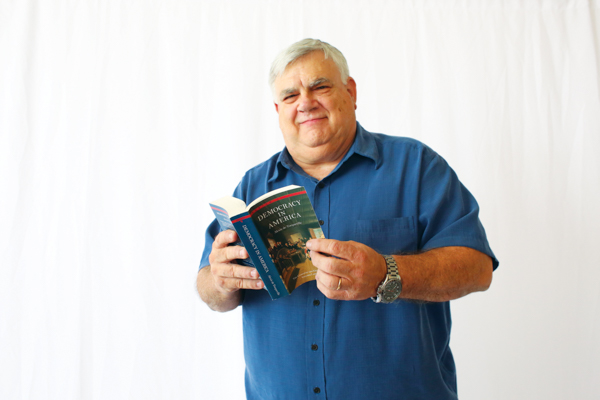
Democracy in America: Reviewed by Dr. Terry Jack, Professor Emeritus, GCSC


Photography by Savannah Jane
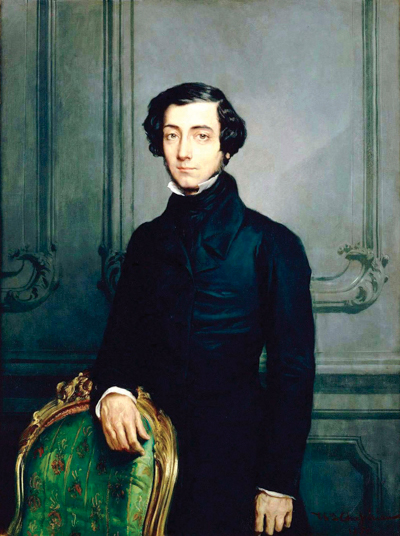
“Americans, as a group, think of politics as a dirty business and politicians as confirmed scalawags not to be trusted for a minute.” This could be a contemporaneous expression of the inexorable pace of daily political life, but it is also one of the many observations a perceptive traveler to early 19th century America, Alexis de Tocqueville, made when he visited in 1831. Tocqueville was born in France in 1805, a few years after Thomas Jefferson became president, and died in 1859, a year before Abraham Lincoln took the oath of office. He studied law and was appointed a magistrate. He came to America to study a recent sociological innovation, the American penitentiary system, arriving in Rhode Island in 1831.
Tocqueville did indeed visit several penal facilities and, in addition, he journeyed through 15 of the 24 states that compromised the Union at the time and talked to thousands of people in all stations of life. As he traveled a nation governed by the U. S. Constitution for less than 50 years, he took detailed notes of the conversations he had. Returning to France in 1832, he began working on one of the most widely read and quoted books ever written about the American character, which he published in two volumes, in 1835 and 1840.
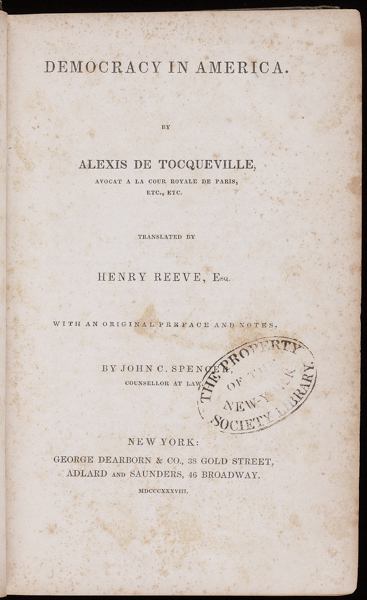
Democracy in America was not written for American consumption, but to explain to the French what Americans were up to in this exotic new land. In offering his explanations, Tocqueville looked into the “soul” of America, for most of the observations he made 181 years ago are as poignant today as when he put pen to paper. He could not have anticipated the vitriolic nature of the 2016 election but he came close. “A presidential election in the United States may be looked upon as a time of national crisis,” Tocqueville wrote. “As the election draws near, intrigues intensify and agitation increases and spreads. The citizens divide into several camps, each behind its candidate. A fever grips the entire nation. The election becomes the daily grist of the public papers, the subject of private conversations, the aim of all this activity, the object of all thought, the sole interest of the moment.”
Individualism, a word that Alexis de Tocqueville was one of the earliest to use, has long since been a catchword for American character. In Democracy in America he defined individualism as a “calm and considered feeling which disposes each citizen to isolate himself from the mass of his follows and withdraws into the circle of family and friends; with this little society formed to his taste, he gladly leaves the greater society to look after itself…” “Aristocracy links everybody, from peasant to king, in one long chain,” Tocqueville said. “Democracy breaks that chain and frees each link.”
Tocqueville was concerned about the future should the untethered individual choose to “stay shut up in the solitude of his own head.” The antidote for this and the best hope for sustaining the life of the republic were for individuals to be active in local organizations. Democracy in America posits that the future of the republic depends on the “habits of the heart” (mores and customs) citizens developed, and on the health of the voluntary associations in which the heart is formed: families, neighborhoods, classrooms, congregations, workplaces, local government, and other places where strangers meet. These voluntary associations were the “little republics” in which people practiced skills of citizenship and learned to make their own decisions about their future. Because of these “little republics” the character of the American people had been formed well before the Constitution was written.
Democracy in America answers the question that energized Tocqueville’s travel: Why does the American policy work? I don’t think the answer would have surprised early 19th century Americans, but contemporary readers surely would be taken aback. The key wasn’t the ingenious structural design (separation of powers, Bill of Rights, and Federalism) bequeathed to us by the authors of the U. S. Constitution. Rather, for Tocqueville, democracy worked because of the aforementioned character, or in his words, “the whole moral and intellectual condition” of its citizens. In relationship to character there was no more important influence than religious faith. Tocqueville called religion “the first of America’s political institutions.” By this he was not suggesting that religion had a formal political role. Rather, he observed that religion shaped the heart, the home, the will, and the public actions of citizens. As he put it: “While the law permits Americans to do what they please, religion prevents them from conceiving and forbids them to commit, what is rash or unjust.”
He ends his discussion of religion in Democracy in America by asking, “How is it possible that society should escape destruction if the moral tie is not strengthened in proportion as the political tie is relaxed? And what can be done with a people who are their own masters if they are not submissive to the Deity.”
Tocqueville was an abolitionist and had advocated the end of slavery in all French colonies. His penetrating account of Jacksonian America did not hide the cruelty of slavery in the southern states. He held out little hope for progress for African-Americans and Native Americans, and did not think the abolition of slavery would solve the racial crisis in the south. He felt that race would plague the nation for years.
As Tocqueville concluded his writing, he made statements that would prompt some to say “right on.” One of Tocqueville’s lasting quotes; “If I were asked, now that I am drawing to the close of this work, in which I have spoken of so many important things done by the Americans, to what the singular prosperity and growing strength of that people ought mainly to be attributed, I should reply–to the superiority of their women.” (emphasis added)
I read Democracy in America for the first time in 1971. At the time I was enrolled in a graduate seminar on American Political Theory and, I must say, Tocqueville was instructive. I came to appreciate that democratic politics has its origins in the conversations people have in their communities about the things that matter to them – not in voting or passing bills. Tocqueville observed that in his native France when a problem occurred, people would go the local lord or magistrate and say, “Your honor, there is a problem. Please fix it.” But in America when a problem occurs, a person turns to his neighbors and says, “We have a problem. Let’s talk about it and decide what we are going to do.” These community-based conversations are the “Laborites of Democracy” in which people make sound decisions about their future. Our politics require “little republics,” or a society of these informed citizens, in order to work effectively.
About Dr. Terry Jack
Elkin Terry Jack served in the U.S. Army in Vietnam before earning two graduate degrees in Political Science from the University of Southern Mississippi. He taught American Government & Politics at Gulf Coast State College for thirty-six years, retiring in 2009. He also served as an Adjunct Professor at Florida State University Panama City, Troy State University, and the University of West Florida. He has read Democracy in America countless times since he first read it in 1971.