
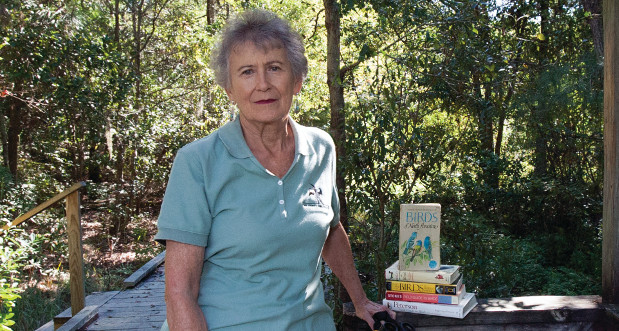
Candis Harbison – Birds of North America


Although I spend a lot of time reading everything from food labels to the latest fiction, I would have to say my favorite book is a simple little field guide, first published by Golden Press in 1966, called Birds of North America. This is the book that fits in a backpack or a large pocket or has even been tucked in my waistband more than once so it is handy when there are birds to be identified. I started birding (the sophisticated way to say “birdwatching”!) when I moved to Panama City in 1973, and it has brought many enjoyable moments and many new pathways to my life.
It is certainly possible to have a great time outdoors and not be aware of the birds, but I have found that being able to identify some of the bird species adds an extra layer of appreciation to the experience of being in a place. Whether responding to early morning calls of the cardinals that nest in the yard or trying to figure out the new birds you see on vacation, ordinary life is heightened by the feeling of kinship with nature. My husband and I were excited to add a bluegray gnatcatcher to our “yard list” the other day. It’s not an uncommon bird, but seeing it in our own yard was like getting bonus points for the day! And watching the least terns that fly here from South America to nest on the roof of the AT&T building downtown links us to the greater world.
Once you begin to care about birds, it is inevitable that you become concerned about their diminishing numbers. About half of our songbirds have disappeared in the last 40 years. My membership in the Bay County Audubon Society led to formation of the Bay County Conservancy – it began in 1998 to take ownership of 30 acres of wetland that
was destined to become a parking lot behind Walmart, Gulf Coast Hospital, and Northside Baptist Church. The physicians who owned the land sold it for a bargain price, and it has been kept open for birds, frogs, and other reminders that humans do not live alone on this Earth. Since then, 12 other preserves totaling almost 300 acres have been acquired to provide green space for plants, animals, and humans. As president of this organization since its founding, I have been privileged to work with many people who care about the fate of our land.
There are several wonderful new bird guides on the market now, such as the National Geographic, Sibley, and Crossley books, but I still have a feeling of fondness when I pick up that tattered copy of the Golden Guide that first started me along this path.