
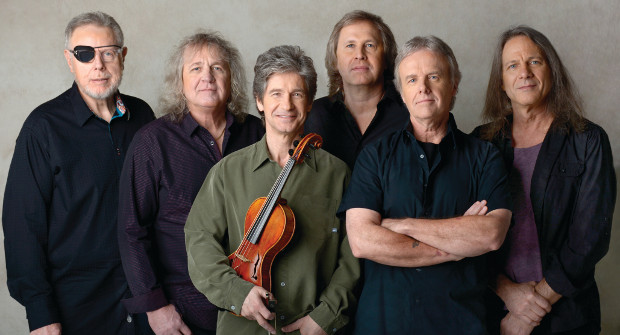
Kansas – Carrying On


By Victoria Stewart; Photos by Mark Schierhol
With the Point of Know Return from album title to certainty, KANSAS reached legend status. The band began their career in 1970 as a “garage band” in Topeka, Kansas. Their big break occurred in 1974 after being discovered by Wally Gold who, at the time, worked for Don Kirshner, when they released their self-titled debut album. Many years and changes occurred since then, but one thing has remained constant, they are a great band that has withstood the test of time. This year they are touring 90+ shows across the country. On September 17, they will be at the Marina Civic Center in Panama City, Florida performing all the songs you know and love. Panama City Living (PCL) was granted an interview with original KANSAS band member, guitarist Richard Williams. We asked our readers what questions they would like to ask KANSAS. The interview highlights are below. For the full interview, go to www.panamacityliving.com.
Harry Lane: What was the primary inspiration for the hit Dust in the Wind?
We were working on the Point of Know Return album assembling the song list. During that process, Kerry Livgren, who was formerly with the band and the major songwriter for the band, was trying to teach himself how to do what is called “Travis Picking,” which is a finger-picking style on an acoustic [guitar]. Meanwhile, he was reading a book. I don’t know what the book was called, but it was about Native American Indians and that inspired him to write the lyrics. So, one day he came into rehearsals and said “Oh, I’ve got another song to throw on the pile of stuff we’re considering” and I guess he had taped himself playing acoustic guitar in just a very rough fashion and had the lyrics he was going to talk singing through it, showing Steve Walsh the phrasing and outline of the melody. Right then and there all of us heard, even in that bare bones moment, a fantastic song.
Jerry Varnum: Who now plays and sings Dust in the Wind?
I’ve always played it. Still do. I played it on the recording and I play it now. Ronnie Platt is our new singer since Steve Walsh retired a year ago. He is a tremendous person and a tremendous singer. And he is also very respectful to what Steve did with that and every song. He’s very respectful to the original recording and the phrasing, the melody lines and all that.
Dane Jay Hallemeier: What is your personal definition of a “Wheathead”?
Kansas is the Wheat State. Always has been. And so, like you have the Deadheads, you’ve got the Parrotheads, you’ve got the Green Bay Packers Cheeseheads. So, from all of that, KANSAS fans themselves are not necessarily from Kansas, but KANSAS fans everywhere started calling themselves Wheatheads. That just grew and grew and grew until now there’s a nation of them.
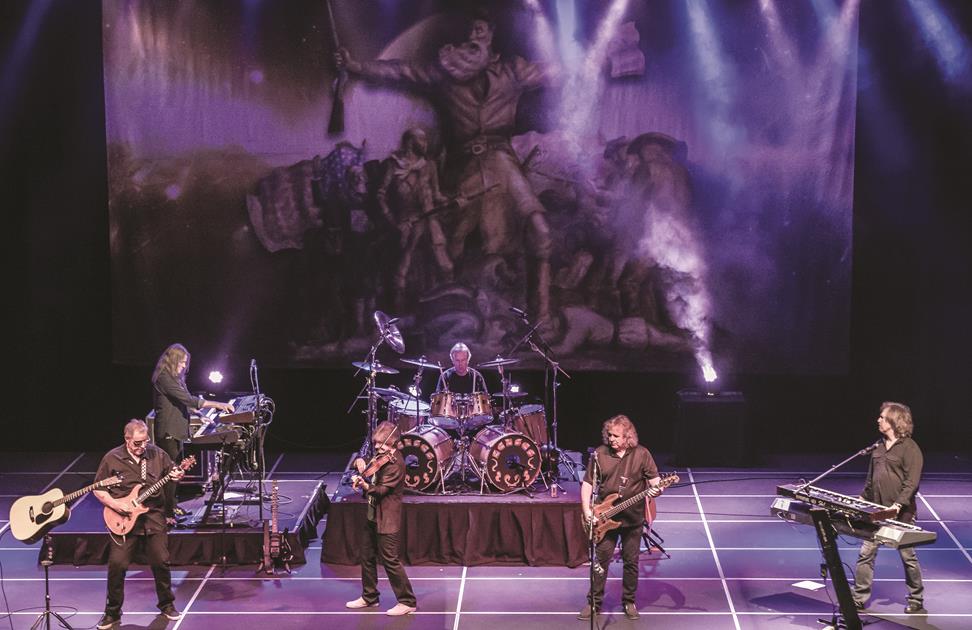
Dane Jay Hallemeier: Tell us how Terry Brock became a member of the band during the tour with HEART in 1983.
Terry used to play with us and he was a background singer with us 30+ years ago. I met Terry through my first ex-wife. She was working in a place called “Seriously Western” during the Urban Cowboy craze. It was a store in Atlanta selling high end Western wear. We had a double date one night with a girl that she worked with and her boyfriend, Terry Brock. As it turned out he lived in the same neighborhood that we had lived in. He was 18 or 19-years-old at the time. He lived with his parents there. And so, he was a young singer, guitar player and we just became friends. We were friends for years. Terry and I shared a condo for several years in the Atlanta area. And so, yeah, I know Terry extremely well.
Jason Bragg: How did the band’s name get decided on?
(Paraphrased): In 1969/70 I lived in New Orleans and played in the band WHITE CLOVER. We used to play the French Quarter and stuff. Well, we came back to Topeka and I went back to college. Dave Hope, the bass player, went on to be in a band that called themselves The KANSAS BLUES BAND and Phil Ehart, the drummer, decided to go to England and get something going. This story is already getting too long (he laughs). So, WHITE CLOVER merged with the band called SARATOGA in Topeka. When that merger happened, Dave Hope came into the thing and we needed a different name. Dave mentioned “How about just KANSAS?” Since he was in the KANSAS BLUES BAND, he said “We should just drop the “BLUES” because we’re not a blues band, let’s just call the name KANSAS.” Then once we got the recording deal KANSAS was not working anymore. Kerry was a great songwriter, so we had Kerry join us and we didn’t want to be WHITE CLOVER, most of this band was in the original KANSAS, and that’s a better name. And so it was not a thought out process, it was just evolution.
Alan Blackburn: How long to the Point of Know Return?
You know, I can’t answer because I don’t know yet. We haven’t reached it.
PCL: Tell us how Wally Gold discovered KANSAS.
Okay, what that was the other KANSAS that mutated and then you have WHITE CLOVER, which was me, Phil, Dave, Kerry, and Steve. We did a recording and made a demo tape out of a little place called Liberal, Kansas. We only had three or four copies of it and we sent it to the four corners of the world. One of them wound up on Don Kirshner’s desk. They listened to it and they really liked what they heard. At that point we were also talking with Kerry Livgren, but anyhow, we needed more material and Kerry was a great songwriter and like I said earlier, that KANSAS had dissolved. So now WHITE CLOVER has a record company very interested in it, and they call and say “Well, we want to come out and see the band, so put together a show, we’ll be out in two weeks.” So we did. We set up a show and we had to get people to come to see us, because, to be honest, nobody really did, nobody cared that much. Alright, so we set up a show out in the middle of nowhere and to get people there, we announced free beer. And so, of course, free beer packed the house. There were people in the streets trying to get in and couldn’t. So now, Wally Gold comes to the show, through all these insane fans screaming and we just did what we do. And he called Don Kirshner back and probably said something like, “I’m not really sure what’s going on here, but there’s something going on, the place is packed, people are going crazy and they’re a really good band”. And that’s how we got the recording deal.
PCL: When you joined KANSAS in 1972, how did that come about?
So, Phil was in Europe, I was in college, KANSAS that had started previously that I wasn’t in, that evolved. Dave was no longer in it. Robbie Steinhardt was in a band out of Lawrence, Kansas called GREAT WHACK. Phil was not having any luck in England and he called me from England and said “I’m going to come back. What do you think about putting WHITE CLOVER back together again?” And I thought it sounds good because I didn’t like college anyway. He had already written to Steve Walsh and Steve was in. He said “What about a bass player? Let’s get Dave back. Dave would be great!” And Dave was all in for it. Dave and I had been kind of playing in a band called PLAIN JANE together and that was a copy band and we didn’t want to do that anyway. We had recently been fired because we wanted to jam too much. (He laughs) Phil had contacted Robbie Steinhardt. Phil said, “There’s this guy up in Lawrence you’ve got to see! Violin player, haystack of hair and there’s something really special about him.” And so, Phil came back and we formed that band, WHITE CLOVER, that version of it. From there we got Kerry in and we took the name KANSAS.

PCL: Which album do you think best defines KANSAS as a group?
I think probably the Leftoverture / Point of Know Return era best defines it, but not entirely. There are songs on all the records that capture the quintessential KANSAS feel and sound and message and all of that.
PCL: Jeb Wright (Classic Rock Revisited – online article) wrote this of your concert in Shawnee, Oklahoma on March 27. “It was clear from the very first song that KANSAS is enjoying a rebirth, the new blood in the band firing them up and pushing them to the limits of their capabilities.” Do you consider this a rebirth of KANSAS? How does this newborn band differ from the band from the 1970s?
Oh… it’s a rebirth absolutely. We’ve signed a record deal for the first time in 15 years. We are going to start recording the first of 2016. It’s familiar in a way that, in the early days, all we cared about was what we were doing. It was the all for all, one for one, pirate ship on the open sea. Doing what we love to do, not too much thought about the past, the future, or anything. It was just the love of doing it. Over the years, dynamics change within people. I think some of that feeling evolved into other interests, families, all these types of things. This is now, in the last year, reminiscent of all of that. It’s not the same, nothing is ever the same, but it is very reminiscent of the hunger of those early days.
PCL: KANSAS is recording a new album in January and February of 2016. Who does most of the writing for these new songs? What can your fans expect to hear?
Those are all good questions that I can’t answer. We are in the process of doing it all. We’ve recorded one song, it sounds great, it sounds like KANSAS very much sounds and plays. We’re assembling, as we speak. We’re talking about the songs that are on the table. They’re the bits and pieces, snippets lying on the floor everywhere and we’re assembling those together. We’re looking outward for songs from other songwriters. We’re looking inward for songs. The discussion is ongoing. We’ll sequester ourselves in an undisclosed location, near you actually, in November to do nothing but work on material for a week. And so, it’s an ongoing process. I don’t know what it’s going to be.
[author image=”https://www.panamacityliving.com/media/2014/07/Victoria-Stewart-e1404931430894.jpg” ]Victoria has lived in Panama City for the past 40 years. She has worked as a Government Contractor for most of her working life. She is an avid fitness enthusiast and runner. Raised in a family who was immersed in music, she plays guitar and is a founding member of Music Matters. Together with husband Crook Stewart III, they host a monthly music jam at their home where musicians come to network. The venue is known as the “The Ghetto Palace” and has become a Music Mecca where local talent comes to play. Following the success of The Ghetto Palace, Victoria and Crook founded “Music Matters” an initiative that brings life and music to downtown Panama City.[/author]