
Camille’s Art for Autism


BY DIANE MERCADO PHOTOS BY SARAH SHIPES
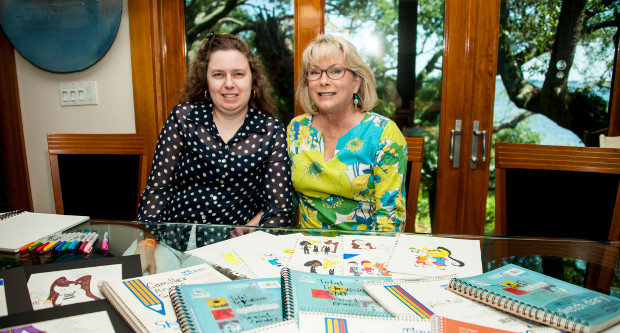
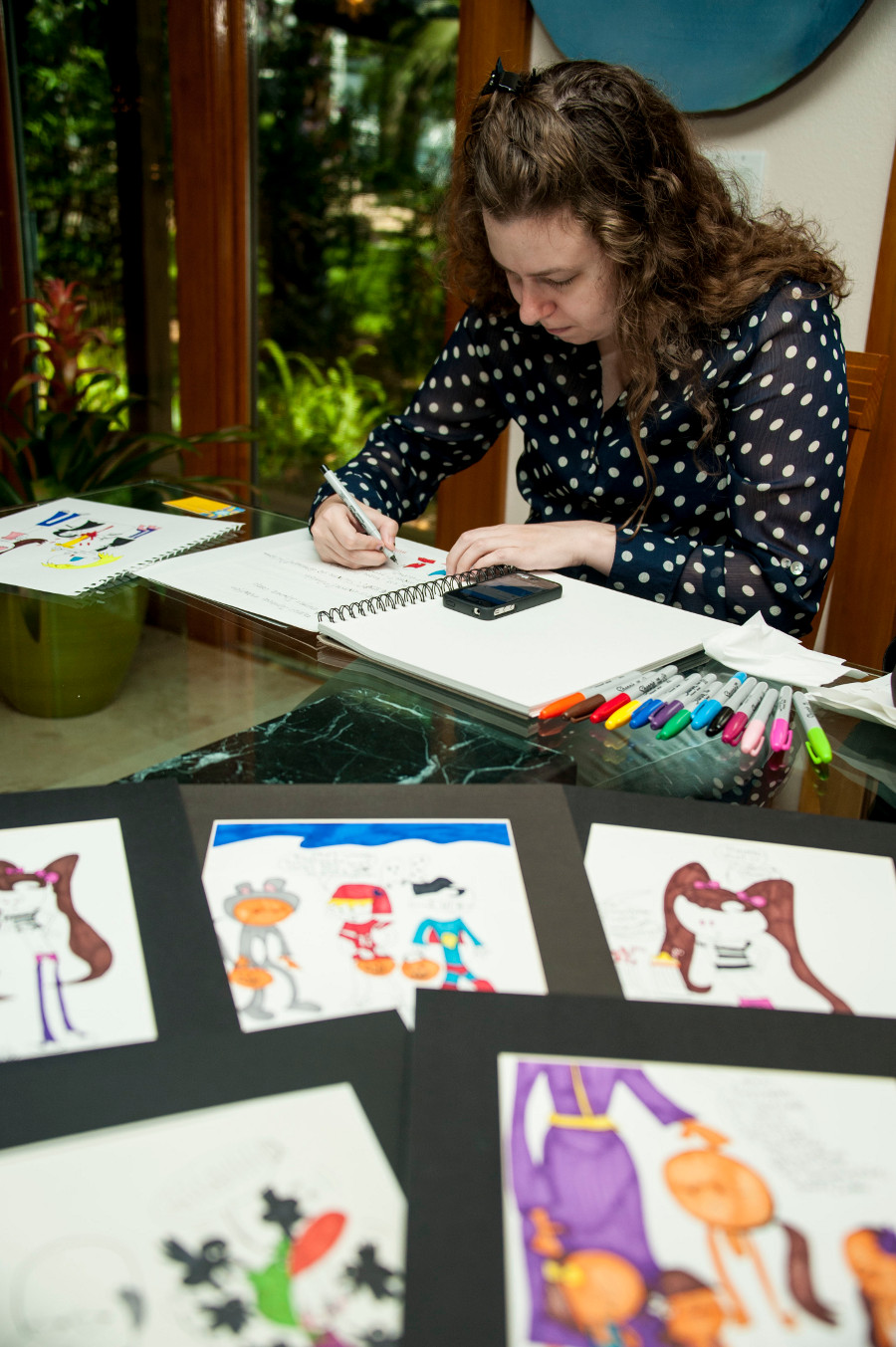
As soon as Camille Butchikas could grab a crayon or pencil in her tiny hand she would draw, a skill that has evolved into her passion. “This is my full-time hobby, my full-time talent,” Camille says.
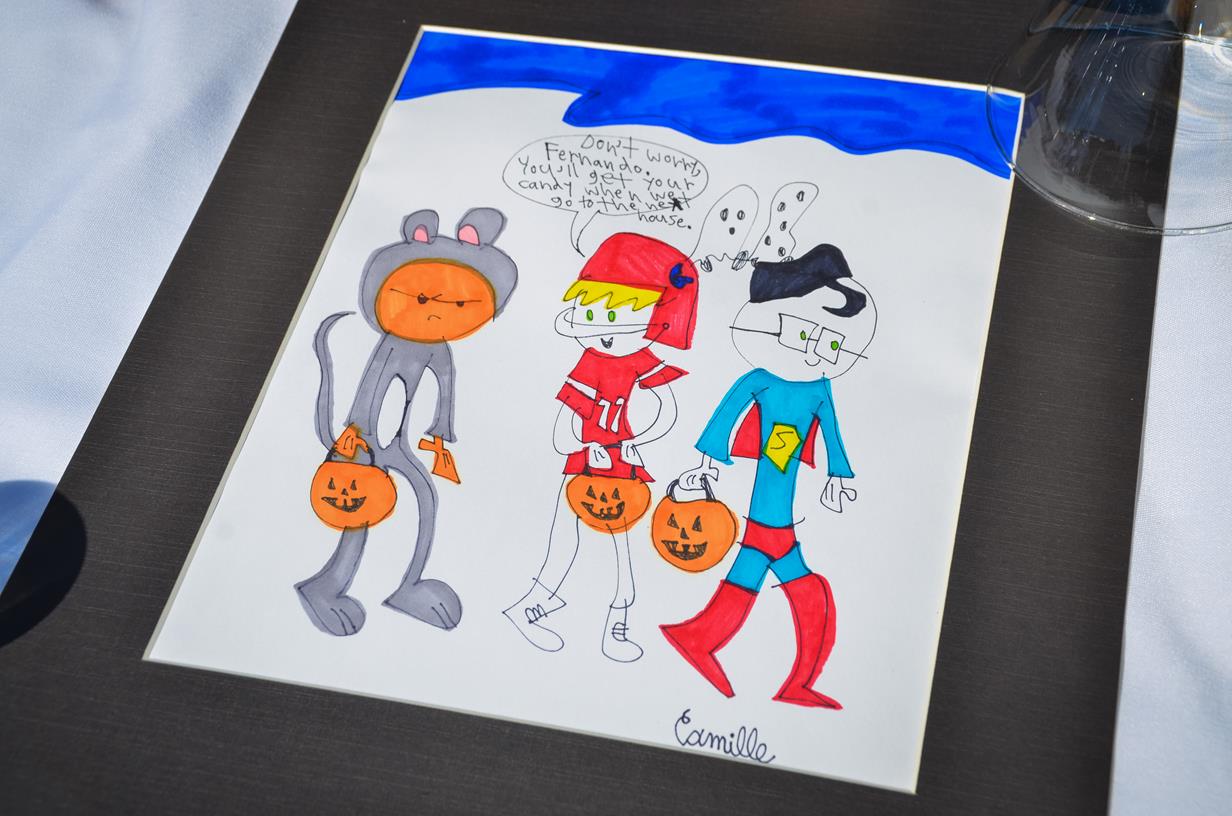
Dozens of sketchbooks filled with crazy, colorful, silly, and serious characters and the stories they live are scattered about the family’s St. Andrews home and garage. They serve as the primary evidence of Camille’s industriousness throughout the years.Camille, now age 28, draws every day at home in her cozy upstairs bedroom cuddling with her two dachshunds (Julianna and Ellie) or downstairs at a small round table set up with a prime view of St.Andrew Bay.
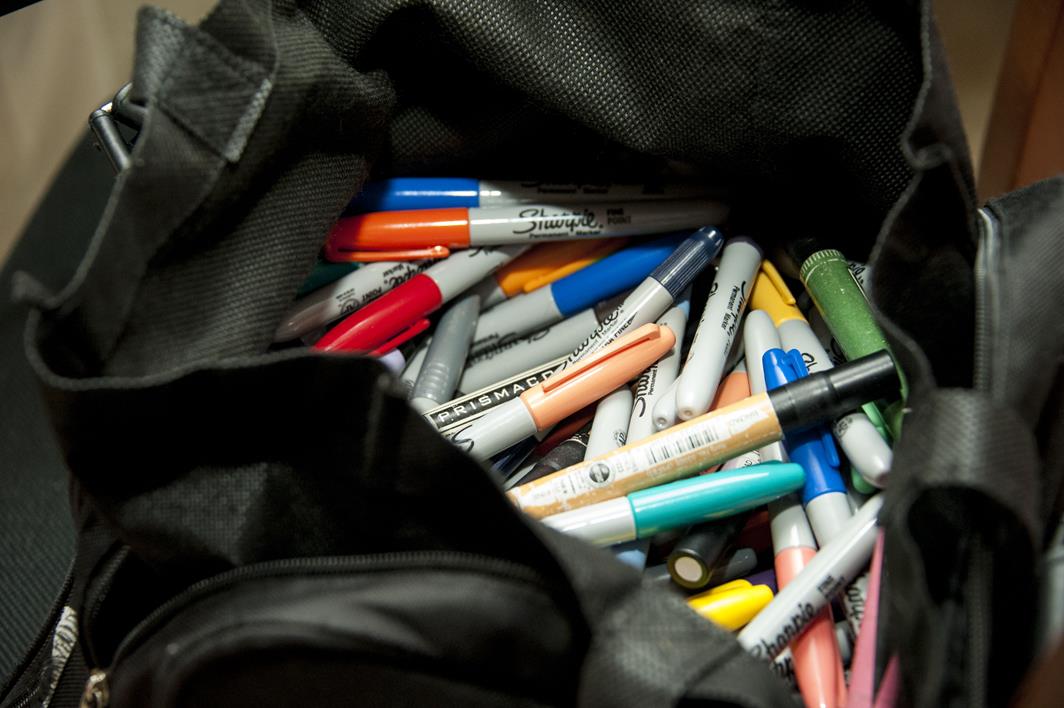
Wherever Camille goes, she carries a sketchbook and a large canvas bag filled with the ultrafine black Sharpies that she prefers to draw with and hundreds of colored Sharpies she uses to color with. She is never without her drawing equipment whether home or away. She describes her drawing style as a cross between Japanese anime and manga – or “Japanese” as she calls it.
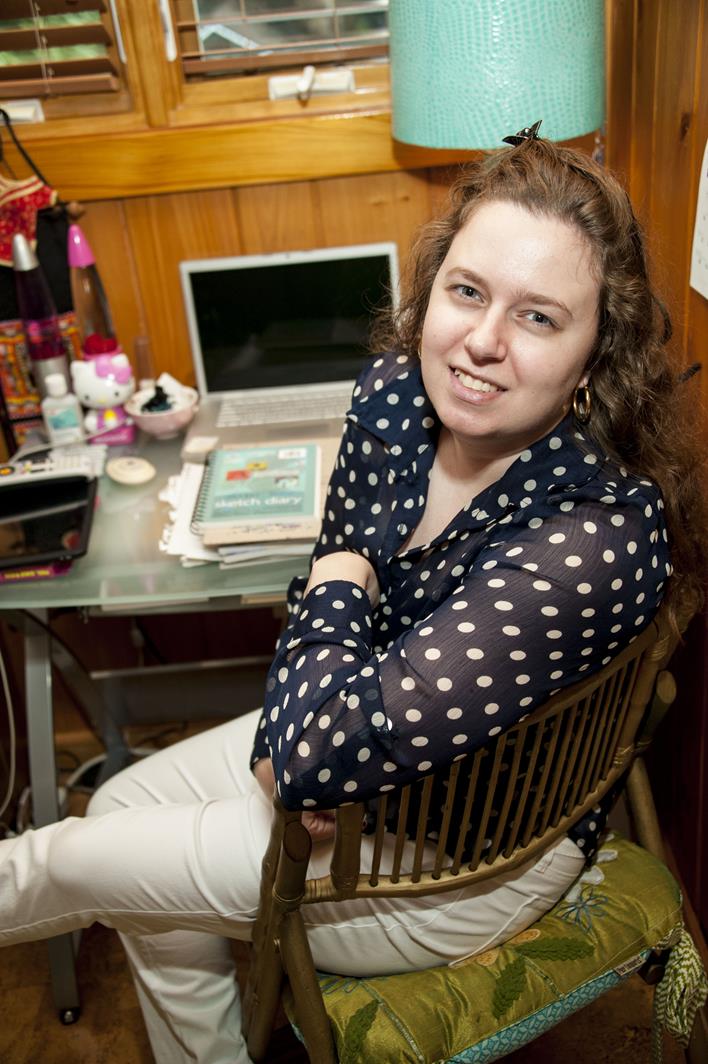
Camille functions somewhere on the autism spectrum. Her mother, Brenda Nunnery, doesn’t know exactly where that is. Little was known about autism when Camille was a child. “Rating systems exist for children and teens now and most of them have evolved considerably since Camille was last evaluated,” Brenda Nunnery explains.
Autism has become a hot topic in recent years as it is a fast-growing developmental disability.It affects nearly one in every 68 children (one in every 45 boys), according to the autismunited.org website. It is estimated that 1 – 1.5 million Americans have some form of autism.
“I do think Camille is quite brilliant,” Brenda Nunnery says. “She amazes us with her knowledge of current events.Her memory is something else.”
The creative process of art works well for autistic-children and adults because it provides a low barrier to entry (anyone can be creative in some form or another). Statistics matter little to Camille.All she knows is she likes to draw and always has because it makes her happy. She knows her characters the same as some people know their friends.
“Camille doesn’t miss much in the way of social cues such as how people act and are feeling,” her mom says. “Long before they enter the two-dimensional world of Camille’s sketchbooks, they live in Camille’s head.”
“I just think of a character and start to draw,” says Camille.
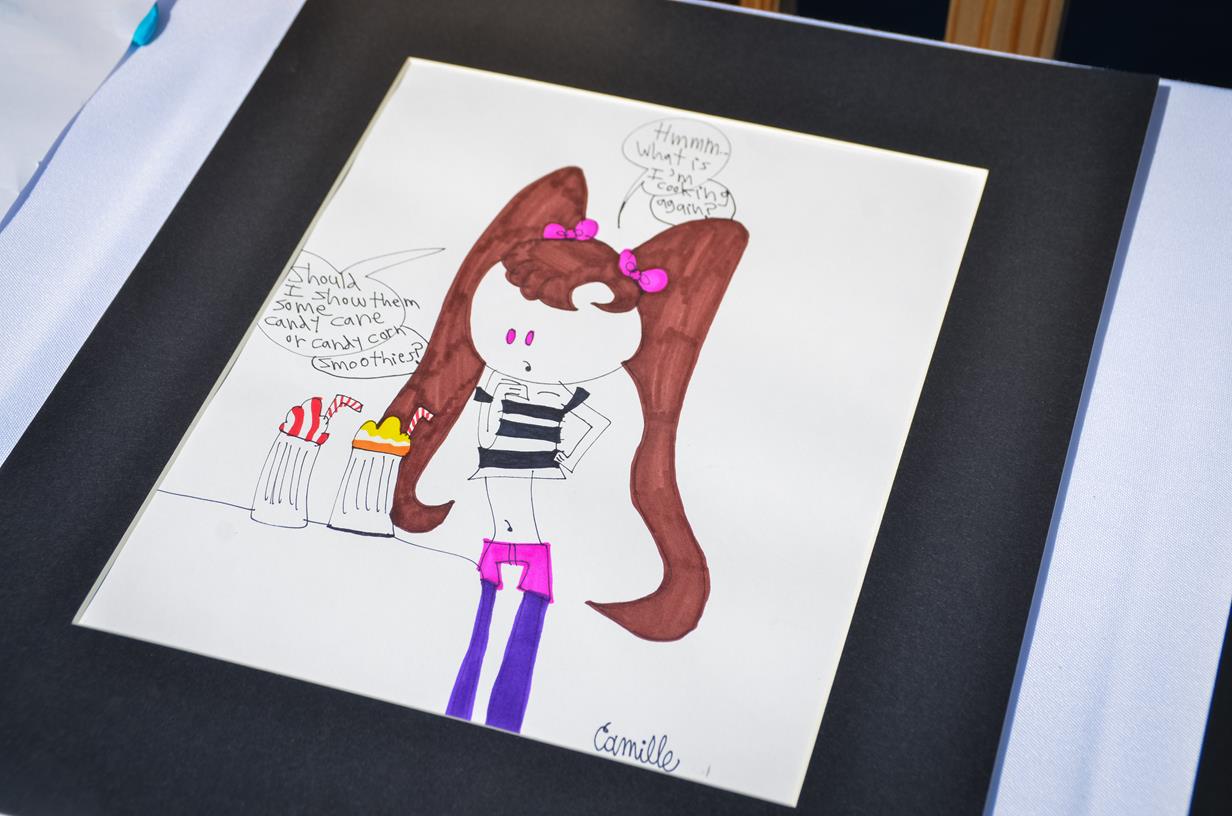
Each book depicts a unique set of characters, some quirky, silly, or odd, but all different. Nearly every book has at least one or more drawings depicting a portrait of each character that lives within the story. She describes their physical attributes and personality traits.No two books are alike. Theme, action, and dialogue vary greatly though every once in a while some characters will reappear in a later story.
Not all the characters speak, but when they do, Camille likes to vary the dialogue and language. Even though most of the stories are in English, Camille enjoys writing in German, French, Japanese, and Spanish, too, using a Google translation app. She does this by looking at the screen translation of what she wants her characters to say while at the same time writing on the sketch.
Camille works on one book until her story is finished before beginning another. She may start in the middle of the sketchbook and work her way back or start in the back and work her way forward. Some characters may come alive in other books but typically Camille creates new characters for each story she wants to tell.
There are several series featuring the same characters such as the Heckoween, 7teen or the Femmetraz series. The characters may be the same but their stories are different.
Unlike most artists, Camille may begin her story in the middle of the book by drawing a finger or toe or some other minute detail. “Detecting what she’s creating can be difficult for some people at first but then it becomes clear as the drawing progresses,” says Alison Butchikas, Camille’s sister, older by two years.Brother, Nicholas, is in the middle.
“Not all her characters are saintly,” Alison explains. “She likes to shock sometimes with risqué dialogue because she likes to see people’s reactions.”
“My mom always described us as if we had an imaginary chain linking us together,” Alison says of her close relationship with her sister. “I was the only one who could understand her when she was little and always knew what she was saying when no one else did. It’s amazing how far she’s come.”
When Camille wants a little more freedom she’ll spend a night or a weekend at Alison’s house on the beach. “Camille is just as normal as everyone else and she may even be smarter at times,” Alison said. “She pays attention when you least expect it.Some things may be over her head but she seems to understand. Sometimes Camille may be a little shy with new people, but she always tells the truth no matter who she’s with. She may not always be polite, but she always gives her honest opinion.”
Alison describes their friendship. “I am the closest friend she has.It comes with being her older sister and watching her grow up. Having her as a sister has made me who I am. She’s taught me patience, understanding, empathy, and love and she has brought the whole family closer together.”
Learning about autism
Brenda Nunnery tells us that Camille had been a typical baby, learning to speak and developing fine motor skills until she was about 18-months-old. Then mysteriously everything changed. Instead of talking she was babbling. It took two years visiting doctors around the country to finally get the diagnosis of autism. Little was known about autism at the time.
Camille has lots of family support, dividing her time living with her mother and nearly constant companion and her stepfather, Dr. Phillip Nunnery, in Panama City and her father, George Butchikas and stepmother, Carolyn Butchikas, in Panama City Beach. They all support raising money for autism research and development.
Although her biological parents divorced early on, Camille’s parents realized the importance of early diagnoses and intervention. That remains key to assuring quality of life for autistic children such as Camille. Her therapy began at home until she was verbal enough to attend public school. “Eventually Camille was placed in public school with a full-time aide,” Brenda remembers. “She learned to read and write and did well. She’s very smart, almost too smart.”
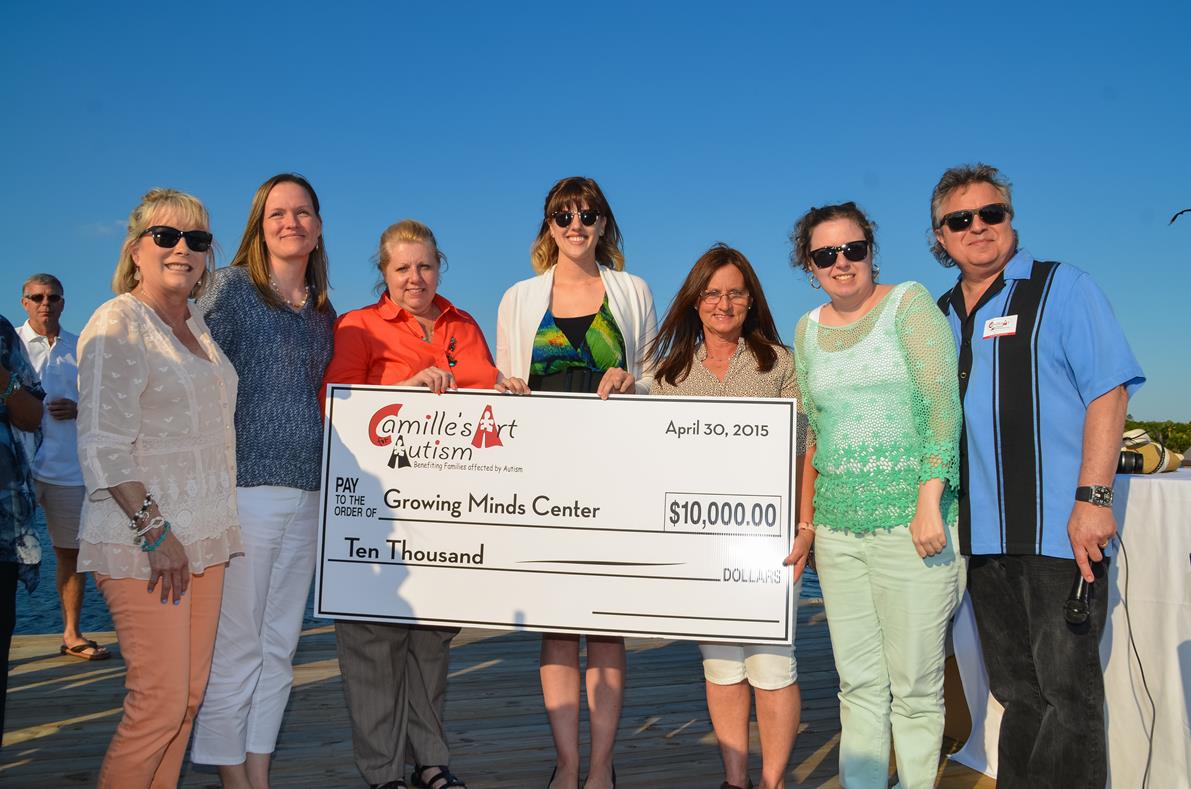
A few years ago the Nunnerys realized that not all autistic children do well in public schools and they created “Camille’s Art for Autism.” The nonprofit organization dedicates itself to raising money to help other families cope with the difficulties that so often accompany a child with autism. The organization donates to private schools in the Panhandle that specialize in educating parents about developmental delays through early diagnosis and therapy. This year the organization donated $10,000 each to three different schools dedicated to working with autistic children.
“’Camille’s Art for Autism’ may be small but it raises awareness and donates funding that local private schools may not get elsewhere,” Brenda Nunnery states. “Autism wasn’t a mainstream subject 28 years ago when Camille was born.When she acted strangely people did not always understand that the behavior was a symptom of autism, not of poor parenting.”
Camille’s art is frequently auctioned off with growing success and great response from buyers and art enthusiasts.Find out more at camillesartforautism.org
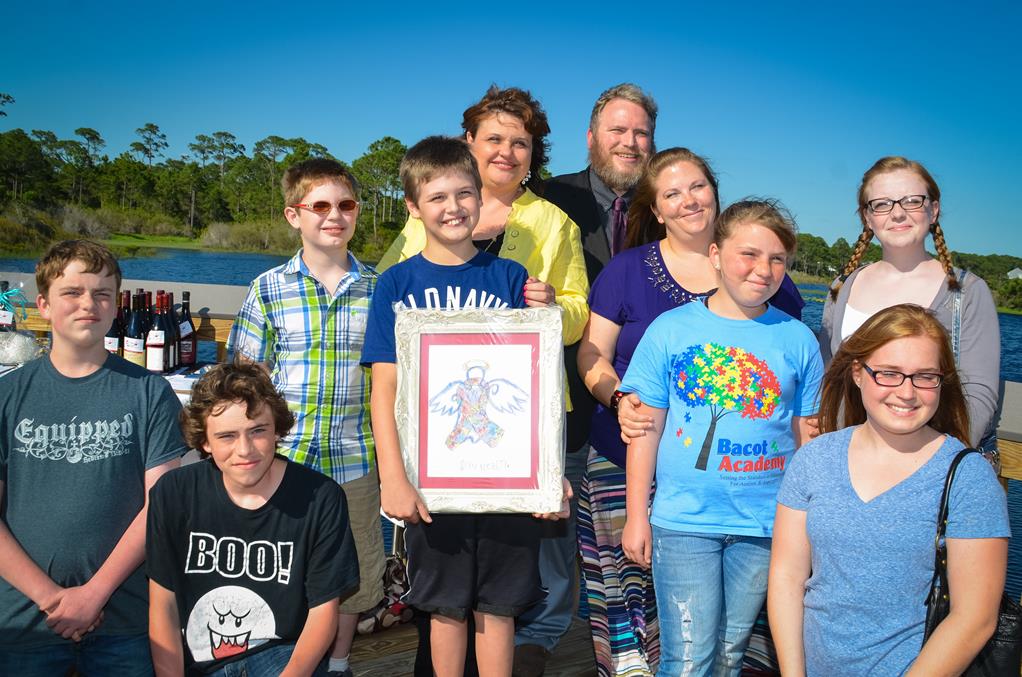
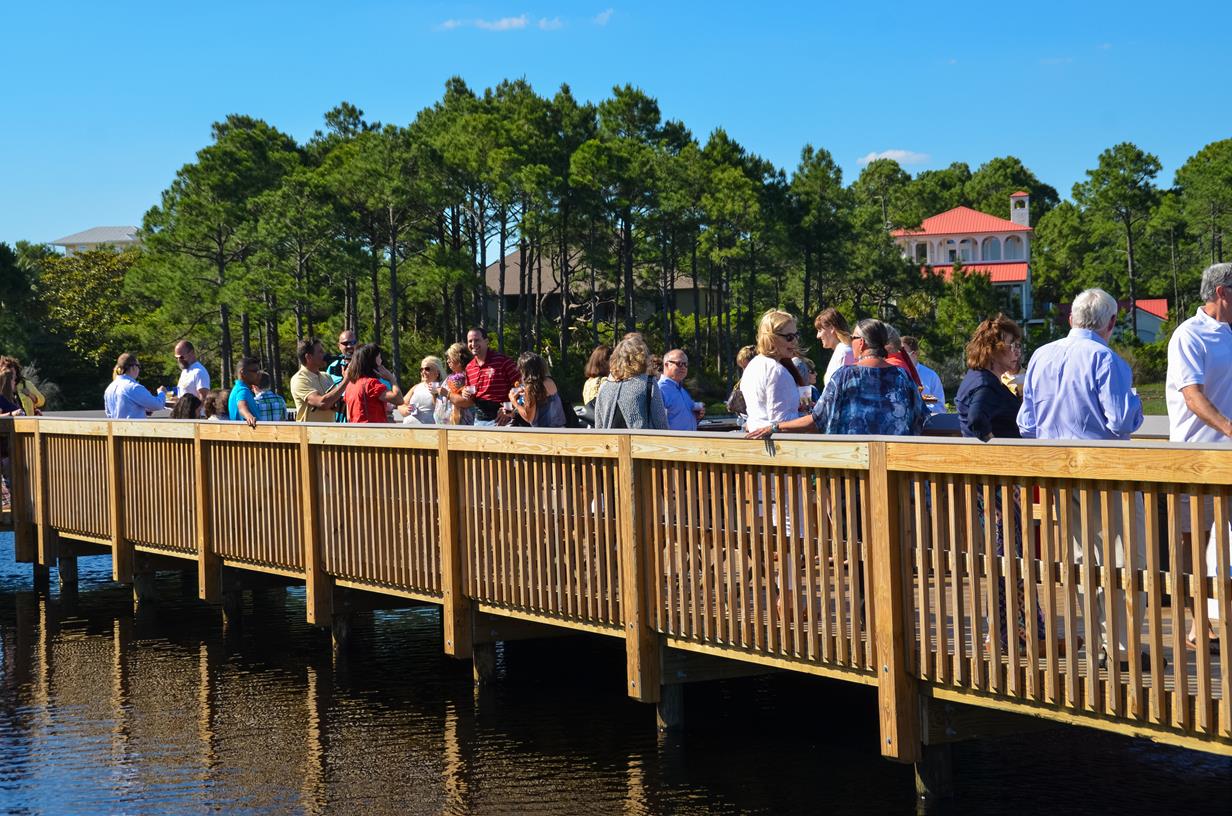
[divider]“Camille’s Art for Autism” presented checks totaling $ 30,000 to three area schools: Growing Minds Center of Port St. Joe, The Bacot Academy of Panama City, and The Gulf Coast School for Autism of Panama City, each received checks in the amount of $10,000 from Camille’s Art for Autism in June. The check presentation was held at Stinky’s Bait Shack on 30A in Santa Rosa Beach.
PHOTOS BY AB PHOTOGRAPHY




[author image=”https://www.panamacityliving.com/media/2014/07/Diane-Mercado.jpg” ]Diane Mercado Mouskourie worked as a technical illustrator and graphic designer for 15 years before earning a bachelor’s degree in mass communication from the University of South Florida. Before retiring and returning to Panama City in 2011, Diane spent more than 20 years working as a journalist and copy editor for daily newspapers in several places across the U.S. Through the course of her career she has interviewed people from all walks of life and written many personality profiles. Diane spends most of her time writing for various publications including Panama City Living magazine and enjoys painting, drawing and gardening.[/author]