
Life Saving Service – The United States Coast Guard


This was the situation that they’d all signed up for: adventurous, dangerous, challenging, life-saving and finished off with grilled cheese sandwiches.
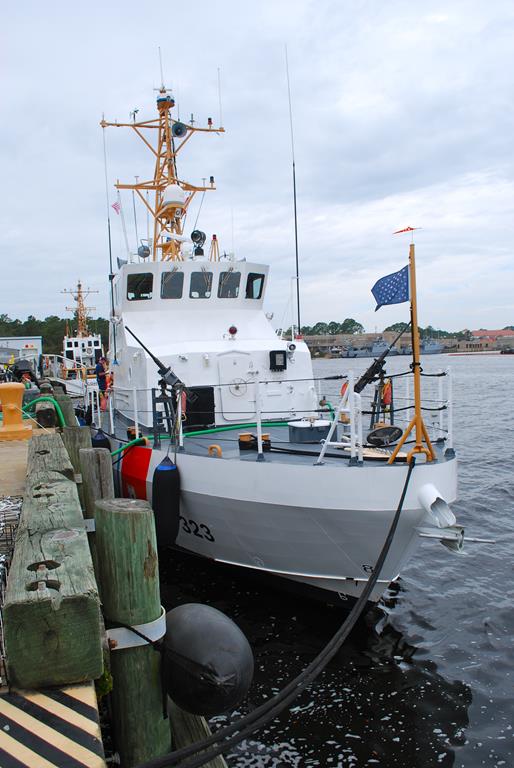
It was a turbulent October afternoon and the United States Coast Guard Cutter “Seahawk” was steaming to the rescue of a disabled fishing boat 30 miles out of St. Andrews Bay. The 87-foot cutter was making way through 12-15 foot swells, the waves crashing over the bow.
“It was a dicey ride,” said Master Chief Jeffery Ryan with a wry smile. “Dicey” was an understatement considering the conditions were on the verge of exceeding what the Coast Guard deems as too rough even for this unsinkable ship. But 15 miles from their position was a 50-foot fishing boat that was in real danger. Anchored in place, the snapper/ grouper boat had no electricity and limited communications. No electricity also meant no way to start the motor.
The fishing boat’s captain only knew partially where he was located, but fortunately the Seahawk had passed the boat previously and marked her position. Five miles away, the Seahawk was able to make radio contact and determine her condition. She would have to be towed.
The waves were too high for a safe launching of the Seahawk’s small boat, so the tow line would have to be passed between the two ships.
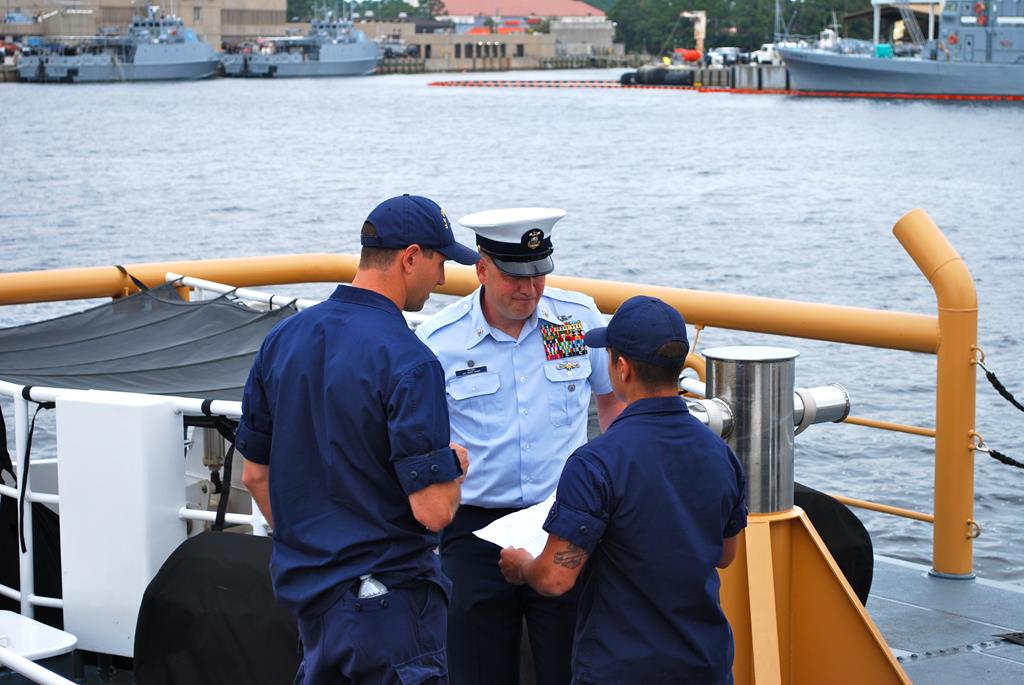
The fisherman cut his anchor line and drifted with the waves, taking a terrible battering as his boat took the worst of the swells amidship. Seahawk’s Executive Officer Justin Kaczynski was at the helm and maneuvered his boat to within 15 feet of the fisherman’s bow, but the cutter was still climbing and plunging down 10-foot swells. On the Seahawk’s aft deck were two crewmen with feeder lines that would be used to transfer the tow line. But one of these crewmen was going to have to throw his line from a lurching deck through the whipping wind to a man standing on another rocking vessel.
It took two passes and three throws, but the line was finally secured. Then came the hours long tow back to St. Andrews Bay.
For the exhausted and drenched crew of the Seahawk, the adventure ended with the smell and comfort of Food Specialist Jeff McCullough’s grilled cheese sandwiches.
Heroes
For Kaczynski, search and rescue was the reason he joined the Coast Guard 12 years ago. Growing up outside Philadelphia, his family always had a boat and he was always on the water. He believed that rescue was all the Coast Guard did.
He quickly discovered that was not the case. His first deployment was in 2003 to the Persian Gulf where he worked on a 110-foot cutter boarding Iraqi vessels and providing security for Navy ships and oil platforms. It was an exciting beginning to a fulfilling career. Kaczynski said he plans to stay in the Coast Guard until they throw him out.
As the Seahawk’s executive officer, he’s in position to take command of his own boat. Besides piloting the cutter, Kaczynski also is leader of the boarding parties and oversees the crew and the boat’s expenditures – as in food and gas.
Kaczynski said he has the best and worst job on the boat. Unquestionably, he said, the Seahawk’s captain, Ryan, has the best job.
Ryan happily agreed.
He began his career on the water in 1986 by joining the Navy. He left that service in 1992, believing that what he needed was to go to college. Despite getting good grades at Ohio State University, Ryan said he hated college. He was restless and missed the constant motion of a life at sea.
Governmental budget cuts prevented his return to the Navy, but the Coast Guard eagerly accepted a man with his experience. In 1993, he joined the Coast Guard and was assigned to a 378-foot cutter.
“It was the best decision I ever made,” Ryan said. He said the difference between the Navy and Coast Guard was in the mission of the two branches.
“The Navy is always preparing for war,” he said. The Coast Guard, on the other hand, is actively engaged in coastal security, search and rescue and overseeing commercial fishing regulations. “There’s always something different going on.”
McCullough, too, was drawn to the Coast Guard for its most recognizable duty: search and rescue.
“It seemed like the best branch of service to go into,” he said. “Better to save lives than to take lives.”
Technological wonder
The Seahawk, which is berthed at the Naval Support Activity base off Thomas Drive, has a crew of 11 and a range of about 700 miles. Despite being commissioned in 2001, she is a relatively new boat for the Coast Guard. She shows it, too.
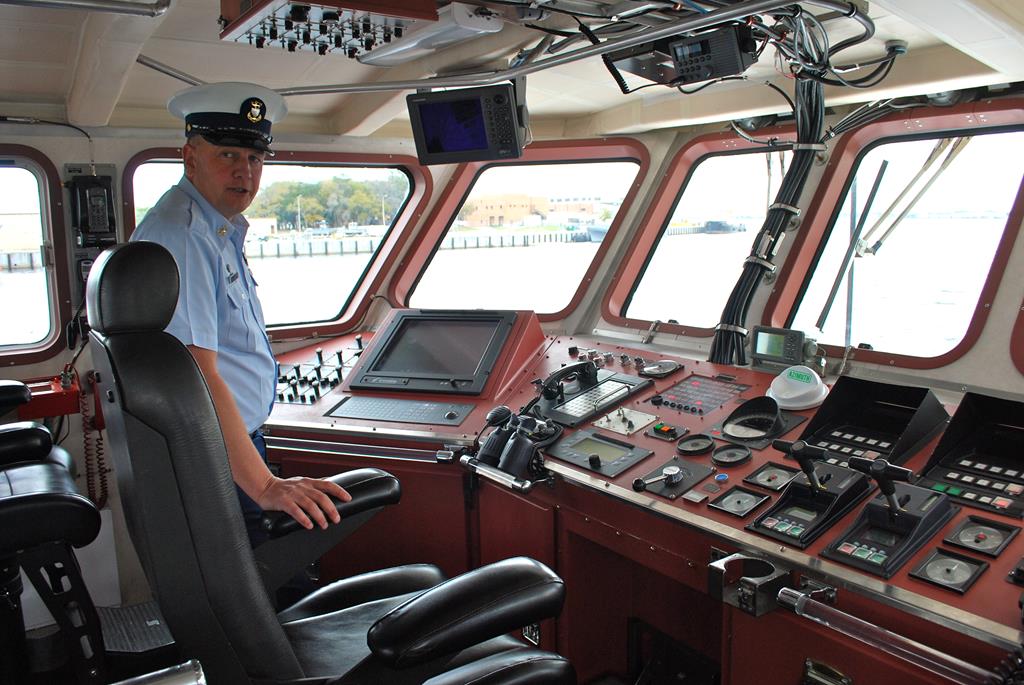
Her command console is equipped with an autopilot that is GPS-steered, long range vessel identification that allows the captain to know what boat is on the radar screen with crew, origin, destination and cargo. Every nuance of the ship’s operation is monitored through the console, including engine status.
Another improvement is the launch and retrieval of the Seahawk’s small boat, which is designed likean oversized waverunner. The small boat is the cutter’s primary means of boarding the fishing boats it regulates.
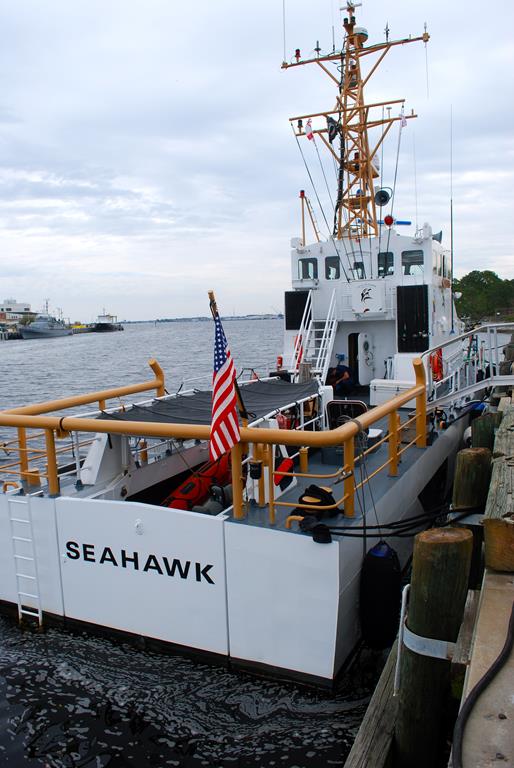
Years ago, the boat would have to be launched over the side by way of a boom, winches and strained muscles. Not only was it awkward, but dangerous in rough seas. But the Seahawk’s small boat sits in its own slip, a ramp, in the aft deck. Its nose almost reaches the deck while its outboard motor sits several feet below. It is launched by opening a rear gate, unhooking a line and – out it goes. When it returns, its pilot drives the boat back into the slip and up the ramp where a crew member secures the line and drops the gate.
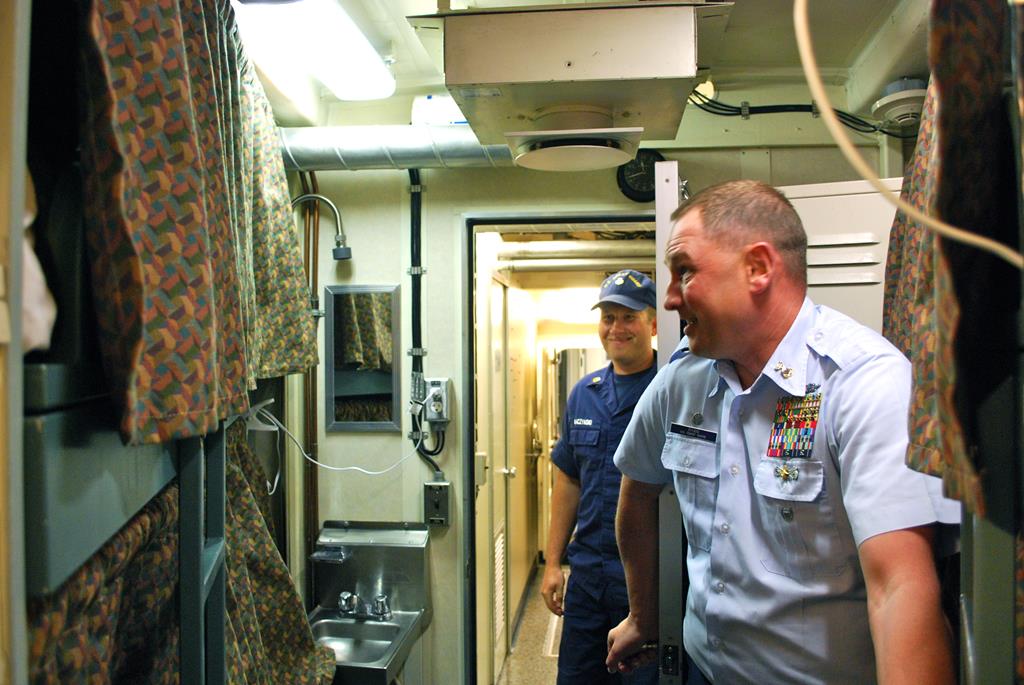
But for all its wonders, the Seahawk remains Spartan in many ways. Captain and crew all share quarters. Ryan and Kaczynski sleep amidship in two-man rooms with minimal accommodations. A shower, with numerous safety bars to steady the bather in rough seas, sits across the hall from toilet and sink.
The crew have quarters based on seniority, with the newest members sleeping in what’s known as the “Anti- Gravity Chamber.” All the way forward, the Chamber sleeps four in an area about the size of a walk-in closet.
They call it the “Anti-Gravity Chamber” because sleepers can find themselves airborne in rough seas. When the Seahawk tops a wave and falls into a trough, the bow falls faster than the men sleeping in the bunks, who find themselves suspended momentarily until crashing back to their mattress as the bow lurches upward with the next wave.
Kaczynski said one trick is to wedge a boot into the metal frame that holds the mattress, elevating the open side and moving the crewman against the bulkhead. That way, he said, they may go up and down but it’s less likely that they’ll fall out of the bunk and hit the deck.
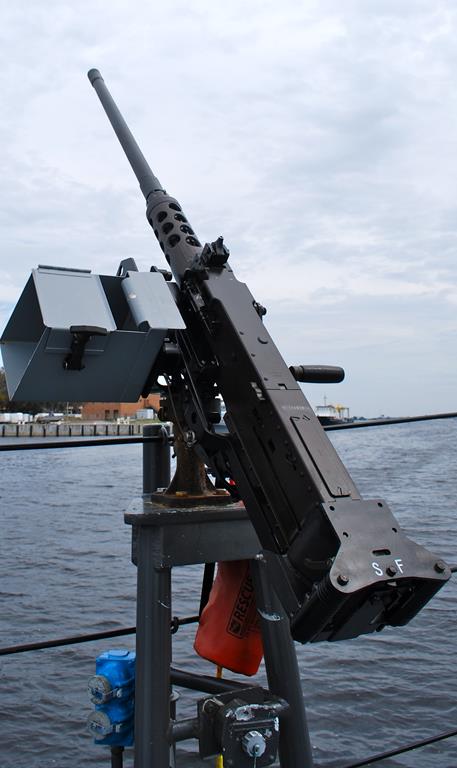
Securely fastened to both sides of the bow are the other Spartan aspects of the cutter: the two 50-caliber machine guns that identify this as a boat that can defend itself.
Search and rescue
Ryan said the Bay County Coast Guard base is one of a group that serves the northern Gulf Coast. The Seahawk is just one of 12 cutters in that group that performs search-and- rescue duties and all of them stay busy.
The October rescue was just the most noteworthy of a string of missions Ryan’s boat had participated in over the fall and winter.
Rescue also is a part, albeit indirectly, of the cutter’s most prevalent mission: regulating fishing boats. When crewmembers board a fishing vessel, they are there to ensure that the fish being caught and the equipment used are legal.
But, Kaczynski said, they also make sure the crew is being safeguarded. He said a fishing boat sank just recently in the area, but without loss of life.
“They know we’re there to check their safety equipment,” he said. “So they welcome us, they’re glad to see us. They know we’re there to make sure they’re safe.”
By David Angier