
Leading the way to careers – Gulf Coast State College


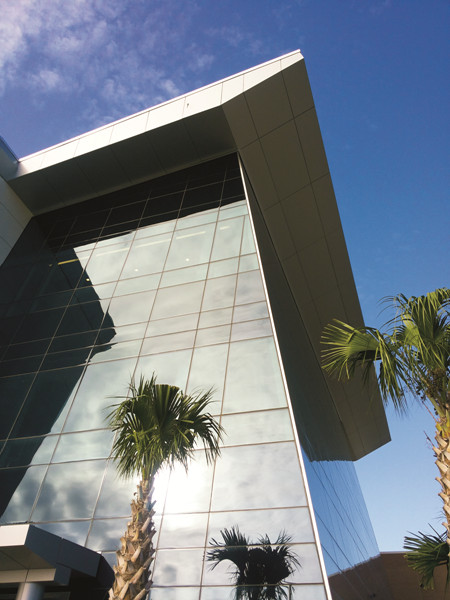 After six years of planning and construction, Gulf Coast State College has opened its Advanced Technology Center, a 95,000 sq. ft. architectural masterpiece. 162 Advanced Technology Centers are currently in existence across the nation, but Gulf Coast State College’s ATC is the newest and one of the most innovative. It is designed to support regional growth and guide students into successful careers. The building itself has gained international recognition for its cutting-edge design and its strong focus on sustainability and the successful incorporation of cutting edge technology.
Dr. James Kerley, president of the GCSC, states: “The ATC is a game changer, offering access and opportunity. Its design is driven by community and industry engagement. When I first arrived as the new president in 2007 my goal was to get extensive input from internal and external sources to determine college and community educational needs.
It was apparent that we needed to refocus our efforts on technical education and implement this goal from high school through college. We hired consultants to review the needs for an advanced technology facility at the college; they interviewed numerous leaders in local military, businesses and industry, and the recommendation was to push forward with urgency to build a modern facility to support the economic development and would be key to building greater partnerships with businesses and industry and our K-12 partners and local schools.
With all this in mind we started a task force. Bill Husfelt, head of Bay County Schools and myself chaired a group of educators and community leaders to push forward with career and technical education and we now have more career academies in the high schools and strengthened partnerships with chambers, economic development, military and the school systems in our 3-county area. Numerous faculty, staff and community leaders contributed to the ideas and programs that now exist in the new facility. We are holding true to the key areas of emphasis in the ATC: Entrepreneurial spirit should prevail throughout the facility and we put emphasis on IT programs, digital media, alternative energy, culinary arts, robotics, fabrication, etc… all stemmed from the original recommendations.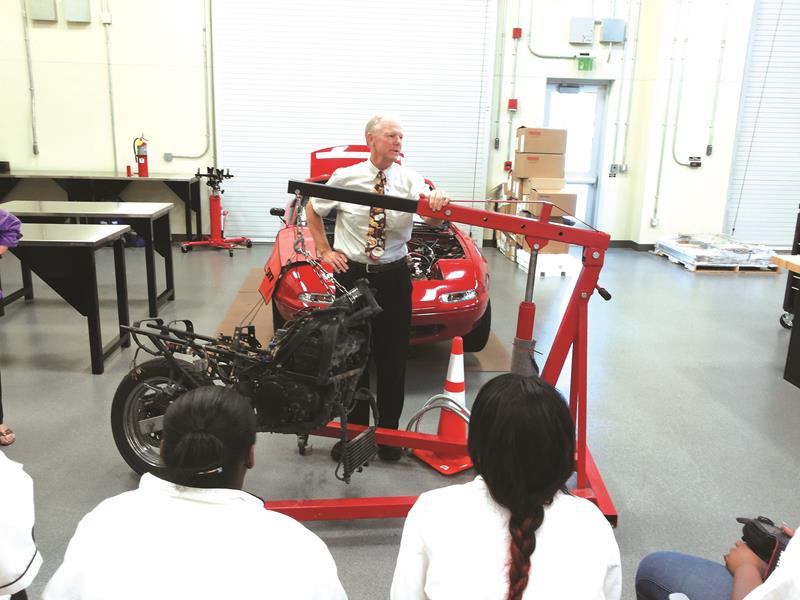
One has to see the eyes of the third graders who recently visited the new ATC, to know we are moving in the right direction.”
Back in the planning stage of the building, Dr. Kerley pointed out that “instead of focusing solely on student access, schools are now becoming concerned with student success. Thankfully, this is not a new trend at Gulf Coast State College – it has been our focus since 1957.”
But yet, there is a certain pioneer spirit amongst the staff and faculty members on campus as well as an obvious enthusiasm and pride for this newest of achievements. Gulf Coast State College calls upon local industry leaders to work hand-in-hand with the college – in a recent meeting with some of Bay County’s biggest employers, college representatives and local industry leaders signed a Memorandum of Understanding to manifest their combined efforts to help develop local talent and provide career opportunities in Bay County.
Dr. Stephen Dunnivant, dean of the ATC points out: “Modern colleges are the liaison between academy and economy. Our mission is to show possible pathways to students. We have a great general education core. The ATC is just one arm of the college, helping to evolve an already successful model. Advanced Technology Centers are proven strategies to accelerate economic development within a region, they support the characteristics of the local workforce. Some people did not quite understand why we placed the culinary institute within the ATC, but hospitality, leisure, and tourism are essential foundations of our local economy and we would be remiss if we failed to include the culinary arts in this new building. There is a strong local demand for culinary talent, just like the need for engineering technology, information technology, and digital media experts. We are clearly also located in a strong region for health care; consequently, there is a high placement rate for healthcare students.
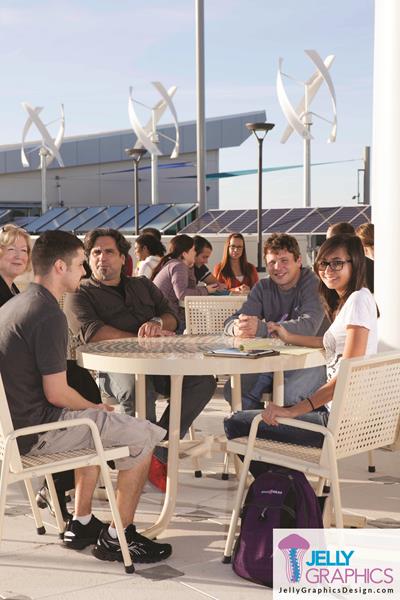 Clearly there is a growing demand for trained technology professionals in our area. If we take a company like iSirona, we are making sure to work closely with them to meet their needs. This company has hired several of our students through internships. Our IT faculty is in close contact with their staff members and we offer externships where we are inviting their staff to teach here at the college.
There are many incentives for local industries to engage with the college. We hold job fairs, support internship placement programs, and offer many incentives for local employers. Basically, we are doing everything possible to invite them to work with our students as early as possible. But it all starts with good planning. Each of our degree pathways has an advisory council that helps drive our curriculum. Whether it is digital media, cyber security, engineering technology, nursing, or surgery technology – they all have advisory councils which consist of the people who would potentially hire the graduates in that field. We are making sure constantly that all of our degrees are relevant.”
[box type=”shadow” align=”alignright” ]About the new Advanced Technology CenterThe Advanced Technology Center implements a combined Siemens and Lucid comprehen- sive energy management system throughout the building. The lobby of the ATC holds a touch screen “building dashboard”, which anyone can access to view energy consumption throughout the facility. Behind this, a “demand flow system” pulls only the energy that is needed at any given moment from the college’s central plant. This is all part of the LEED certification of the building, modeling the latest technologies in energy management and consumption.
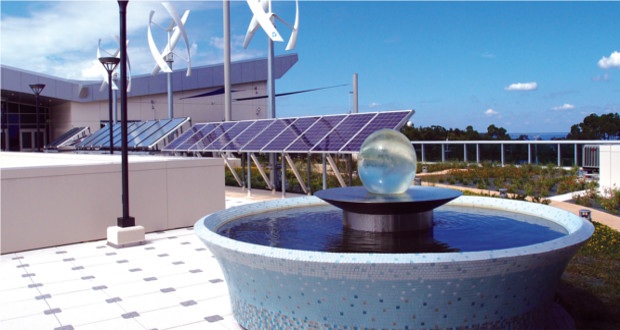
The building itself contains numerous energy saving elements, from construction materials to the green roof. The “green roof” contains a vegetated area providing insulation and helping to lower rooftop temperatures and mitigate the heat island effect. This space also houses several alternative energy systems. The photovoltaic arrays (solar panels) and wind turbines harness energy from the sun and wind, and then feed that back to the local power grid. The entire roof is a water collection system, complete with an “overflow” cistern, which directs water to the nearby pond for use on the ATC’s surrounding grounds. These roof systems are tied into two Alternative Energy Labs for students. In these labs, students learn how to manipulate solar and wind energy systems, as well as monitor their effi ciencies.
In the coming year, the ATC will receive its LEED certification. LEED (Leader- ship in Energy & Environmental Design), is transforming the way we think about how our buildings and communities are designed, constructed, maintained and operated across the globe. It takes at least a year from the time the building has opened to determine which “level” of LEED the ATC merits. As of now, the facility sits on the border between “silver” and “gold.” Regardless of which level the building finally earns, it stands as a shining example of smart energy management and environmental stewardship in our region.
Far more importantly, the ATC stands as an example of what a college and its network of support can produce. It took a perfect storm to bring this vision to life. The right internal leaders, talented faculty, state support, local philanthropy and business and industry. If we are going to create high- paying jobs that will convince our children to call this community home, this is clearly the right direction.
By Dr. Stephen Dunnivant [/box]Following the hype about the ATC, Dr. Dunnivant points out other highlights the college has to offer. “A college like Gulf Coast State College is greater than the sum of its parts. We have Rosie O’Bourke and the Visual Performing Arts, Greg Wolf and his great wellness and athletics program, and the social science degree programs host forums where students learn to debate. This is really an amazing college. Key to all this was the leadership of Dr. Kerley for the last 7 years, along with the 25 years before that with Dr. McSpadden and Dr. Tyree before that.”
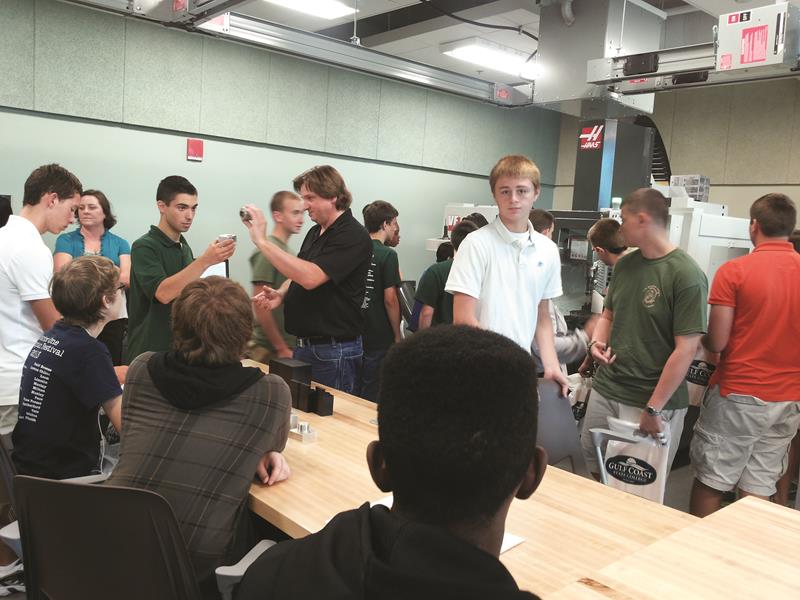
Every Friday, high school and middle school students are invited to explore the ATC and the courses that are offered. They tour the building and explore its many features, such as the technology lab, also nicknamed the Fab Lab, with its cutting-edge tools, including a high-end 3D printer and the latest CNC machines.
Dr. Dunnivant goes on to point out advan- tages for the students: “We have the least expensive tuition in the State of Florida. Our board, with the support of our foundation, keeps the tuition low and insures the highest possible access for our courses. We also have high historic GPAs for transfer students, as they score better in class than the native university students.”
Dr. Dunnivant recounts exceptional reactions from parents and potential students who have been touring the building. “I overheard a conversation between a high school student and his parents who were touring the ATC for the first time and suddenly the mother remarked: ‘Why are we sending you to a college in Alabama?’ Clearly for me, to hear that comment was the best proof that we will reach our goals of growing, attracting and retaining local talent.”
By Val Schoger Photography: Beck Graben and Sonja Revells