
An Endangered Species: The Commercial Fisherman


 By Peggy Guice
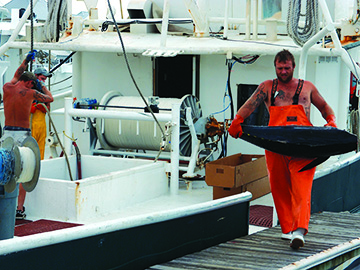
Captain Carl Roby has earned his living on the sea his entire life, starting out as a deckhand at the age of 12, and later working on boats in the oil field. Roby says, “I was once the youngest master captain in the country. You had to be 21, and I was 21 years and 3 days old.” After more than four decades on the water, today he captains the Cynthia Renee, a 55-foot long line fishing boat that is based out of St. Andrews Marina in Panama City.
Long line fishing is a commercial fishing technique. It uses a long line (called the main line), with baited hooks attached at intervals. There are different types of long line fishing, and many different species can be targeted, depending on how the lines are placed in the water.
The Cynthia Renee is not Captain Roby’s first boat, but she may be his last. These days, commercial fishermen must comply with a staggering number of rules and regulations, just to be in business. “It is a hard way to make a living,” Captain Roby says. “There is no young blood coming in anymore.”
Captain Roby says that unregulated fishing in other countries has a negative impact on the U. S. commercial fishing industry. To that end, the National Oceanic and Atmospheric Administration (NOAA) identifies countries that have fishing vessels engaged in illegal, unreported and unregulated (IUU) fishing activities. Once a country has been identified to have these types of activities taking place, the United States consults with them to encourage the end of the undesirable activity. If the country in question does not take appropriate action and receives a negative certification, imports of fisheries products from that country “may” be prohibited.
There are currently no limits on the number of yellowfin tuna that may be taken from Florida waters. However, the manner in which the fish are caught is regulated (right down to the size and type of the hooks that are used). Live bait is not allowed.
Once the yearly operating costs are tallied up, it is no wonder that few now choose commercial fishing as a way of life. Fuel can run well over $100,000 per year. Add to that the cost of liability insurance, dock fees and maintenance, licensing fees, salaries for the crew, and the federally required vessel monitoring system (VMS), and it becomes even more clear.
Due to the enormous cost of operating, several years ago Captain Roby sold a 94-foot vessel (also named Cynthia Renee), and downsized to his current vessel. The economy of running a smaller boat just made sense. These days his operation targets sushi grade tuna and some swordfish. Captain Roby prefers to deliver quality over quantity. A smaller boat means lower operating costs, and also shorter trip times. Less time at sea translates into better quality fish and therefore more profits.
Once caught, the fish are iced (not frozen). The crew tries to deliver the catch to port on Tuesdays and Saturdays (when the Dixie Fish Company picks up), further cutting down the time it takes to get the fish to the end customers.
Working on a boat is not for the faint-of-heart. Accidents happen. Captain Roby tells a story about one fishing trip where he found himself in the water, hooked to the same line as a large tuna. While trying to pull the fish onboard, a large hook from the line went into his hand. The fish took off for deeper water, pulling Roby overboard. “That fish pulled me down, deep, almost to the end of the fishing line. If it hadn’t been for my crew, I wouldn’t be here today.”
Captain Roby left the United States in 1988, but came back in the mid-2000’s when his father was diagnosed with illness. Married to wife Rosario for 25 years now, when he isn’t fishing he is in Guatemala at their family home. As this article was being written, he had returned to Guatemala for the birth of his second grandchild.
A family man, his boat is named after his two daughters (Irene Renee and Cynthia Victoria). Son Gustavo gave up fishing and now makes his living doing construction. Roby’s ties to the Panama City area go way back. He smiles when speaking of his grandmother. “My grandmother was known as Miss Eva, and she used to work as a bookkeeper at Captain Anderson’s.”
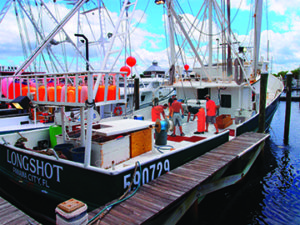
Other fishing boats at the St. Andrews Marina belong to Captain Roby’s family. The Longshot belongs to his nephew. The Orion is run by his sister and brother-in-law. The Hatuna Matata, once owned by Roby’s brother, was sold and is now operating in Brazil.
Why should we care about the commercial fishing industry in Panama City (and in the United States)? One reason is quality. The rules and regulations that our commercial fishermen must comply with assure the safety and quality of the fish that make it to our restaurants and dinner tables.
It is important that we know the source of our fish and seafood, because not all of it measures up the same. When we buy locally caught fish, we are not just helping to preserve the fishing industry in our community. We are also supporting our local economy. Today, around 90 percent of the seafood consumed in the United States is imported. How does that help our economy?
Here in Panama City we are fortunate to have a number of places to buy locally caught fresh fish and other seafood. We are fortunate to live in a town with a commercial fishing fleet, and many excellent seafood restaurants. There are more than dozen fresh fish markets in Panama City and Panama City Beach. Supporting these businesses means insuring that future generations will be able to buy and eat local fish. Let’s do all we can to support the local industry.