
A.D. Harris Mounts a Comeback


By Steve Bornhoft
Blondell Harris McGowan knows as well as anyone that the collection of modest buildings at East 11th Street and Macarthur Avenue always was reserved for a precious purpose: enriching, enlightening and even saving young lives.
In the era of segregation, a black high school was located here. Subsequently, the campus was converted to Glenwood Elementary School, a sixth-grade center and, finally, A.D. Harris High School, an alternative school for students who, for whatever reason, departed the mainstream.
Today, sadly, the place is mostly idle. The Bay County School Board, acting on budget-cutting recommendations made by Superintendent Bill Husfelt, voted in February 2009 to close the school that had been named for McGowan’s father.
Ownership of the 5.61-acre property would later be transferred to a Panama City Community Redevelopment Agency (CRA) and, for the vast majority of tired public buildings in low-income neighborhoods, that turn of events may have been the kiss of certain death.
But A.D. Harris is proving to be the exception to the rule. A community of persons including optimists, historians, visionaries and public officials is working to re-establish the shuttered school as a community resource, a “learning village.” And, like a forest that regenerates following a fire, there are signs of new life here.
“My father was a career educator,” McGowan recalls. “He had a faculty of two when he served as principal of the old Lynn Haven School on Highway 390. He had a faculty of 15 at the Bay Harbor School in Springfield and 30 to 35 teachers at Glenwood Elementary.
“But wherever he was, he always taught more than reading, writing and arithmetic. He started by educating parents about the importance of sending their children to school and he taught people how to succeed in life.”
A.D. Harris High School was true to its namesake’s mission. There, students once lost came to be found.
I visited the alternative school a few times before its closure. Tasked by a philanthropist to explore the nature and extent of the homeless student population in Bay County, I went to A.D. Harris to encounter the problem first-hand. There, Dennis Dykes, a teacher with an orange Afro bigger than a bushel basket, introduced me to students including a memorable young woman who subsisted by relying upon the kindnesses of friends.
She would stay with one buddy until she wore out her welcome, then move on to the next. The presence at the outskirts of her life of a rich uncle was of no help. But she was strong and independent beyond her years and A.D. Harris helped keep her tethered to possibility.
Anita Dillard served as A.D. Harris High School’s principal. Never had I encountered a school leader as close to her students as she was.
There was no way a student could arrive at A.D. Harris in new shoes or a new jacket or a new haircut without Miss Anita taking notice. Once, I listened to her preside at an A.D. Harris commencement exercise held in a banquet room at a Holiday Inn. For the students involved, it may as well have been the Ritz Carlton in Atlanta. Dillard made her students feel special.
The members of the A.D. Harris community, if they had little or nothing else, had one another. I found myself pulling for everybody involved including especially the homeless girl, whom I saw graduate. Something tells me she is doing just fine these days.
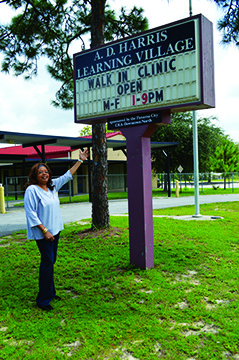
McGowan was instrumental in bringing about the A.D. Harris Improvement Society, which leases the campus from the Downtown North Community Redevelopment Agency and manages the emerging “A.D. Harris Learning Village.”
“I’d like to see the village become a place where people can learn how to get a job and keep a job,” McGowan says. “We need financial literacy classes here and I’d like for A.D. Harris to host a GED testing center. We need nighttime and weekend classes for people who work. I want to see a well-equipped media center. We’ve got a community garden going that is maintained by foster children. We hold events here like our Barbecue Cookoff and our Gumbo Getdown that bring people together.”
In short, she wants to see the Learning Village breed success, just like her father did, just like A.D. Harris High School did. What is called for is not so much a reinvention as a resurrection.
Toni Shamplain shares McGowan’s vision. She is the program manager for the Downtown North CRA and she’s got plenty of A.D. Harris cred. She was born and raised in Panama City and attended Glenwood Elementary School. A.D. Harris is a place that occupies her past, her

present and, she feels certain, her future.
I enter, with Shamplain, a tile-floor, one-time auditorium equipped with a stage whose curtains have been overtaken by mildew.
“My introduction to public speaking came right here,” Shamplain remembers. “My momma told me not to let people see my knees knock.”
And then Shamplain launches into, well, something of a speech.
“The transfer of ownership agreement won’t allow us to establish a school here that would compete for students with the school district,” she begins. “But we can make A.D. Harris a place where people will learn skills, share knowledge, come together as a neighborhood and explore their heritage and culture.
“For example, we’ve got a group that wants to come in and lease this auditorium space as a place where they can teach dance and performance art to seniors. They’ve got their own floor, mirrors and poles.”
At this, I cannot help but interrupt.
“Poles,” I say. “We’re not talking about pole dancing for seniors, are we?”
“No, I meant rails,” Shamplain laughs. “I went vertical when I should have gone horizontal. You’ve given me a visual that I’m going to ask you to take back.”
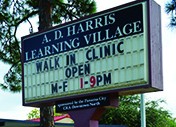
“The Health Department has established a center here,” Shamplain resumes her speech. “People requiring urgent care will be able to get what they need in a non-emergency room setting at relatively low cost. The Gulf Coast Workforce Board has a computer lab here where folks have earned Microsoft certifications and seniors have come to learn computer skills.
“I’d like to see our kitchen used as a place where people can process and can the foods that they raise. We’ve got people interested in supplying day-care services here. This place has a lot of potential. It can live a new life as a community center and community resource.”
To make possible the various amenities and activities they have in mind, McGowan and Shamplain recognize, the Learning Village will need to attract more paying tenants from both the public and private sectors. Sustainability is fundamental. Currently, the CRA is paying utilities at the village, but that won’t be the case forever.
The Downtown North CRA was created in 1993. It is among four CRAs authorized by the Panama City Commission and will sunset in 2023.
“We know what our lifespan is,” Shamplain says. “I’m a time-limited experience. Tax incremental financing of a project like the village won’t be around for long.”
When a local government creates a CRA, it computes the total value of taxable properties within its boundaries. The CRA then captures all of the tax dollars generated by subsequently made improvements in the district. This enables tax incremental financing (TIF) of projects listed in a CRA district plan. Already, thousands of TIF dollars have been used within the Downtown North CRA to build sidewalks.
“Pedestrians shouldn’t have to compete with cars,” Shamplain maintains. “That competition isn’t fair. I grew up competing with cars.”
Shamplain has no quarrel with accountability. In a “previous life,” she designed and administered long-term substance-abuse treatment programs in South Florida, Puerto Rico and the U.S. Virgin Islands and developed systems for assessing their effectiveness.
“Public dollars need to lead to meaningful societal outcomes,” she says. “We must be accountable and deliver a tangible product. At the same time, we have got to have a flexible vision. Life is a moving target and we have to evolve. It’s like the song says: ‘If you wanna revolution, the only solution: Evolve.’ We can’t be shackled by the past, but we don’t want to lose sight of it and the lessons it can provide either.”
So it is that Shamplain and others are working toward the realization of a cultural heritage tourism district with A.D. Harris as its hub.
“Today, there is no place in Panama City where you can go and see the history of the African American community in our town,” Shamplain observes. “The A.D. Harris Learning Center should include a cultural interpretive center, a space that would stimulate one to dig further and learn more about our history, more about our home.”
Shamplain looks about herself and says, “This is home for me. This is home.”
And, somewhere, A.D. Harris nods assent.