
The Miracle of the White Leaves


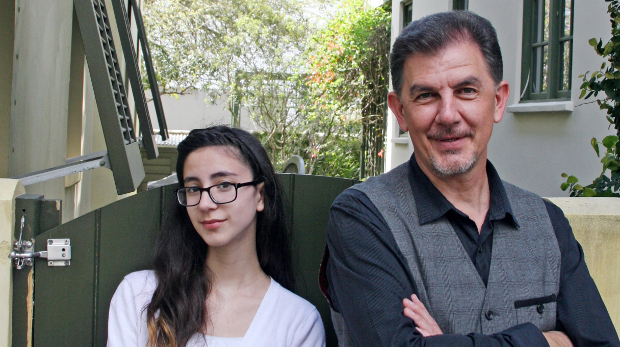
Nearly four years ago on a day like many other days, Dr. Stephen Walter Dunnivant was entertaining his nine- year-old daughter, Gina, while driving her home from school. Story-telling is a lifelong father-daughter bonding activity they share. Together they create fantastic stories about dragons the size of bumblebees, entire lands of rolling fuzzy creatures, or worlds where everyone is made of stone. This particular tale started with Stephen saying, “One day there was a monk and a grasshopper. They were sitting in a field in Italy. The monk fell asleep while copying a book, which the grasshopper finished…”
A self-assured voice from the backseat matter-of-factually corrected him. “No Daddy, the monks weren’t in Italy. They were in Ireland.” Dunnivant looked into the rearview mirror, as Gina explained, with great patience, how the Irish monks saved many books by copying them by hand which took a “really, really, really” long time.” She said her source of information was a book she read at school. He chuckled and finished the story, marveling at the concrete certainty of her nine-year-old mind.
 The next day at work at Gulf Coast State College, Stephen consulted with Dr. Richard Baldwin, a history professor, about his conversation with Gina. Dr Baldwin confirmed Gina’s facts. He told Stephen a detailed saga of “How the Irish saved civilization.” Dunnivant was captivated by the history of “The Carolingian Renaissance” that made such a vivid impression on his daughter.
This led to months of creative discussion between the father and the daughter and a decision to write and share their story with other children. So began “The Miracle of the White Leaves.”
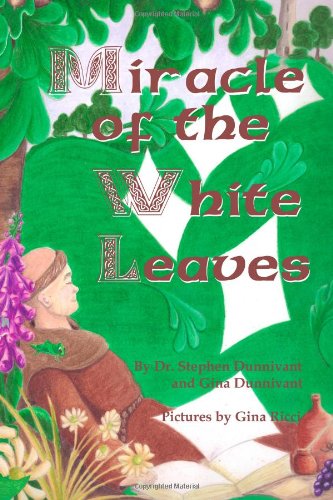
The story chronicles three miraculous events and one monk’s drive to find the “rational”explanation. Faelan, is the faith-filled monk protagonist with his magical insect friends. The Dunnivant’s fashioned the character of the antagonist, Ricard, after Dr. Baldwin. He is a man of reason and logic. Gina insisted that the Ricard become the “good guy” in the end. As a life lesson and discussion point, her father conceded for Ricard to grow and change but, in his own way, while staying true to his core beliefs. Thanks wholly to Gina’s creative input, the key character of Princess Theodrada (Charlemagne’s actual youngest daughter) emerged. She was also the brainstorm behind the storyline in which the grasshoppers named “Morning,” “Noon,” and “Night,” create schools for children in two different countries.
Written originally as a screenplay, Dunnivant took it to a writers’ conference in Los Angeles, California where he “pitched” it to 17 studios in three days. Six studios expressed interest in the story. All suggested, however, that it should first be published as a children’s book.
Converting the play to a book began the next father-daughter adventure that spanned two more years. Stephen found a local illustrator, Gina (yes, same first name as his daughter) Ricci. The younger Gina attended every meeting with the illustrator, lending a young reader’s perspective to each picture. Gina bounces in her red sneakers excitedly and her hands become animated as she describes “my favorite part…”is getting to work with Gina Ricci. “She has a British accent, too!” she effuses. The final illustrations of Princess Theodrada look remarkably like 13-year- old Gina Dunnivant.
During an unseasonable Florida ice storm this past winter, both the college and Gina’s school were closed. The father and daughter spent this time together completing the book, embedding the completed illustrations, and designing a cover. The book was published and is now available on Amazon. Or, you may get a copy and have it signed at Sun Dog Books in Santa Rosa on May 17th.
“Completing this project with Gina is one of my greatest joys. It is a tale of faith and reason, and of timely tolerance,” Dunnivant proclaims. Gina represses a smirk, letting her face transform into a look of regal and long- suffering poise. She returns her father’s gaze levelly as he stares at her as if she was a magical creature. “We wrote a book, that will always be something of a miracle to me, and to her, too, I hope.” Still looking into his eyes, she says with complete self assurance “and it’s only the first book…”
Associate Professor of Theatre at Gulf Coast State College Jason Hedden asked if he could read the screenplay. Hedden submitted it to a local Arts Alliance. It was selected by the Alliance as the Gulf Coast State College’s 2014 Summer Theatre Project: From Page to Stage, the Making of a Musical. During a six-week course, students will serve as part of an artistic team to adapt the screenplay to script and create original music for the play. The world stage premiere of “The Miracle of the White Leaves” will be held the Spring of 2015 at the Marina Civic Center of Panama City. GCSC students and community members with interest and skills in writing, storytelling, singing, songwriting, instrumental music, acting, dance, choreography, design, photography, costuming, videography, sound recording, visual art, etc. are encouraged to apply. Individuals interested in the project should contact Jason Hedden at jhedden@gulfcoast.edu or call 850- 769-1551 ext. 2889.
By Carol “Cat” Turner