
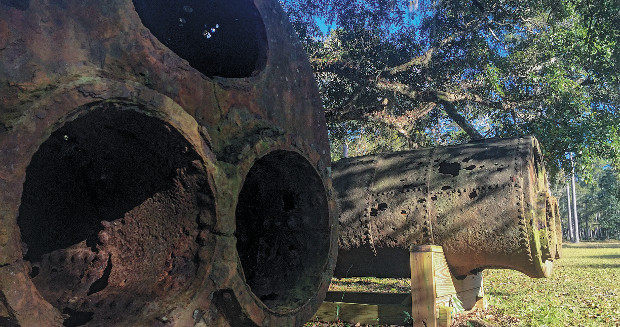
A LANDMARK IN SLAVE RESISTANCE


BY SHARMAN RAMSEY
“The explosion was awful, and the scene horrible beyond description. You cannot conceive, nor I describe the horrors of the scene. In an instant lifeless bodies were stretched upon the plain, buried in sand and rubbish, or suspended from the tops of the surrounding pines. Here lay an innocent babe, there a helpless mother; on the one side a sturdy warrior, on the other a bleeding squaw. Piles of bodies, large heaps of sand, broken guns, accoutrements, etc, covered the site of the fort. The brave soldier was disarmed of his resentment and checked his victorious career, to drop a tear on the distressing scene.”
– Army and Navy Chronicle. 13 vols. Washington: B. Homans, 1835-1842. Vol. 2, 115.
One of the most appalling massacres upon this continent took place in our very own backyard 200 years ago this year. The destruction of the Negro Fort located 15 miles up the Apalachicola River is known as the first battle of the First Seminole War. At that time Florida was divided into Spanish East Florida and Spanish West Florida with the dividing line being the Apalachicola River. North of this Spanish territory was the American Mississippi Territory and the state of Georgia.
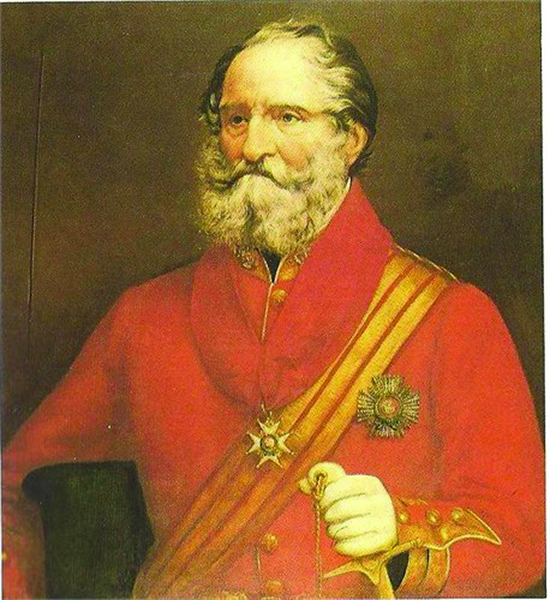
The events that led up to the massacre began on March 27, 1814 when the battle of Horseshoe Bend ended the Creek Indian War, a part of the War of 1812 between British and Americans. At the Treaty of Fort Jackson, Andrew Jackson confiscated 23 million acres of Creek land. Fleeing the consequences, a family group of about 1000 led by former Red Stick prophet Peter McQueen, made its way ragged and hungry through the swamps to Pensacola. There they met up with British officers Colonel Edward Nicholls, an Ulster Protestant from Coleraine, and Captain George Woodbine, who clothed them, fed them, and enlisted the warriors in the Corps of Colonial Marines. Armed and clad in the red jackets of the Royal Marines, they paraded in the square along with escaped slaves who were promised freedom and free Blacks who saw their freedom challenged should Americans win their battle against the British.
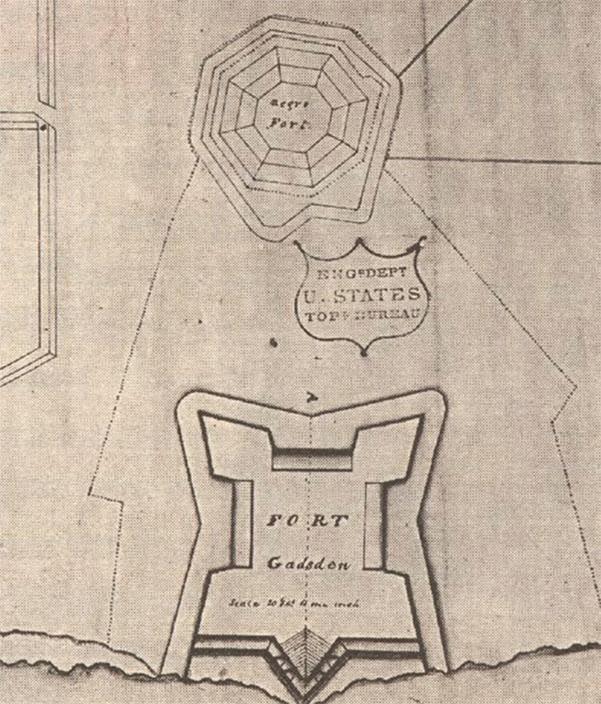
At the end of the War of 1812, Nicholls and Woodbine led this group of Indians and Blacks to a point about 15 miles above the mouth of the Apalachicola River known as Prospect Point. The area was officially under Spanish control. There, together, they built Fort Nicholls. The fort wound up being called the Negro Fort in successive years. The fort was an octagon of earthwork that surrounded the principal magazine. There was an extensive rectangular enclosure covering about seven acres with bastions on the eastern corners having parapets 15 feet high and 18 feet thick.
Upon being ordered to withdraw, Nicholls “left with each soldier or head of family a written discharge from the service, and a certificate that the bearer and family were, by virtue of the Commander-in-Chief’s proclamation, and their acknowledged faithful services to Great Britain, entitled to all the rights and privileges of true British subjects….[who had]….a perfect right to their liberty….” (1)
When Woodbine and Nicholls returned to England, the fort was put in the hands of the Red Stick allies who had come with them from Pensacola. But the Red Sticks moved out and settled with the nearby Seminoles and the fort wound up in the hands of those Blacks who had joined up with Nicholls in Pensacola under the leadership of a man named Garcon.
Woodbine and Nicholls had left the Fort well armed and William Hambly, a former employee of John Forbes who owned several trading posts and also had a plantation nearby, was supposed to be in charge but Hambly left the fort and joined up with the Americans.
As the Negro Fort grew stronger, Georgia plantation owners’ fear grew over the potential of a slave revolt. The large colony of so-called exiles had fled South Carolina nearly 100 years earlier. They lived around where Woodbine and Nicholls built the fort at Prospect Bluff. Their cornfields spread about fifty miles up and down the river and their numbers were growing.
William McIntosh, Old Captain Isaacs and Mad Tiger who fought with the Americans in the Creek War arrived with a party of about 150 Creek Indians known as “friendly” because they fought with the Americans during the Creek War. They galloped around the fort shouting, threatening and getting shot at by Garcon and his men.
Lt. Col. Clinch sent for gunboats that arrived four days later. Isaacs and Mad Tiger went into the fort under a flag of truce to demand surrender. Garcon, wearing the ragged red jacket of his uniform of the Corps of Colonial Marines, told them he would ‘blow up the fort if he could not defend it.’ The Union Jack had already been flying above the fort. As the Red Sticks left the fort, Garcon raised a red flag of no surrender above it.
Usually the river is too shallow for a boat to get close enough to get a shot fired that would do any harm to the fort. But, as the result of the eruption of Mt. Tambora in Indonesia in April 1815, the weather took a strange turn in 1816.
1816 became known as “the year there was no summer.” At Prospect Point, the site of the Negro Fort, the water ran fast and high.
William Hambly betrayed his former allies and told the Americans where to shoot. Sailing master named Jarius Loomis woke the cook up at five o’clock in the morning on Saturday, July 27, 1816. He told the cook to build up the fire as hot as he could get it and stick the cannon balls in it. Eventually, the cook came out and said, “Breakfast is ready.” Loomis trained one of the guns so that it wouldn’t hit earthen ramparts of the fort and loaded it with red hot shot. He made a direct hit on the magazine.
The earth shook and the sailors thought they’d blown themselves to kingdom come. When the smoke cleared, they were faced with such an awful sight that the Americans felt sorry for the victims. The lucky ones were dead. Of the 334 in the fort, 275 were killed. The explosion was felt all the way to Pensacola and scared those who were close so badly that they abandoned the spot.
Those who survived and those who lived around the fort and could avoid being captured and sent back to those claiming to be their masters and did not get scalped by McIntosh’s “friendly” Indians, fled to the swamps. Garcon, the leader, survived – only to be captured by the friendly Creeks who promptly shot him.
The dead lie buried in a mass grave at the site of the Negro Fort.
Claiming to be acting as an agent for Forbes and Company, Hambly seized the Blacks who had come from Pensacola. Clinch took the American Blacks to Camp Crawford/Fort Scott for a $50 a head bounty. Many former slaves who survived joined the Red Stick comrades in arms in the Seminole villages. Those having lived among the Americans and British, had the advantage of being able to speak English. Prominent among this group is a man named Abraham who became the “sense bearer” for Seminole Chief Micanopy and a major player in later Seminole Wars.
When Andrew Jackson came across the American border into Spanish Florida to pursue the Seminoles in 1818, he directed his aide-de-camp, Lieutenant James Gadsden, to build another fort upon the ruins of the Negro Fort. Renaming the fort, Fort Gadsden, Jackson effectively pulled the covers up over an event that had worldwide repercussions. Dr. Nathanael Millet, Associate Professor in the Department of History at Saint Louis University as well as a Fulbright Fellow at University College, London, argues that the event at the Negro Fort deserves to be remembered as one of the largest and most impactful acts of slave resistance in North American history.
[author image=”https://www.panamacityliving.com/media/2016/01/sharman-at-desk-for-cover.jpg” ]Sharman Burson Ramsey holds degrees from the University of Alabama and Troy University and has served as an adjunct professor at Gulf Coast State College and Troy University. She is webmaster of Southern-style.com: A Downhome Perspective of All Things Southern and author of historical fiction and cozy mysteries: The Mint Julep Mysteries, Swimming with Serpents and In Pursuit, the first two in a family saga published by Mercer University Press. As a member of the Bay County Library Foundation Ramsey is actively involved in Books Alive. Sharman Ramsey and Ronda Kimborough with the US Forestry Service will be speaking on the Negro Fort at the February meeting of the Bay County Historical Society, February 22, 2016, at 7 PM at the Bay County Library.[/author] [divider]
(1) (Dr Nathaniel Millett lecture online. http://www.gresham.ac.uk/lectures-and-events/north-americas-largest-act-of-slave-resistance Dr Millett is Associate Professor in the Department of History at Saint Louis University. He is also Fulbright Fellow at University College, London.) After Nicholls retirement in 1835, he became a famous full-time anti-slavery advocate who was even a founding member of the British and Foreign Anti-Slavery Society.
(2) Portrait (ca 1855) of General Sir Edward Nicolls, KCB, RM, in the Officers’ Mess of the Royal Marines Barracks, Stonehouse, Plymouth (UK). Portrait reproduced thanks to assistance from Mr. Nigel Moss. Permission to reproduce accorded by Commanding Officer, 30 Royal Marine Commando.Licensed under Public Domain via Commons – https://commons.wikimedia.org/wiki/File:General_Sir_Edward_Nicolls,_KCB,_RM.jpg#/media/File:General_Sir_Edward_Nicolls,_KCB,_RM.jpg

(3)”Fort Gadsden and Negro Fort” by Unknown – From the National Archives.. Licensed under Public Domain via Commons – https://commons.wikimedia.org/wiki/File:Fort_Gadsden_and_Negro_Fort.jpg#/media/File:Fort_Gadsden_and_Negro_Fort.jpg
